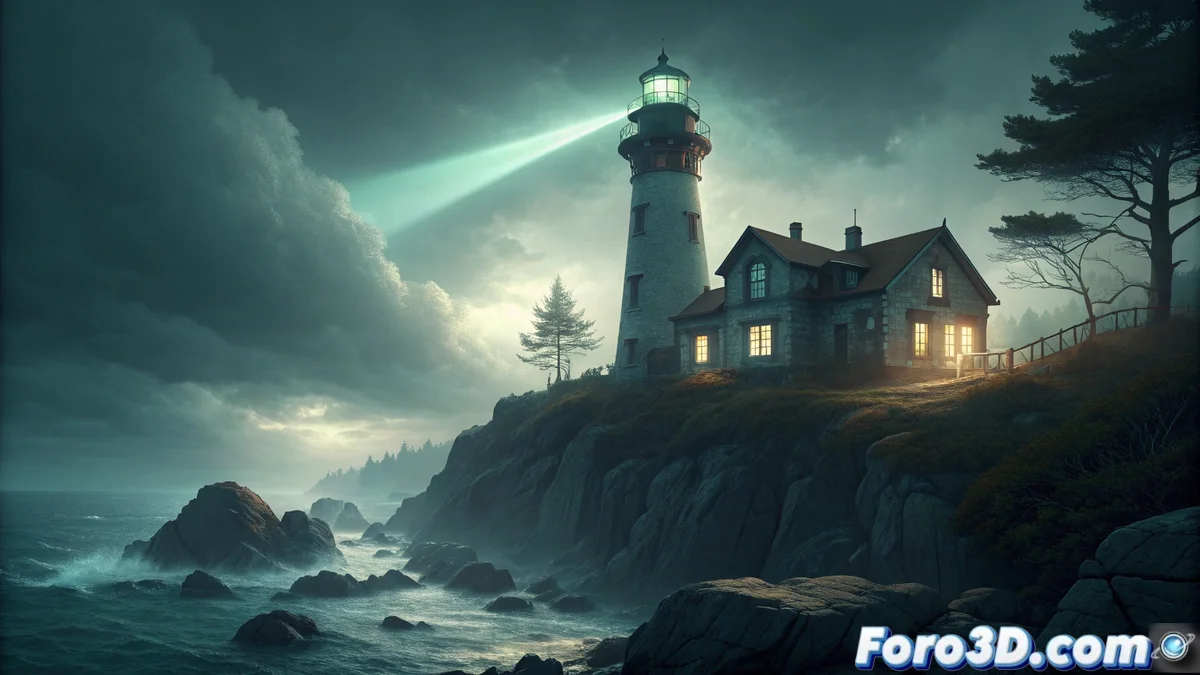
Maine's Lamp-Less Lighthouse: History and Creation in Goxel
On the rocky coast of Maine stands a unique structure: the lamp-less lighthouse, erected in the mid-19th century to protect New England commercial maritime traffic. Its location on the dangerous Wreck Point made it a crucial navigation point, though today it remains abandoned yet shrouded in mystery 🌊.
Historical Development of the Lighthouse
The lighthouse operated effectively for decades under the care of several keepers and their families, but in the early 20th century, it began its decline. Advances in navigation and changes in commercial routes led to its progressive abandonment. In 1938, the original Fresnel lens and its rotation mechanism were dismantled, leaving the tower empty. During World War II, the first reports of inexplicable flashes from the structure emerged, giving rise to the legend of the ghost lighthouse that persists to this day.
Key Events in the Lighthouse's History:- Construction in the mid-19th century to guide merchant ships
- Progressive abandonment in the 20th century due to technological changes
- Dismantling of the Fresnel lens in 1938 during modernizations
- Appearance of inexplicable luminous phenomena since World War II
This lighthouse demonstrates that sometimes the absence of light can be more visible than its presence, especially when it comes to phenomena that challenge both physics and common sailor sense.
Cultural Impact and Legacy
The lamp-less lighthouse has become an icon of Maine's maritime folklore, symbolizing the duality between hope and danger. The light of lost hope serves as a cultural metaphor for the deceptions that can lead to disaster. Local artists and writers have incorporated this phenomenon into their works, exploring themes of perception and reality, as well as the boundaries between the tangible and the supernatural. Maritime authorities maintain official warnings about the site, cataloging it as a dangerous navigation point.
Highlighted Cultural Elements:- Representation of the hope-danger duality in maritime life
- Influence on artists and writers from the New England region
- Official warnings maintained by maritime authorities
- Exploration of themes on perception and reality in artistic expressions
Project Preparation in Goxel
To recreate this legendary lighthouse in Goxel, start a new project with dimensions of 128x128x128 voxels, balancing detail and performance. Set the color mode work mode to have a full palette from the start. Establish the view in perspective using the camera tool to capture both the lighthouse and its coastal surroundings. Select an appropriate color palette with grays for the stone, blues for the sea, and dark greens for coastal vegetation 🎨.
Modeling and Main Structure
Begin by modeling the rocky base using the cube tool with dark gray color, creating an irregular formation that rises from sea level. Build the lighthouse tower using the line tool with voxels in white and light gray tones, ensuring it tapers slightly toward the top. For the lantern dome, use the sphere tool in hemisphere mode with metallic gray color, leaving the top part open to symbolize the absence of the original lens. Add architectural details like windows and cornices using the brush tool in small sizes.
Essential Modeling Steps:- Creation of irregular rocky base with cube tool and dark gray tones
- Construction of tower with line tool and white and light gray voxels
- Design of dome with sphere tool in hemisphere mode and metallic color
- Addition of architectural details with brush tool in reduced sizes
Lighting and Materials
Create the ghostly light beam effect using Goxel's shader editor with a combination of transparency and light emission. Configure a material with emissive properties in a very faint bluish-green tone, applying it to a semi-transparent voxel cone that extends from the lighthouse dome toward the sea. For the rock and lighthouse surfaces, use textures with subtle color variations that suggest the wear of time and exposure to the elements. The water should be represented with voxels in multiple shades of blue and green, with a slightly reflective finish 💡.
Special Effects and Final Rendering
Implement the coastal mist effect using layers of semi-transparent voxels in bluish-gray tones, distributed irregularly around the lighthouse and over the water. To simulate the spectral nature of the light, apply a low-intensity but wide-radius glow post-processing effect. Set the ambient lighting in nighttime tones with a moon partially obscured by clouds to enhance the mysterious atmosphere. Perform the final render in high resolution by activating anti-aliasing and soft shadows options, exporting in PNG format to preserve the quality of the luminous effects ✨.
Visual Effects Techniques:- Use of semi-transparent voxel layers for coastal mist
- Application of glow post-processing effect for spectral light
- Configuration of ambient lighting in nighttime tones
- Export in PNG with anti-aliasing and soft shadows
Conclusion and Final Reflection
Maine's lamp-less lighthouse represents a unique fusion of history and mystery, where the physical absence of light has generated an even more powerful presence in the collective imagination. Its recreation in Goxel not only allows exploring advanced voxel modeling and lighting techniques, but also connects with a maritime legend that continues to defy rational explanations. This project demonstrates how digital tools can bring to life stories that transcend time, capturing both the architectural essence and the cultural legacy of historical structures 🏗️.