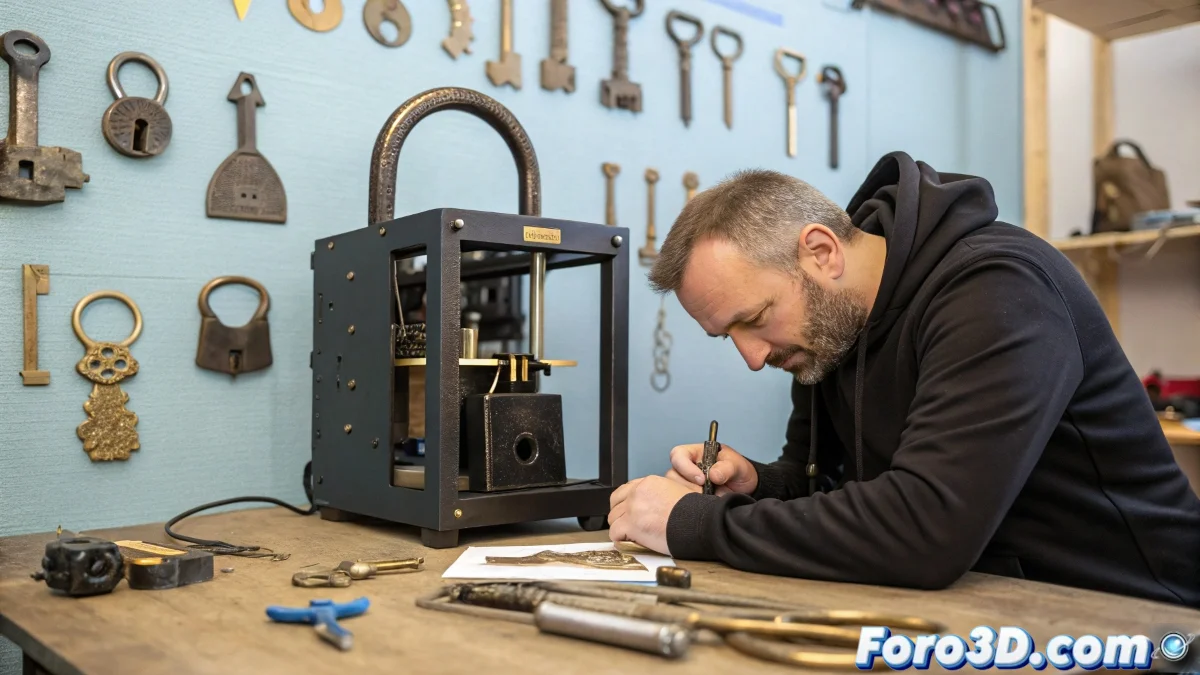
When Locksmithing Meets 3D Printing
Amid the jingle of keys and the inevitable "I left my keys inside," a new ally has arrived for locksmiths: the hum of a 3D printer. Don't expect it to magically open your door (yet), but it will create those impossible parts that save the professional time and gain more grateful clients. That said, it still can't print that client who insists "the lock broke on its own."
"The new locksmith's assistant: lock picks, infinite patience... and a 3D printer for when the catalog says 'that one's no longer manufactured'"
Keys of the Future for Locks of the Past
In the world of locksmithing, where every mechanism is a unique puzzle, 3D printing emerges as that prodigious apprentice who never tires. From copies of rare keys to internal components of old locks, it's now possible to solve problems in minutes that previously required days of searching. That said, the machine still can't distinguish between a security lock and a toy one... what a relief for apprentices.
- Exact spare parts for obsolete mechanisms
- Custom tools for specific jobs
- Organizers for that chaos of lock picks and keys
- Prototypes for new security systems
From Digital File to Opening Door
Beyond basic solutions, 3D printing enables innovations that improve both security and efficiency. Training keys for apprentices, anti-copy protectors for master keys, even complete systems to organize the workshop. The only limitation is imagination (and the filament's resistance to breaking attempts). That said, be careful about promising "any solution," or they'll ask for a lock that only opens with the right mood and you'll end up studying psychology.
What No Locksmithing Manual Mentions But 3D Solves
Between emergency and emergency, there are hundreds of small miracles a printer can make real:
- Tool holders in the van
- Guides for precise cuts in cylinders
- Adapters for electronic systems
- Hand protectors during delicate jobs
Security with a Touch of Innovation
In the end, 3D printing doesn't come to replace the locksmith's knowledge, but to give them more tools for their trade. Because when it comes to protecting what we value most, it doesn't matter if the solution comes from a traditional method or an STL file. What's important is that doors open when they should and close when they need to, now with a touch of smart plastic. And who knows, maybe soon they can even print that client who remembers where they left the keys... though that would be pure magic. 🔑😉
So now you know: the next time you see a 3D printer in a locksmith's van, it's not that they've changed professions. It's simply the natural evolution of a trade where precision and security have always gone hand in hand.