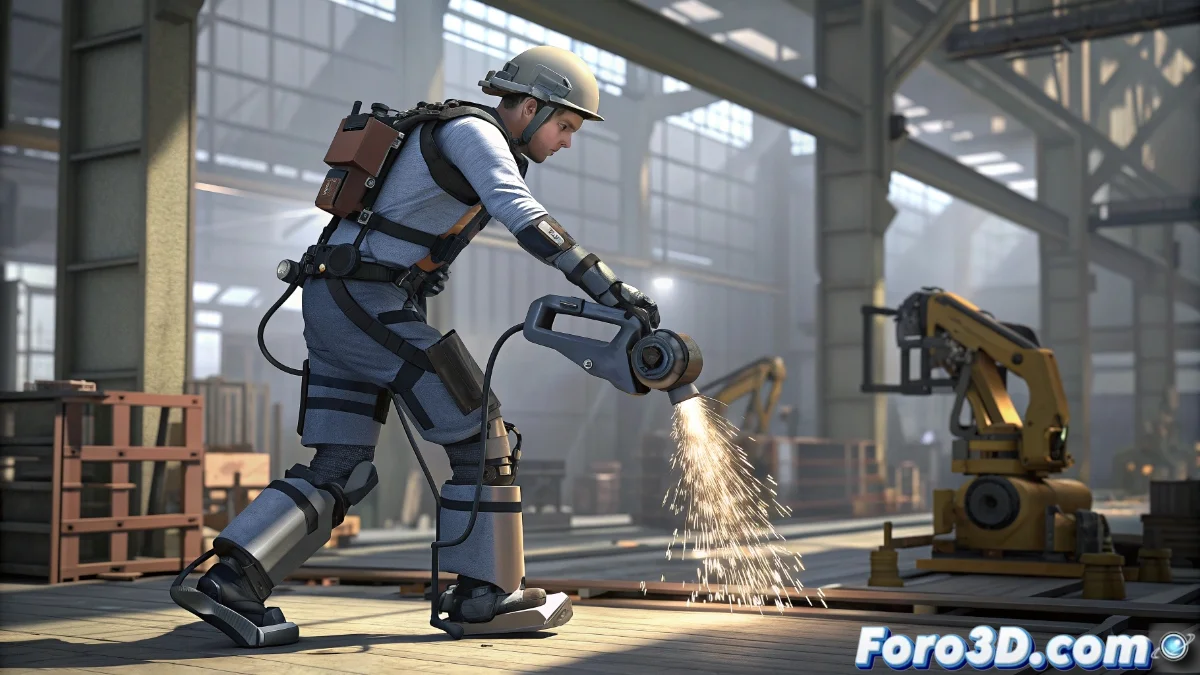
Lockheed Martin's Fortis: Revolutionary Industrial Exoskeleton
The Fortis exoskeleton, created by Lockheed Martin, marks a milestone in industrial ergonomics, designed for tasks involving handling heavy tools for hours. This passive system is worn on the upper body, directing the effort from the tools through a mechanical structure to the ground, making it easier for operators to perform tasks with greater accuracy and less muscle fatigue. The technology operates without motors or external power sources, using only mechanical principles to transfer loads, resulting in lightweight and reliable equipment that optimizes productivity in challenging industrial environments. 🛠️
Fortis Technical Details
Built with lightweight and durable materials, such as aluminum alloys and advanced polymeric components, Fortis ensures robustness without adding excessive weight to the user. Its modular design allows customization for various body types and activities, with joints that replicate natural human movement to avoid limiting agility. The system incorporates attachment points for industrial tools like grinders, drills, or rivet guns, redistributing up to 90% of the weight to the legs and eliminating strain on arms and back. This results in fewer workplace injuries and greater efficiency in maintenance, construction, or manufacturing operations.
Key features:- Resistant and lightweight materials that ensure durability without compromising mobility
- Joints that mimic human movement to maintain flexibility during work
- Anchor points that redistribute the load, reducing fatigue in critical body areas
The implementation of Fortis has transformed the way workers handle heavy tools, improving both safety and efficiency in industrial environments.
Implementation in Industrial Sectors
In industries such as aeronautics, shipbuilding, and heavy manufacturing, Fortis proves its worth by allowing employees to handle equipment weighing up to 15 kg with apparent ease. Operators on assembly lines or maintenance report greater comfort and ability to perform repetitive tasks without the typical physical wear, shortening rest periods and increasing production. Companies that have adopted this exoskeleton notice decreases in absenteeism due to musculoskeletal problems and improvements in work quality, as reduced fatigue enables greater concentration on technical details.
Practical advantages:- Handling heavy tools with ease, improving precision in complex tasks
- Reduction of physical wear in repetitive movements, increasing overall productivity
- Decrease in injuries and absenteeism, translating to safer work environments
Impact and Future Prospects
With Fortis, there are no longer reasons to avoid using tools that seem taken from a medieval blacksmith shop, although now the challenge might be deciding who uses the exoskeleton on morning shifts. This advancement not only improves ergonomics but also drives innovation in the industry, offering a sustainable solution to reduce fatigue and elevate safety standards. In summary, Fortis represents a crucial step toward more efficient and healthy work environments, where passive technology becomes an indispensable ally for workers. 💪