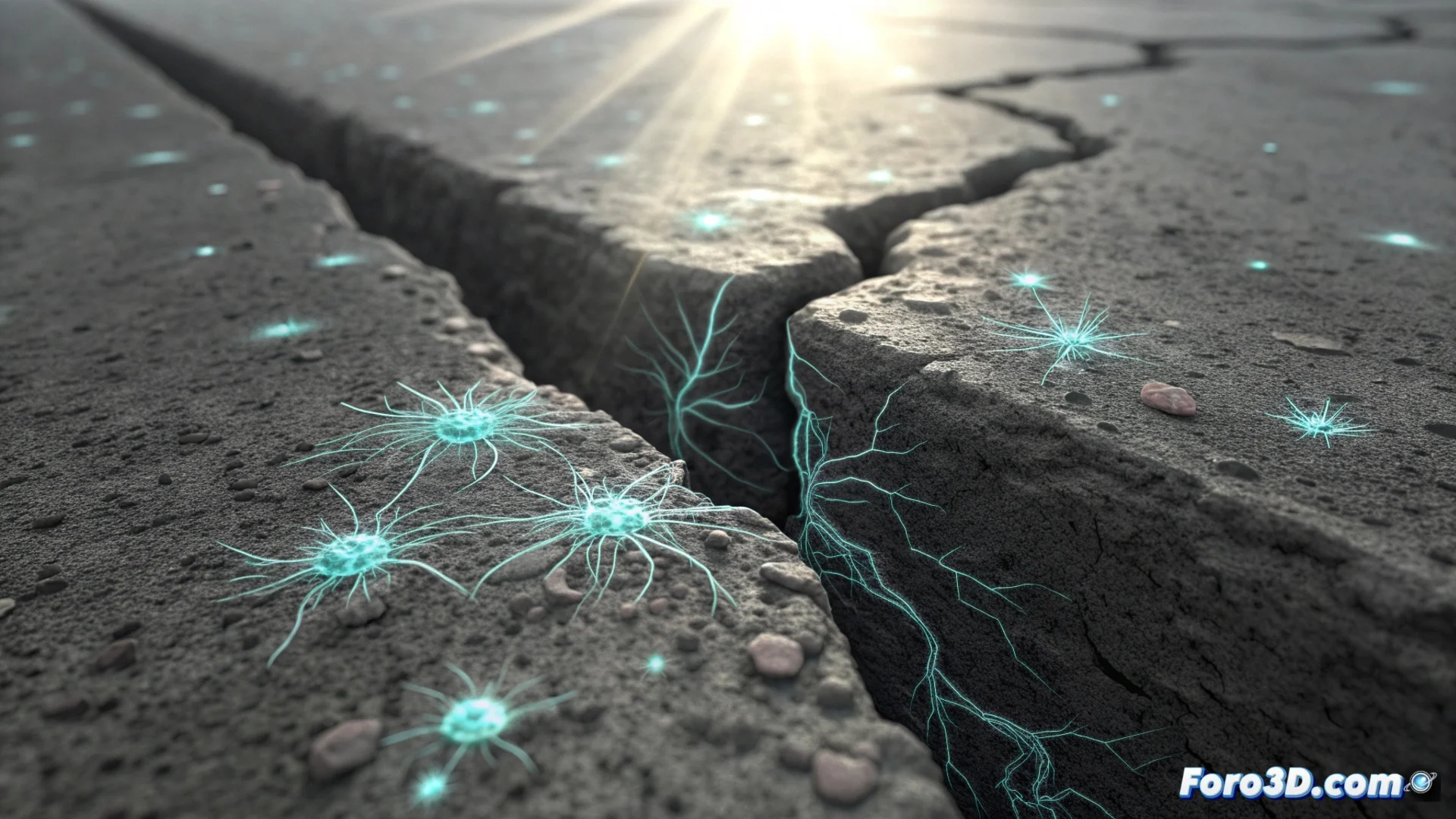
Living concrete repairs itself with cyanobacteria
Innovation in construction materials is advancing toward biological systems. Living concrete incorporates photosynthetic microorganisms, specifically cyanobacteria, which remain in a latent state within its structure. This approach seeks to endow buildings with an autonomous response capability to damage. 🦠
Activation mechanism and biological sealing
The process begins when the material cracks and allows the entry of water and carbon dioxide. These elements, along with sunlight, act as triggers to activate the bacteria. Species like Synechococcus initiate their photosynthetic metabolism, which alters the local chemical environment.
Key steps of the biomineralization process:- The cyanobacteria consume CO2 and water, raising the pH around the crack.
- This change promotes the precipitation of calcium ions already present in the concrete.
- Calcium carbonate (calcite) forms, a crystalline material that grows and progressively obstructs the opening.
The goal is to create more resilient and sustainable structures.
Impact on durability and maintenance
Implementing this material can transform how we manage infrastructures. The ability to seal cracks autonomously restores part of the mechanical integrity and prevents damage progression, significantly extending service life.
Potential areas of application:- Critical and hard-to-access structures, such as bridges, dams, or wind towers.
- Reduce the frequency and cost of maintenance and repair operations.
- Develop constructions with a lower environmental footprint by requiring fewer repairs.
Challenges and future of the material
The technology is still being researched to optimize its long-term viability. Efforts focus on ensuring that the bacteria survive in different climatic conditions for decades and on scaling production to make the material commercially viable. The path is promising to achieve buildings with their own defense system. ☀️