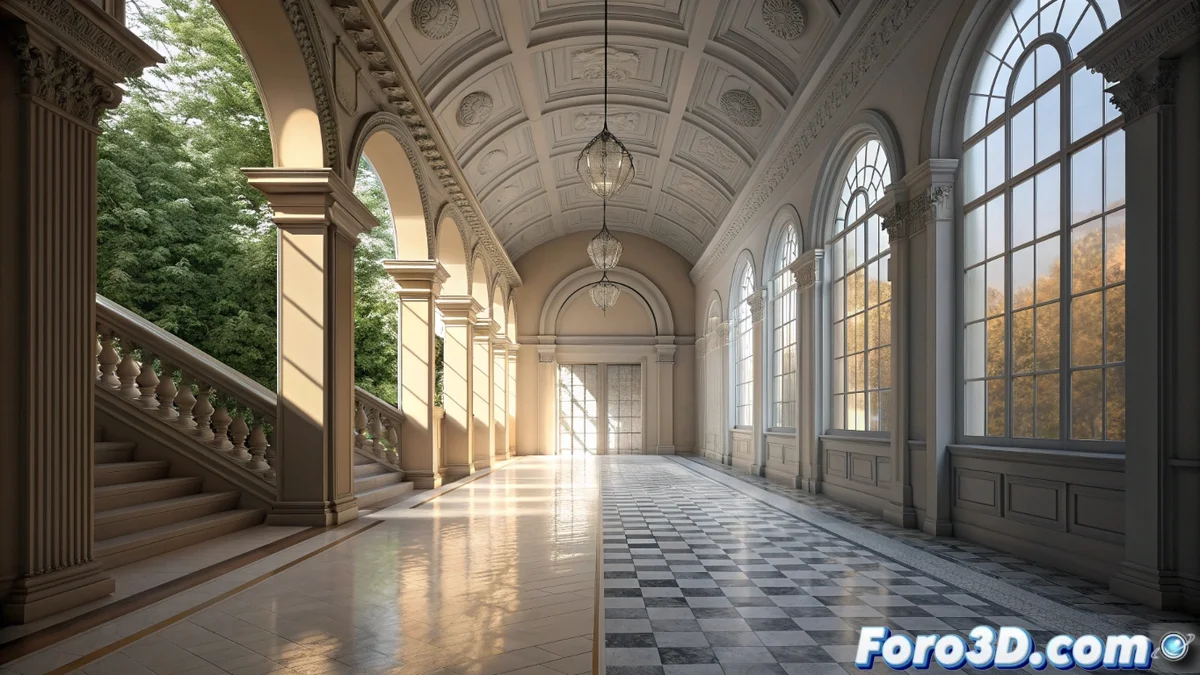
Lightscape and Modern Path Tracing Engines: Two Ways to Illuminate
In the world of 3D rendering, two technical philosophies have marked eras: precomputed radiosity and physical simulation in real time. While Lightscape defined a standard for architectural visualization, engines like Cycles or Corona have taken realism to another level. 🔦
The Legacy of Lightscape: Radiosity and Coherence
Lightscape was based on the radiosity method. This algorithm mathematically solves how light is exchanged between diffuse surfaces, generating uniform global illumination free of harsh shadows. A great advantage is that the lighting solution is viewpoint-independent. Once processed, you can explore the model in real time without recalculating the light, which was revolutionary for its time.
Main Characteristics of Radiosity:- Precomputes and stores the lighting for the entire scene at once.
- Prioritizes interactivity after the initial calculation, which is usually slow.
- The results can be perceived as flatter and lack certain complex light details.
Lightscape prioritized an interactive and predictable lighting solution, ideal for projects where lighting coherence is key.
The Modern Approach: Path Tracing and Real Physics
Contemporary engines use path tracing, a variant of Monte Carlo ray tracing. Instead of precomputing, they simulate the physical path of millions of light rays (photons) from the camera to the light sources. This method inherently captures effects like precise reflections, refraction, volume scattering, and ambient occlusion.
Main Characteristics of Path Tracing:- The lighting is viewpoint-dependent: every angle change requires reprocessing.
- It is computationally intensive, but produces very high physical realism.
- It natively integrates all types of surfaces, both diffuse and specular or glass.
Choosing the Right Method for Your Project
The choice between these paradigms depends on the objectives. Lightscape's radiosity was ideal for interactive architectural presentations where absolute lighting coherence was needed when navigating. Current path tracing is chosen when the end goal is to achieve maximum physical fidelity, representing any material or complex lighting effect, at the cost of needing more power to calculate. It is a testament to how technology advances: what once required hours to process, we can now adjust and preview in minutes, although the final definitive render still invites us to a break. ☕