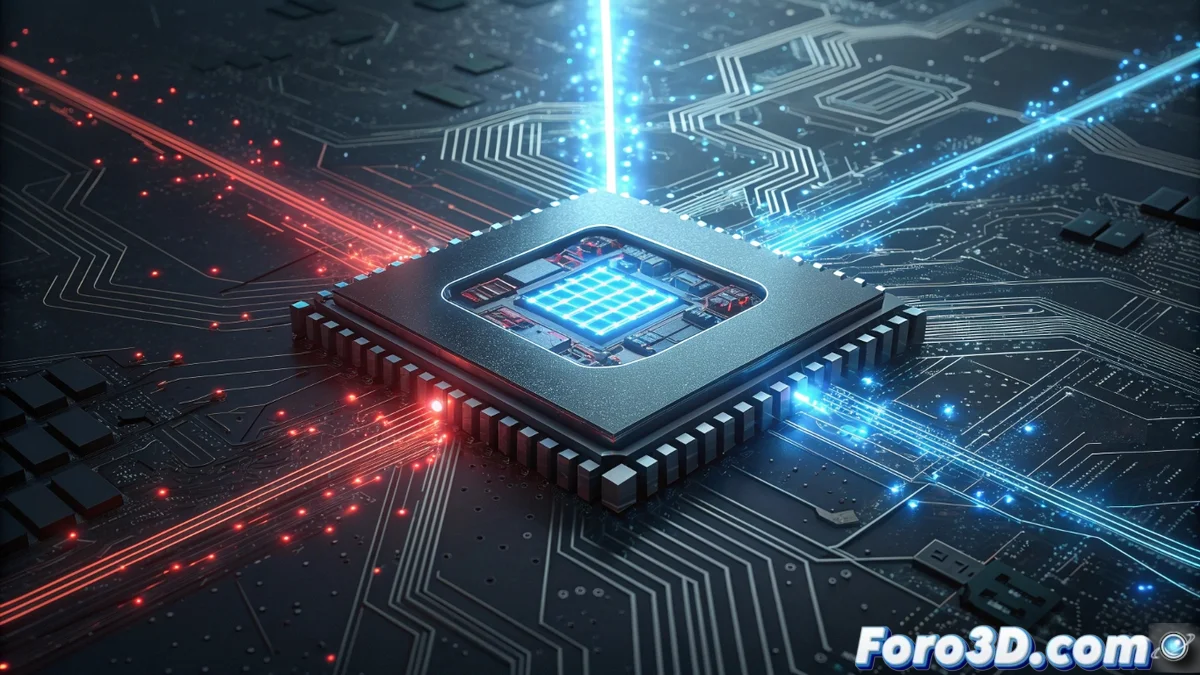
Lightmatter Passage: Photonic Computing for AI Inference
The evolution of artificial intelligence demands a quantum leap in the hardware that supports it. Facing the physical and power consumption limits of traditional silicon chips, Lightmatter bursts onto the scene with Passage, a revolutionary platform that changes the paradigm: instead of electrons, it uses photons (light) to perform the massive calculations of deep neural networks. This approach is not merely an improvement, but a redefinition of computational architecture for the AI era, promising exponentially greater performance with a fraction of the energy. 🚀
How does a light-based processor work?
While a conventional electronic chip relies on the movement of electrons through nanowires, generating heat and speed limitations, Passage operates on a different plane. The system is built on a silicon-integrated network of lasers, modulators, and optical detectors. Here, data is encoded in light pulses that propagate and are processed at the speed of light, with negligible thermal dissipation. Matrix and vector operations, essential for AI models, are performed inherently in parallel in this optical medium, eliminating memory and bandwidth bottlenecks.
Key advantages of photonic computing:- Extreme speed: Photons travel faster than electrons and enable massive parallel processing without interference.
- Radical energy efficiency: Dramatically reduces power consumption by minimizing resistance and heat generation.
- Scalability: Facilitates the interconnection of optical components, allowing for more complex and powerful systems.
The promise is clear: processing speed and energy efficiency far superior to current electronic solutions.
Impact on the future of AI development
The arrival of technologies like Passage could be the tipping point needed to overcome current AI barriers. The enormous GPU clusters that power models like GPT or Stable Diffusion face practical limits in power and cooling. Photonic computing addresses these issues at their root, opening the door to larger and more complex models that can be trained and deployed sustainably. This would not only accelerate research on frontiers like AGI (Artificial General Intelligence), but also democratize advanced capabilities.
Transformative applications enabled:- Real-time inference: For autonomous vehicles, where latency is critical.
- Hyper-realistic personal assistants: With instant conversational and contextual understanding capabilities.
- Sustainable data centers: Dramatically reducing the carbon footprint of global cloud infrastructure.
A new paradigm on the desktop
The horizon posed by Lightmatter is fascinating. In the not-too-distant future, concerns about the temperature and power consumption of a GPU in our PC for rendering or simulation could become obsolete. Instead, we could integrate photonic accelerators that perform AI inference tasks at mind-blowing speeds with minimal consumption. Maintenance challenges would no longer involve changing thermal paste, but ensuring optical cleanliness of the system so that dust does not interfere with the delicate laser beams. This technological shift not only redefines computing power, but also our physical relationship with the machines that drive digital creativity. 💡