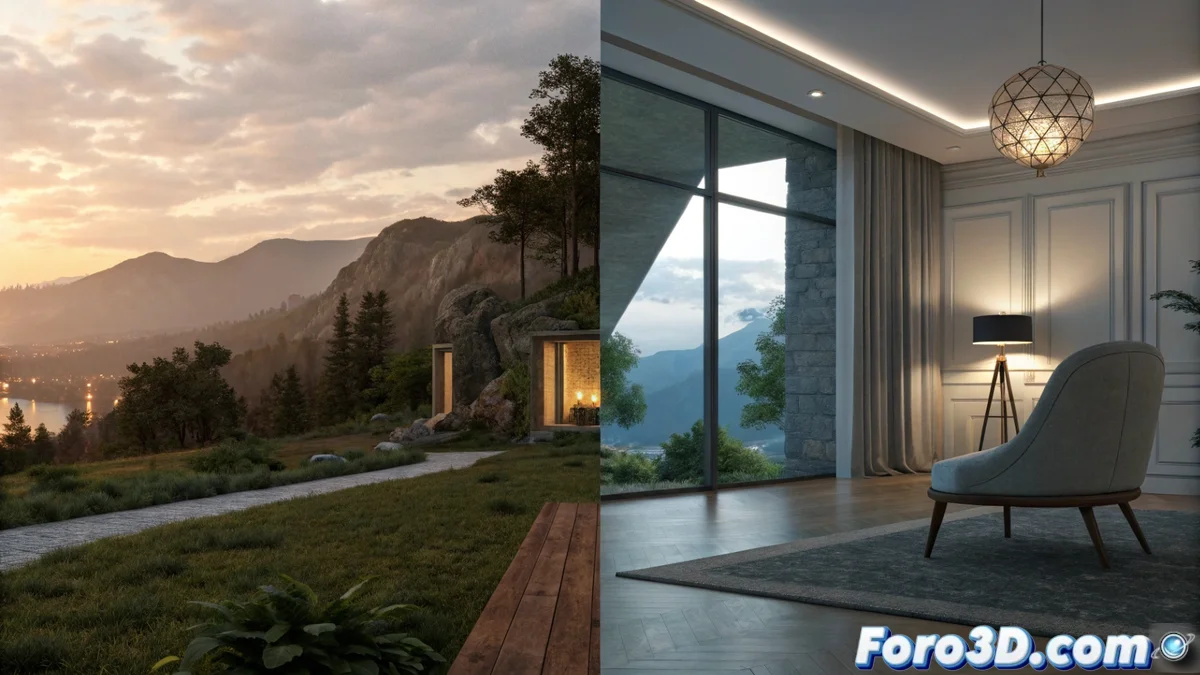
Lighting Comparison Between Softimage XSI and Autodesk Maya
The world of 3D rendering evolved with specialized engines. Softimage XSI integrated Mental Ray as its core, a standard for years. In contrast, Autodesk Maya adopted Arnold as its default renderer later. The way each handles light, materials, and workflow defines radically different creative experiences. 🎨
Mental Ray in XSI: Technical Control and Precision
Mental Ray in the Softimage XSI environment operates with a classic ray tracing paradigm. To simulate effects like global illumination or caustics, it relies on calculating and adjusting photon maps. This method provides very detailed control, but requires the artist to understand and adjust many parameters to balance processing time and final visual quality.
Key features of the Mental Ray workflow:- Define lights and their properties individually and separately.
- Set up and precalculate photon maps for indirect lighting and caustics.
- Build materials by connecting nodes in a shader tree, allowing for complex behaviors.
Mental Ray offers legendary precision, but mastering its photons for perfect caustics was an art in itself.
Arnold in Maya: Intuition and Physical Realism
Arnold introduces a path tracing-based approach. This method greatly simplifies the process to achieve physical realism, as it simulates more directly how light travels in reality. Lighting is based on area emitters and physically-based sun and sky systems, reducing the need for deep technical adjustments.
Central aspects of Arnold's approach:- Uses unified materials like Arnold Standard Surface, with parameters tied to real-world physical properties.
- Calculates light progressively, showing a result that improves with each pass and with less "firefly" noise.
- Allows for experimentation and on-the-fly changes in a more direct and intuitive way.
Contrasts in the Artist's Experience
Those who worked with XSI and Mental Ray value the meticulous control and logic of its interface, though it could feel dense for new users. Those moving to Maya with Arnold gain immediacy and a more intuitive workflow, though rendering can consume a lot of system memory. Many artists who migrated miss Mental Ray's precision, but few miss spending hours adjusting photons to project a simple caustic. The choice between one method and another reflects the preference between absolute technical control and a more fluid and physical approach. ⚙️✨