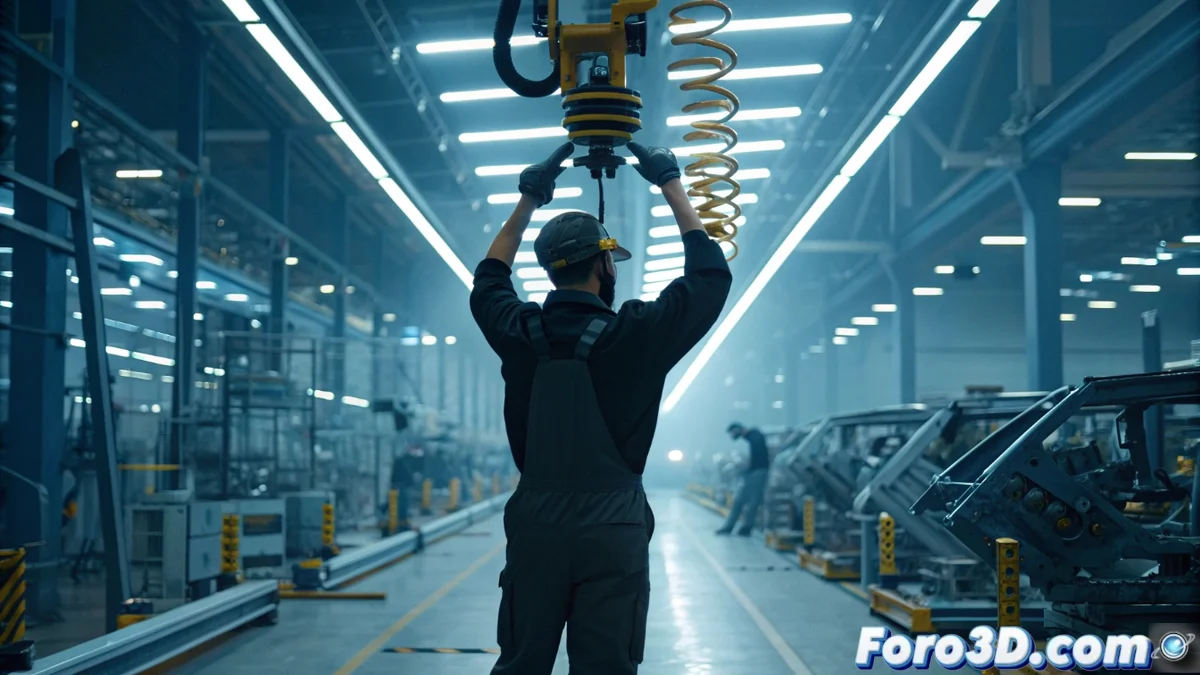
Levitate Technologies' Airframe: Revolution in Workplace Ergonomics for Overhead Arm Work
Innovation in industrial ergonomics reaches new horizons with the Airframe system developed by Levitate Technologies. This device represents a paradigm shift for professionals who must keep their upper limbs elevated during full work shifts, addressing one of the most common challenges in modern production environments. 🦾
Intelligent Support Mechanism
The technological heart of this passive exoskeleton lies in its ingenious system of twisted springs that function as kinetic energy accumulators. When the user lowers their arms, the mechanism stores mechanical force that is later released during elevation, creating an assisted levitation effect that neutralizes between 80% and 90% of the natural weight of the limbs.
Key Technical Features:- Progressive resistance calibration that dynamically adapts to different movement angles
- Modular architecture that allows customizing the level of assistance according to specific requirements
- Effective support in both maintained static positions and repetitive movement cycles
Evolutionary irony: while our ancestors raised arms to gather tree fruits without help, modern industry requires exoskeletons for equally natural but technologically complex tasks
Implementation in Industrial Environments
The practical applications of Airframe span sectors where operating tools above shoulder level is constant, highlighting its implementation in automotive manufacturing, aeronautical assembly, and infrastructure construction. The adoption of this technology generates quantifiable benefits that directly impact workplace health indicators and operational efficiency.
Documented Advantages:- 60% reduction in repetitive strain injuries in shoulder and neck areas
- Decrease in work absenteeism related to musculoskeletal disorders
- Average 25% increase in productive work cycles without compromising operator comfort
Impact on Workplace Well-being
Independent ergonomic studies confirm that continuous use of the Airframe system significantly reduces accumulated tension in trapezius, deltoids, and cervical region, areas particularly vulnerable during activities requiring prolonged arm elevation. This solution represents not only a technological advancement but an evolution in the conception of the human-machine relationship in productive environments. 💡