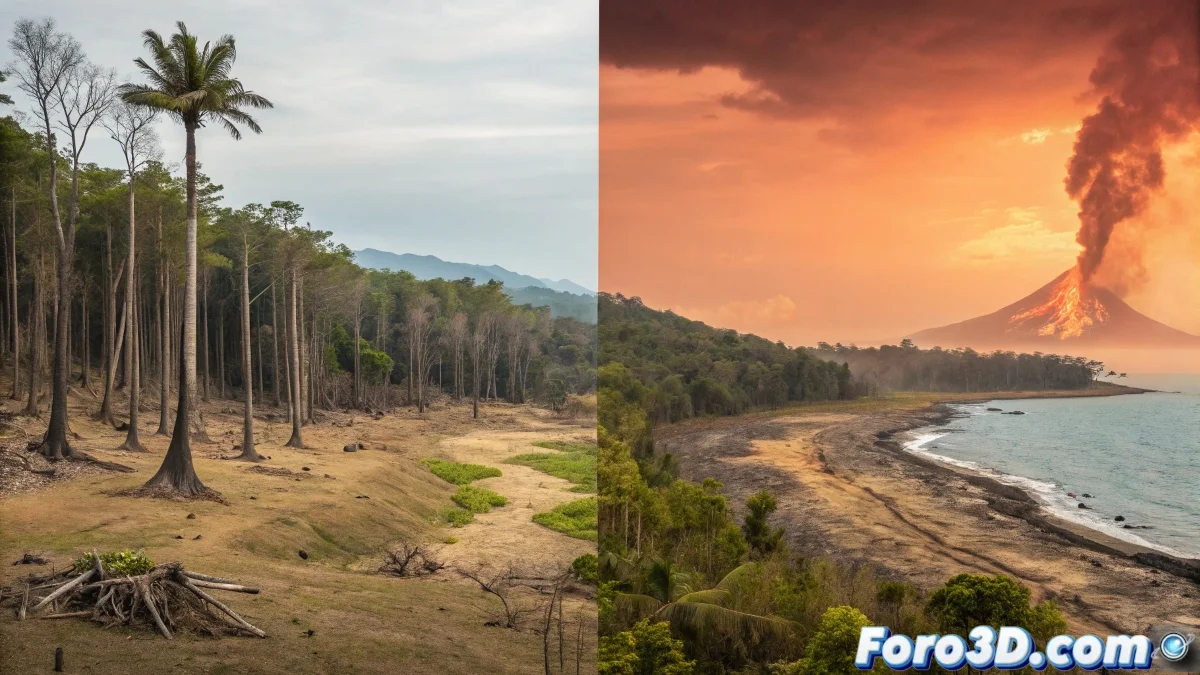
The Earth as a Perpetual Greenhouse: Lessons from the Past
A recent study has revealed that approximately 252 million years ago, during the Permian-Triassic mass extinction, the Earth experienced an extreme climatic phenomenon that turned it into a super-greenhouse. This period, which lasted around 5 million years, was triggered by the massive destruction of forests and a significant increase in CO₂ levels. This historical event offers crucial lessons for understanding the risks of current climate change.
A Climate Collapse Driven by Lost Vegetation
The Permian-Triassic mass extinction was one of the most devastating events in Earth's history, eliminating approximately 96% of marine life and 70% of terrestrial life. One of the main causes was a series of massive volcanic eruptions in what is now Siberia, which released enormous amounts of carbon dioxide into the atmosphere. This caused a global temperature increase of up to 10 degrees Celsius, which in turn led to the disappearance of vast forests that acted as carbon sinks.
The loss of these forests was catastrophic, as it eliminated one of the most important natural mechanisms for regulating the climate. Without vegetation to absorb CO₂, the planet entered a state of super-greenhouse, where high temperatures and elevated CO₂ levels persisted for millions of years.
A Dangerous Parallel with the Present
The study of this historical period is especially relevant today, as we face similar challenges with climate change. Accelerated deforestation, especially in tropical forests like the Amazon, is reducing the planet's capacity to absorb CO₂. At the same time, greenhouse gas emissions continue to increase, leading to global warming similar to that experienced during the Permian-Triassic.
The key difference is that, in the past, these changes were driven by natural events like volcanic eruptions. Today, however, human activity is the main driver of climate change. This means that, unlike our prehistoric ancestors, we have the ability to take measures to mitigate these effects and protect our ecosystems.
The history of the Earth teaches us that ecosystems are fundamental to climatic stability. Without them, the planet could become a perpetual greenhouse. The good news is that, unlike the dinosaurs, we have the capacity to act and change the course of our climatic future. 🌳