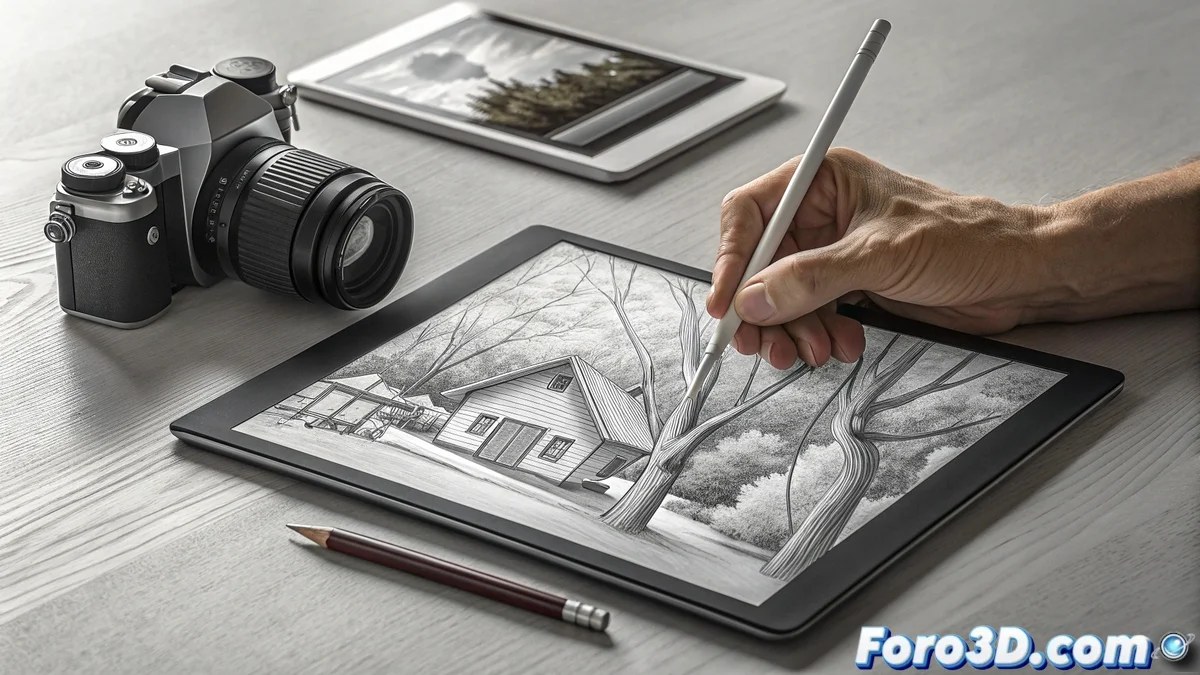
Learning to Draw Using Photographs as Reference
The use of photographic images as supporting material constitutes a fundamental strategy for visual creators who aspire to perfect accuracy and authenticity in their graphic representations 🎨. This methodology facilitates the detailed examination of dimensional relationships, spatial depth, and specific characteristics of elements and environments, being crucial for reproducing the real appearance with fidelity.
Selection and Evaluation of Visual References
The initial phase involves the careful selection of an image with adequate resolution that clearly displays the components you intend to analyze, whether it be facial anatomy, architectural structure, or textile surfaces. It is vital to examine the photograph thoroughly to recognize essential aspects such as depth axes, relative scales between objects, and tonal gradations.
Visual Decomposition Process:- Fragment the reference into basic geometries and repetitive configurations
- Transfer this information to the working surface in an organized manner
- Ensure proportional correctness and compositional balance
Deep structural analysis prevents frequent deviations such as perspective distortions or lighting irregularities
Technical Implementation in Creation
After completing the referential study, you begin the translation of data to the physical or digital medium, employing systems like grid overlays or comparative procedures to preserve precise dimensional relationships. You develop the work in overlapping stages, starting with subtle strokes that outline the primary silhouettes and progressively incorporating nuances such as shaded areas, specular highlights, and surface qualities.
Continuous Verification Methods:- Systematically alternate between observing the reference and your production
- Progressively adjust each visual component
- Perfect the ability to capture the essential nature of the subject
Integration and Artistic Evolution
With sustained practice, this methodology becomes internalized, allowing you to generate more believable and communicative works, even when operating without direct referential supports. It is crucial to remember that, while references represent invaluable tools, they do not replace personal inventiveness; eventually you can attribute any discrepancy in your result to the photograph, but constant practice is what genuinely determines artistic evolution ✏️.