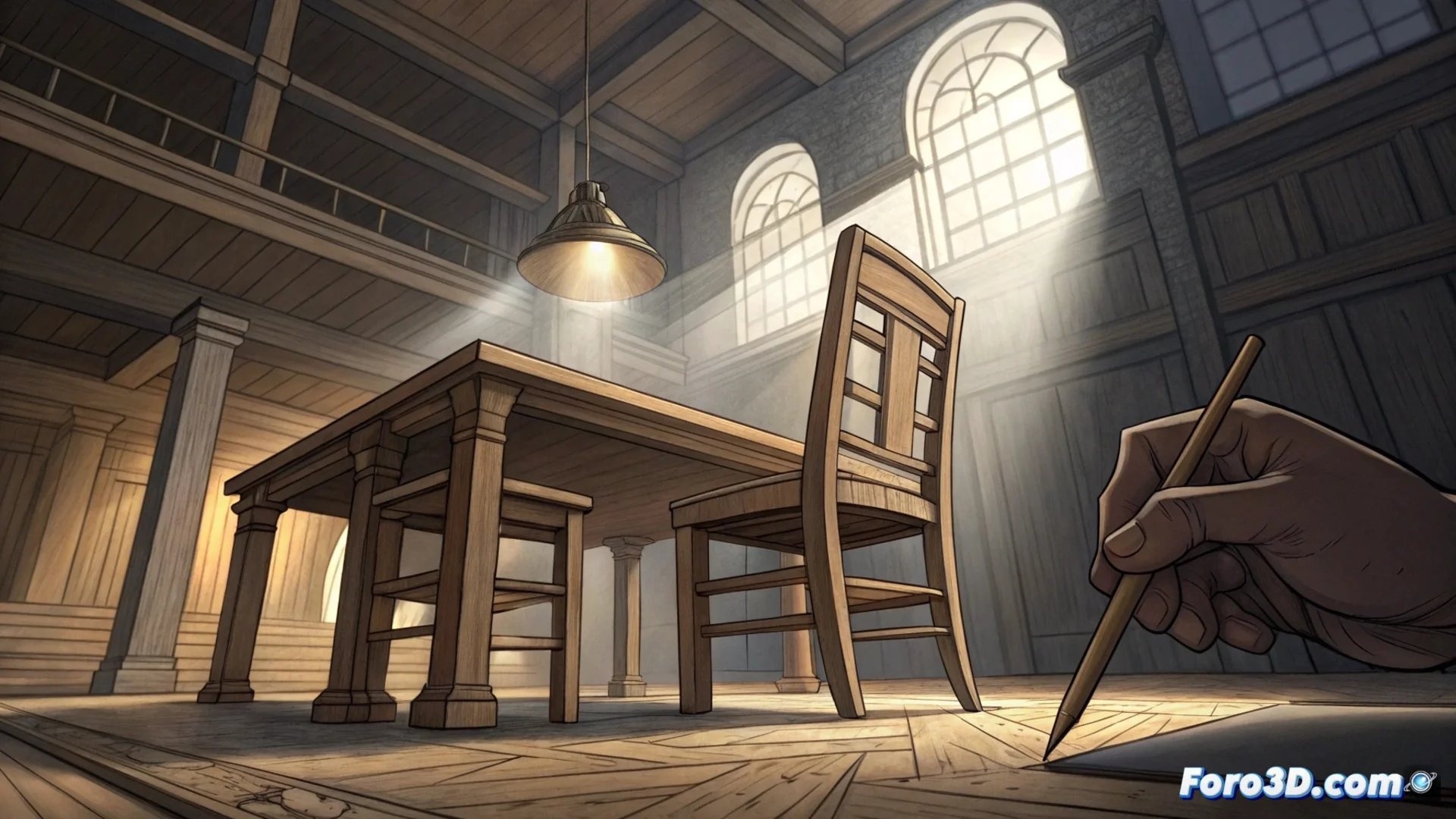
Learn to Draw from an Unusual Point of Observation
Exploring radical viewing angles is a practice that transforms how you perceive and represent space. This strategy goes beyond looking at an object; it's about physically adopting a position that challenges your usual point of view, such as lying on the ground or imagining observing from a high branch. This shift forces your brain to interpret spatial relationships through a completely new lens, deactivating preconceived patterns and activating a deeper analysis of structure. 🎨
Implementing Extreme Perspective in Your Routine
To integrate this method, you don't need special materials, but rather the willingness to change your body position. The process begins by selecting an everyday subject, like a piece of furniture or a corner of a room. The crucial step is to drastically change your point of observation.
Key Steps to Get Started:- Choose the Angle: Position yourself on the ground to look up, use a mirror on a tilted surface, or simulate the view from an elevated position.
- Observe the Distortions: Analyze how converging lines are altered, how nearby elements enlarge disproportionately, and how planes overlap in unexpected ways.
- Draw the Perception, Not the Knowledge: The hand must translate what the eye sees at that instant, especially the intense foreshortenings, ignoring the preconceived mental image of the object.
From the ground, the familiar world transforms; a table becomes a giant canopy and the legs of a chair turn into monumental columns.
Advantages of Abandoning the Conventional View
This exercise is not just a technical challenge. By drawing from the perspective of an insect or from a reflection, you strengthen your ability to break down complex forms. You face composition problems where the main focus shifts and empty spaces acquire an unexpected narrative weight.
Concrete Benefits You Gain:- Expand Your Visual Repertoire: You accumulate graphic solutions for representing scenes with greater dynamism and narrative force.
- Improve Structural Analysis: You understand the underlying geometry of objects by viewing them from angles that reveal their hidden volumes.
- Break Compositional Monotony: You avoid falling into predictable frontal or side perspective schemes, injecting originality into your illustrations.
Integrate the Technique for Lasting Results
The key is consistent practice. When a drawing seems flat or lifeless, try turning your head or flipping the paper. Over time, this way of working becomes internalized, allowing you to tackle any project with a powerful tool to create images that capture attention due to their unique point of view. Next time, before drawing, ask yourself: what if I looked at it from below? 🔍