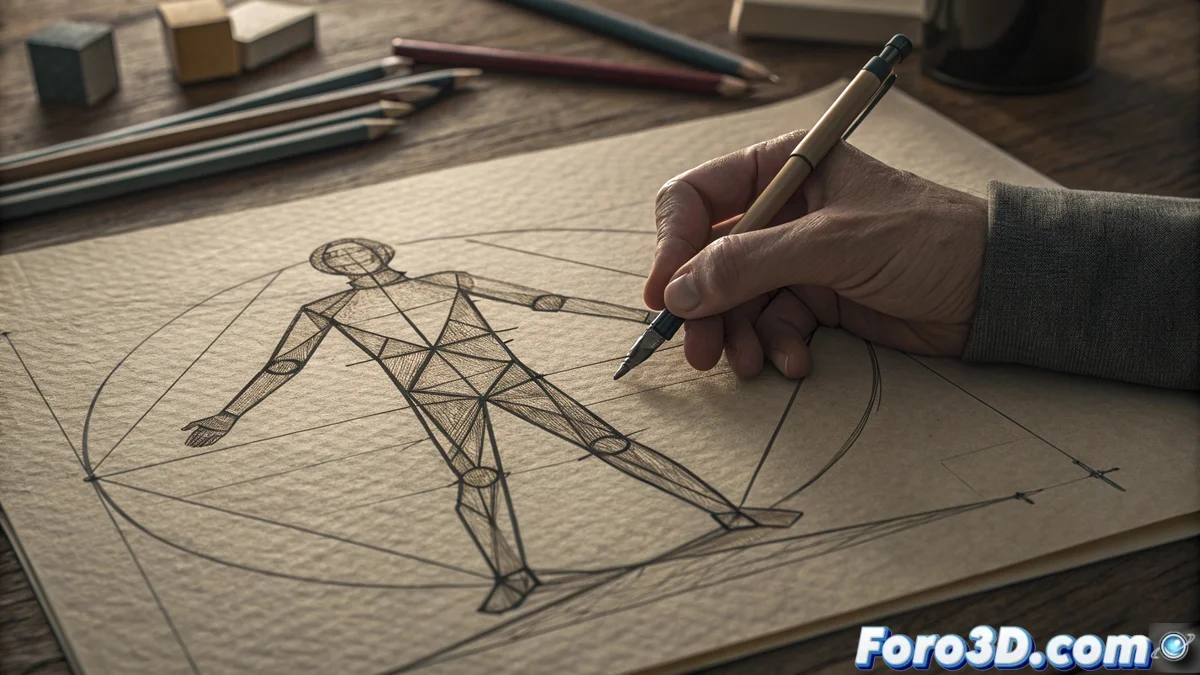
Loom in Drawing: Essential Technique for Structuring Your Creations
The loom represents one of the fundamental pillars in academic drawing instruction, consisting of the progressive construction of any figure using elemental volumes before addressing specific elements. This methodology ensures structural solidity and precise spatial relationships from the earliest creative stages 🎨.
Fundamentals of the Constructive Process
When starting any graphic project, we identify the primary shapes that compose the subject: cylinders for limbs, spheres for joint articulations, and prisms for angular elements. We draw lines of action that capture the postural dynamics, using ellipses and rectangles to represent main masses. These guidelines are iteratively adjusted until achieving a proportional scheme where each component maintains dimensional and positional coherence 🔷.
Recommended Methodological Sequence:- Identification of dominant geometric shapes in the model
- Drawing of movement axes and general direction
- Superposition of basic volumes with light, correctable strokes
The loom functions as an invisible scaffold: it supports the entire work before details take center stage
Pedagogical Benefits of the Loom
This technique develops analytical capacity to visualize ensembles rather than isolated fragments, training perception to measure angles and distances with greater accuracy. By proceeding from the general to the particular, the artist consolidates the underlying architecture before committing to definitive elements, optimizing workflows and time resources ⏱️.
Main Applications:- Human and animal anatomical illustration
- Architectural and complex object design
- Character development for visual narrative
Consequences of Omitting This Stage
Those who dispense with structural loom frequently discover irreversible disproportions in advanced phases, evidencing that even artistic expression requires solid foundations before surface finishing. Constant practice with simple models up to complex compositions internalizes three-dimensionality even though the support is two-dimensional, preventing errors such as unbalanced limbs or contradictory perspectives 📐.