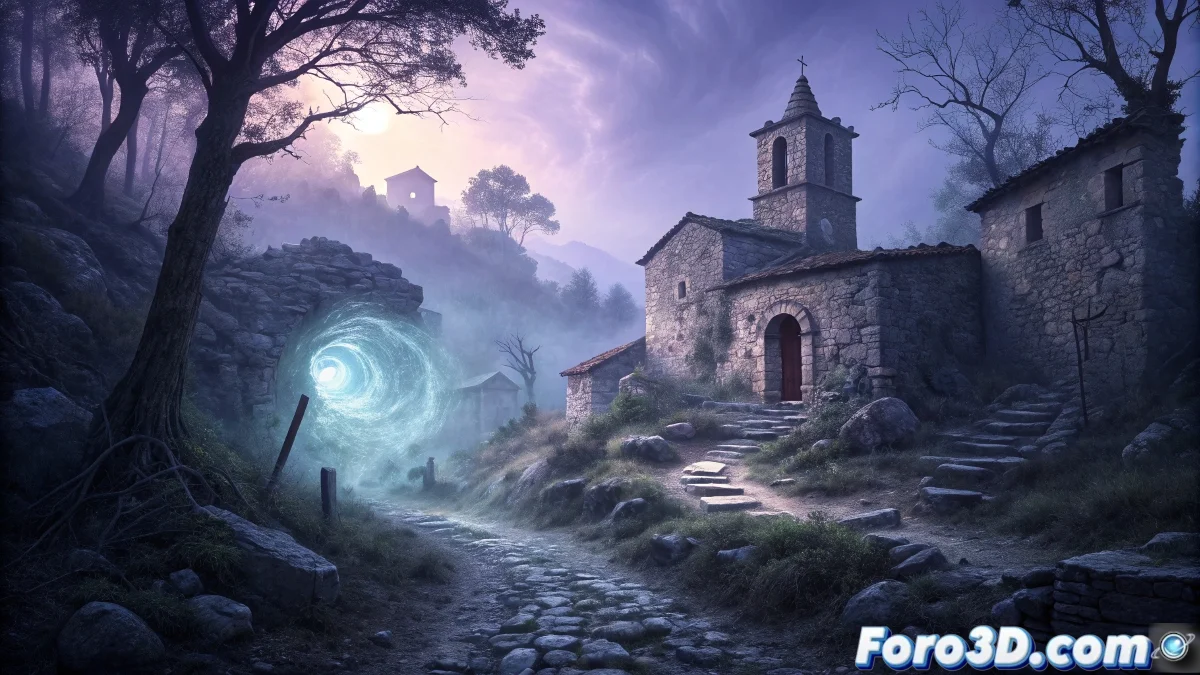
The Supernatural Atmosphere of La Mussara
In the mountains of Tarragona hides one of the most intriguing mysteries of Spanish geography. 👻 La Mussara, a ghost town abandoned for decades, has accumulated numerous legends about inexplicable disappearances and a supposed dimensional door that connects to other planes of existence. This perfect setting for supernatural recreations finds in Houdini the ideal tool to capture its mysterious essence. The software's volumetric simulation and procedural effects capabilities allow building an unsettling atmosphere where the fog is not simply a visual element, but another character within the place's paranormal narrative.
Volumetric Simulation Techniques
The convincing recreation of La Mussara requires advanced mastery of Houdini's volumetric tools. The fog that envelops the abandoned town must behave like a living entity, with organic movements that suggest an intelligent presence behind its ethereal appearance. Volume containers combined with procedural noise fields allow creating fog banks that move unpredictably, selectively hiding and revealing the town's ruins. Precise control over density, dispersion, and animation transforms a simple atmospheric effect into the central element that conveys the mystery of the place.
Gaseous fluid dynamics can shape a changing and organic fog
Recreation of Paranormal Effects
The legend of the dimensional door represents the most complex creative challenge within this project. Houdini offers multiple approaches to visualize abstract concepts like interdimensional portals and spatiotemporal distortions. The combination of VDBs, geometric deformers, and distortion shaders allows creating effects that suggest a rupture in the fabric of reality without falling into overly explicit visual clichés. The key lies in subtlety and suggestion, creating visual anomalies that arouse curiosity without fully revealing their nature.
Project Setup and Base Modeling
The construction of a convincing paranormal environment begins with a solid geometric base and meticulous project organization. The nodal structure must facilitate iterations and adjustments throughout the creative process.
- Procedural geometry: Use terrain and deformation nodes to create characteristic eroded hills and paths
- Modular ruins: Develop a construction system that allows variations in collapsed structures
- Nodal organization: Structure the node network with clear logic to facilitate adjustments and modifications
- Layer system: Implement layers to manage different scene elements independently
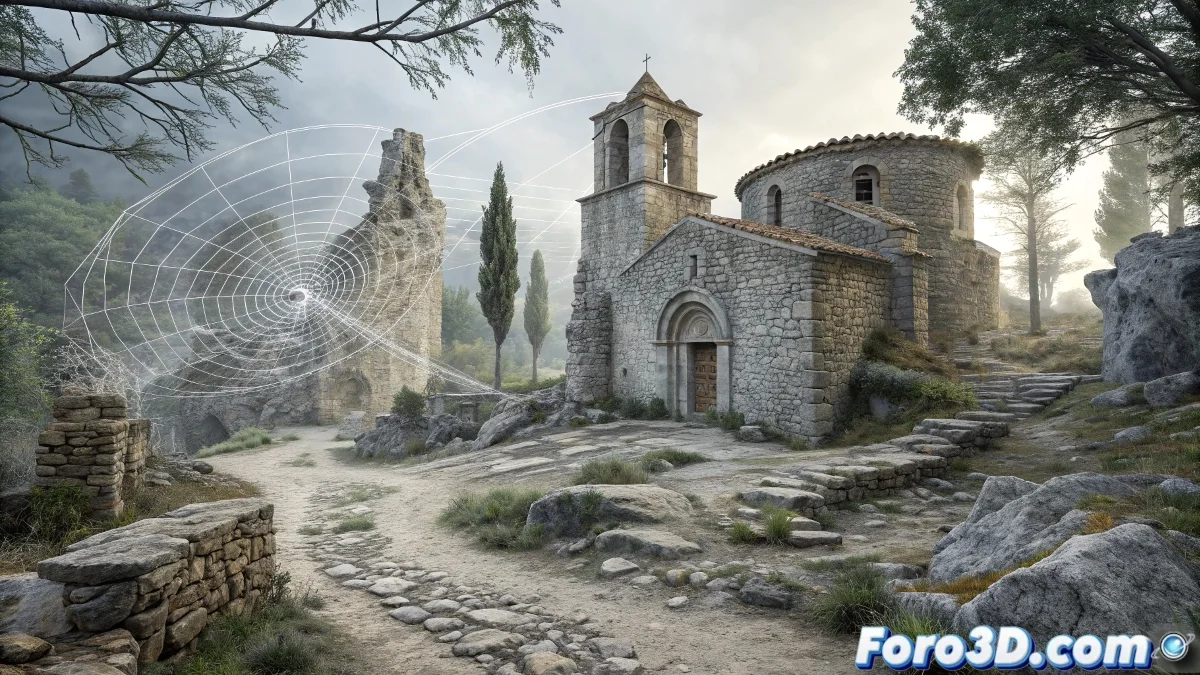
Atmosphere Simulation and Environmental Effects
The visual magic of La Mussara lies in the interaction between physical elements and atmospheric effects. Each component must contribute to the overall sensation of mystery and abandonment.
- Fog volume setup with variable density controlled by animated noise fields
- Implementation of particle systems for suspended dust and ethereal elements in the environment
- Creation of ambient lighting that simulates specific weather conditions and times of day
- Development of wind effects that affect vegetation, particles, and volumetric dynamics
Supernatural Effects and Narrative Elements
Paranormal elements must integrate organically within the environment, avoiding the sensation of being artificially added effects. Credibility depends on this subtle integration.
- Creation of spatial distortions using VDBs and procedural geometry deformers
- Development of dimensional portals with emissive shaders and energetic particle effects
- Implementation of fading and materialization systems to simulate disappearances
- Animation of environmental elements that react to invisible presences or hidden forces
Lighting and Final Render
The lighting setup is the element that unifies all visual components and establishes the definitive emotional tone. Light must suggest more than it shows directly.
- HDRI setup with specific atmospheric conditions that accentuate the mystery
- Use of directional lights with grazing angles that create elongated and dramatic shadows
- Implementation of strategic point lights to simulate paranormal or inexplicable light sources
- Adjustment of render parameters to maximize the quality of volumetrics and atmospheric effects
While the legends continue to fuel the mystery of La Mussara, Houdini artists demonstrate that sometimes the best way to explore the paranormal is through algorithms and precise simulations. 🌫️ Because, let's be honest, what would be more terrifying than a ghost town where even the fog has real physics?