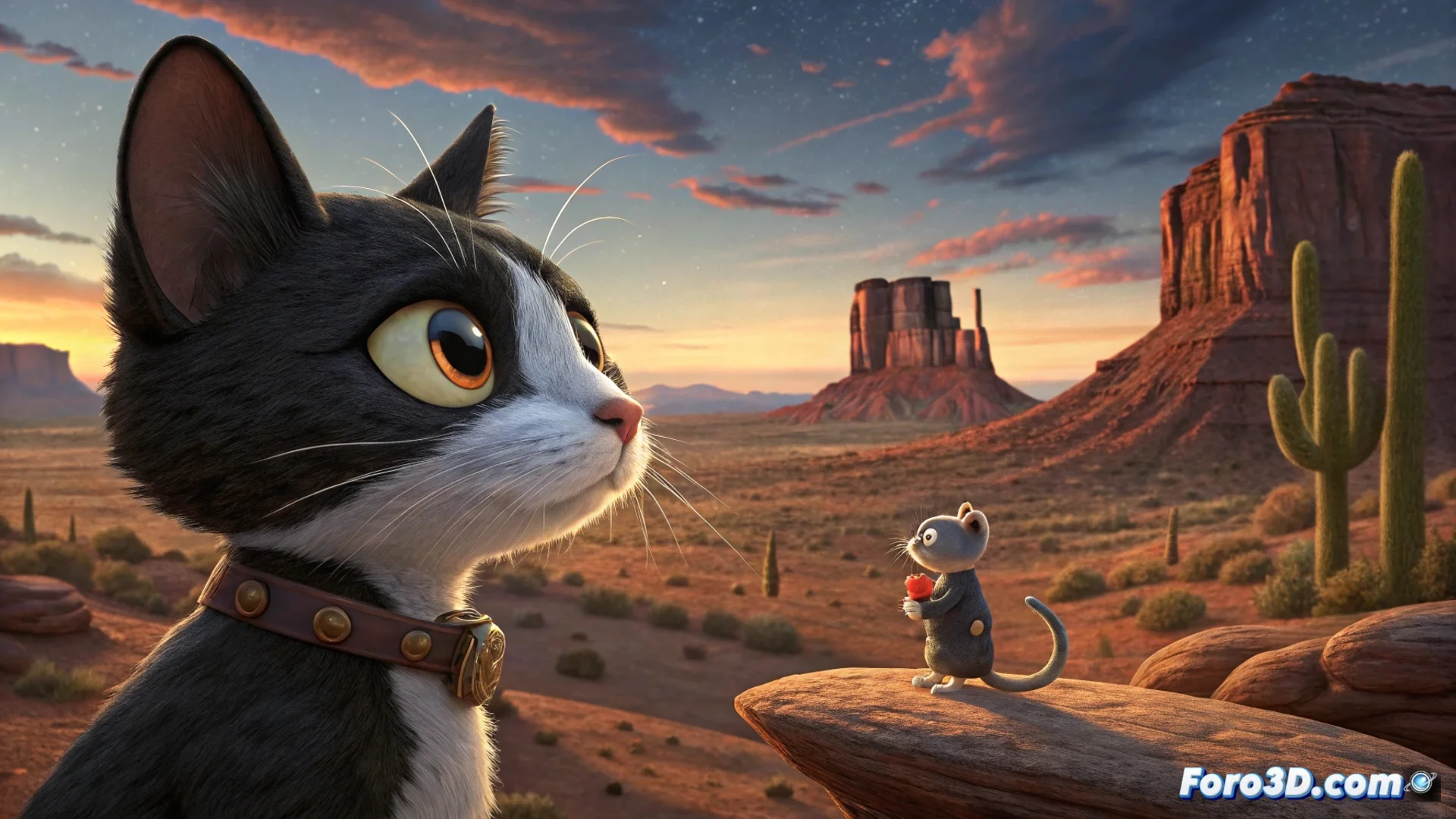
George Herriman's Krazy Kat: a surrealist triangle in the desert
The work Krazy Kat, created by George Herriman, defines a repetitive and dreamlike dynamic in the world of comics. A gender-ambiguous cat, Krazy, feels a deep love for the mouse Ignatz, who expresses his affection in the only way he knows: by throwing bricks at his head. This act of "affection" is watched over by Offissa Pupp, a police dog who tries to protect Krazy and arrest Ignatz, closing an absurd relationship triangle. 🎭
A setting that refuses to be stable
The most striking visual element of the series is its location. Herriman sets the actions in the Coconino desert, a landscape that mutates from panel to panel. Mesas, cacti, and rock formations adopt different shapes, eliminating any notion of a fixed space. This approach, very ahead of its time, generates a dreamlike atmosphere and perpetual movement, where the environment directly reflects the characters' emotions and the illogical nature of their bonds.
Pillars of visual narrative:- Circular dynamic: The premise of the brick as a declaration of love and the arrest as protection repeats in an endless poetic cycle.
- Emotional landscape: The Coconino desert is not a background; it is an active character that changes to express moods.
- Inverted roles: Aggression is interpreted as affection, and authority seeks to protect from an unrequited desire.
In this universe, a brick to the head is the ultimate declaration of love, and imprisonment is the most sincere way to protect someone from themselves.
A legacy of graphic and narrative freedom
Beyond the transformable backgrounds, Herriman forged a unique visual language. His line is expressive and playful, and he experiments fearlessly with language, mixing cultured English with invented dialects. The composition of the panels breaks the rules of its era, varying sizes and perspectives to control the reading rhythm. This creative freedom marked a before and after.
Herriman's key innovations:- Expressive drawing: Lines that convey movement and the psychology of the characters immediately.
- Invented dialogue: Mixture of linguistic registers that adds depth and humor to the interactions.
- Panel composition: Unconventional page design that guides the reader's gaze in a unique way.
An enduring influence
George Herriman's work in Krazy Kat did not stay on the newspaper pages. His boldness in narrating and drawing directly influenced subsequent generations of artists, both from underground comics and avant-garde animation. Many creators recognize in this strip a license to explore that expanded the limits of what could be told and, above all, how it could be told with images and words. His absurd triangle in a mutable desert remains a beacon of unrestricted creativity. ✨