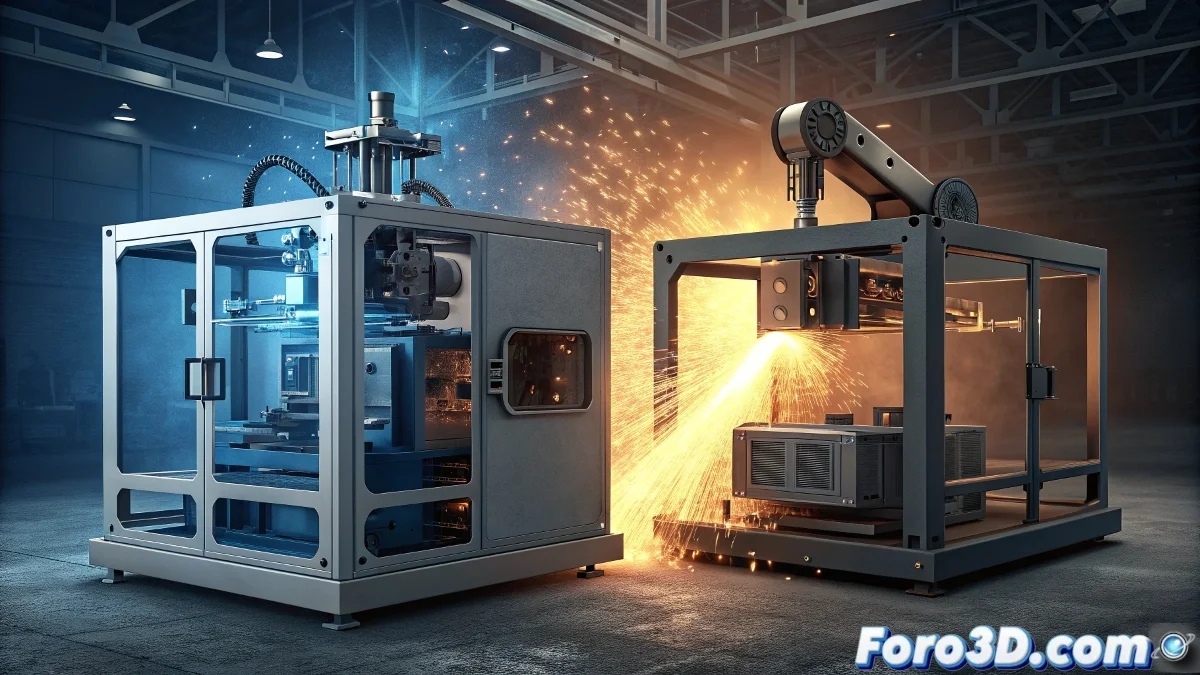
KraussMaffei vs Arburg: A Strategic Shift in the European 3D Printing Market
In a move that reflects the diverging strategic visions within the German manufacturing industry, KraussMaffei announced a significant expansion of its 3D printing division while its direct competitor Arburg confirmed its exit from the additive manufacturing market. This contrasting development underscores the volatile and competitive nature of the industrial 3D printing sector, where even established players must continuously reassess their positions. KraussMaffei's decision to double down on the technology coincides with a moment of consolidation and maturation in the global market.
KraussMaffei's Strategic Expansion
KraussMaffei is channeling substantial investments into developing its 3D printing portfolio, particularly in large-format extrusion technologies and hybrid systems that combine additive and subtractive manufacturing. The company has announced the launch of a new generation of series production 3D printing systems designed specifically for automotive and aerospace applications. These developments include significant advances in production speed, repeatability, and material capabilities, addressing precisely the limitations that have hindered widespread adoption of 3D printing in high-volume manufacturing.
KraussMaffei's strategy focuses on integrating 3D printing into existing production lines rather than treating it as an isolated technology. The company is developing solutions that enable hybrid manufacturing where different technologies collaborate sequentially, with 3D printing systems working alongside injection molding machines and CNC in unified workflows. This approach reflects the understanding that the future of manufacturing will not be dominated by a single technology, but by the intelligent orchestration of multiple complementary processes.
KraussMaffei Expansion Areas:- Large-format systems for automotive parts
- Additive/subtractive hybrid technologies
- Development of advanced composite materials
- Integration with existing production lines
- Software platforms for digital manufacturing
Arburg's Strategic Withdrawal
By contrast, Arburg has decided to cease development and sales of its Freeformer 3D printing systems, marking the end of nearly a decade-long foray into the additive manufacturing market. The decision reflects the unique challenges facing traditional players when competing in a space dominated by agile startups and companies purely dedicated to 3D printing. Despite significant technical advances, Arburg struggled to achieve the scale and profitability needed to justify continued investment in the competitive segment.
Arburg's exit does not represent a technological failure—the Freeformer systems were technically competent—but a recognition of challenging commercial realities. The company cited intense competitive pressure, long sales cycles, and the need to concentrate resources on its core injection molding machine business as key factors in the decision. This strategic move allows Arburg to focus its efforts on domains where it maintains sustainable competitive advantages, particularly in high-precision machines for medical and consumer applications.
In a rapidly evolving market, we must be disciplined about where we can create unique value for our customers. Sometimes, the smartest strategic decision is knowing when to redirect resources.
Implications for the European 3D Printing Market
These opposing moves reflect the maturation and segmentation of the industrial 3D printing market. While some players withdraw from specific segments, others double down where they see potential for sustained growth. KraussMaffei appears to be betting on the long-term convergence between traditional and additive manufacturing technologies, positioning itself as an integrated rather than specialized provider. This approach leverages its existing expertise in industrial automation and established relationships with top-tier manufacturers.
Arburg's exit could create opportunities for other players in the plastic 3D printing segment, particularly in applications where Freeformer technology had gained traction. However, it also serves as a warning about the challenges of scaling 3D printing businesses in an increasingly competitive and commoditized market in the low- and mid-range segments. The move suggests the market is entering a phase where only players with sustainable competitive advantages and differentiated approaches will thrive long-term.
Factors Influencing Strategic Decisions:- Consolidation of the industrial 3D printing market
- Intense price competition in mature segments
- Need for specialization versus diversification
- Differential profitability between technologies
- Innovation speed versus execution capability
The Future Competitive Landscape
KraussMaffei's expansion and Arburg's withdrawal likely herald a period of greater consolidation in the industrial 3D printing sector. We expect to see more similar strategic moves as companies adjust their positions to changing commercial realities. For KraussMaffei, the challenge will be to demonstrate that its integrated approach can generate substantial returns in a market where many have underestimated the complexity of serving demanding industrial applications.
In the long term, these developments could lead to a more stratified and specialized market, with different players dominating specific segments based on their unique core competencies. Industrial 3D printing could evolve toward a landscape similar to other manufacturing technologies, where a few large players coexist with numerous niche specialists. What is clear is that the journey from promising technology to sustainable business is proving more challenging than many initially anticipated.
The contrast between KraussMaffei's expansion and Arburg's withdrawal perfectly illustrates the dynamic and ruthless nature of emerging technology markets. While one company sees opportunities where another sees insurmountable challenges, both decisions reflect careful strategic assessments of where they can create lasting value. For the 3D printing industry as a whole, this divergence marks another step in its evolution from experimental technology to established component of the modern manufacturing toolkit.