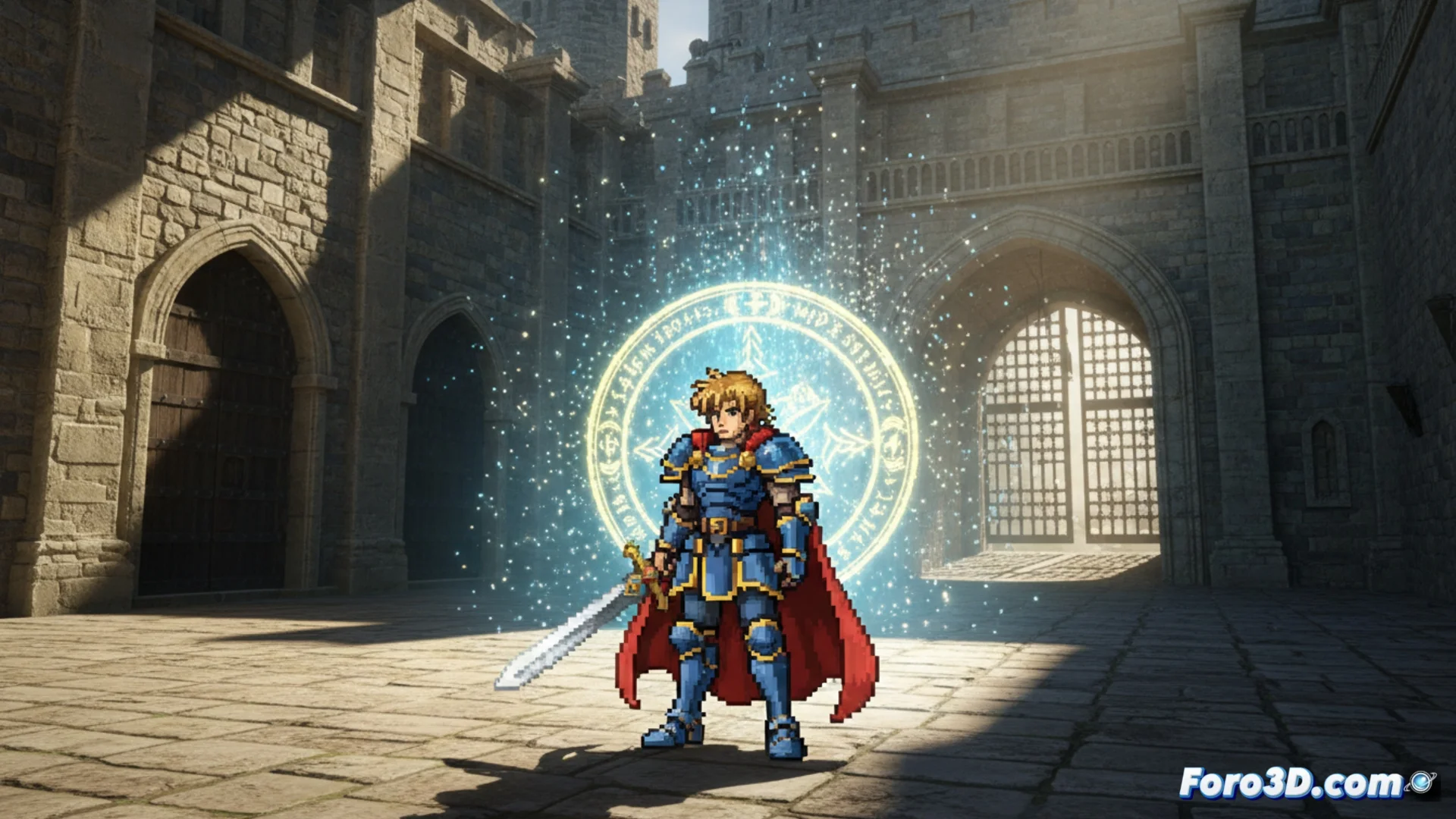
Konami Develops an HD Remaster of Suikoden I and II with a Proprietary Engine
The company Konami is immersed in a project to relaunch the classics Suikoden I and II in high definition. To achieve this, it does not resort to commercial solutions, but has built an internal graphics engine specialized in achieving a hybrid visual style known as 2.5D. The central purpose is to respect the artistic essence of the original versions while incorporating contemporary technological advances. 🎮
The Integration of Pixel Art and Three-Dimensional Environments
The core of this HD remaster lies in fusing two distinct visual worlds. On one hand, the character sprites are created and animated preserving the classic pixel art, using tools like Aseprite. On the other, the scenarios are built as detailed three-dimensional backgrounds, modeled in applications like Blender or 3ds Max. All these elements converge in Konami's engine, where a dynamic lighting system acts as visual glue, projecting coherent shadows and reflections onto the sprites. Combat effects, such as spells or summons, are redesigned using modern particle systems to increase their visual impact. ✨
Key Details of the Artistic Process:- The 2D sprites are crafted with dedicated pixel art tools, maintaining their authenticity.
- The 3D backgrounds are rendered with high detail to create depth and atmosphere.
- The unified lighting calculates how light affects each layer, integrating both styles naturally.
Some pure pixel art advocates might see the addition of dynamic lights to an old sprite as adding modern elements to a classic work, but the visually cohesive result usually silences those discussions.
The Technical Foundations of the Proprietary Engine
Konami's custom engine is not a simple container; it is specifically designed to manage the complex interaction between 2D and 3D assets. One of its most critical functions is processing how dynamic lighting impacts sprites that are essentially pre-rendered flat images. This involves precise calculations for the light to interact credibly. Additionally, the engine natively implements the particle system for special effects, always seeking to optimize performance and maintain a stable frame rate on multiple platforms. The entire workflow is structured for smooth collaboration between artists and programmers. ⚙️
Main Technical Features:- Efficient management of 2D/3D combination and lighting on sprites.
- Internal implementation of particle effects for total control over visuals.
- Focus on optimization to ensure smoothness on different hardware.
A Visual Rebirth for a Legendary Saga
This Konami project represents a bridge between nostalgia and modernity. The resulting style, which evokes titles like Octopath Traveler, demonstrates that it is possible to modernize a classic without betraying its soul. Through a custom-built graphics engine, the company not only improves the graphics but redefines how pixel art can coexist and be enhanced with current three-dimensional technology. The HD remaster of Suikoden I and II thus positions itself as a case study in the preservation and evolution of video game visual legacy. 🏮