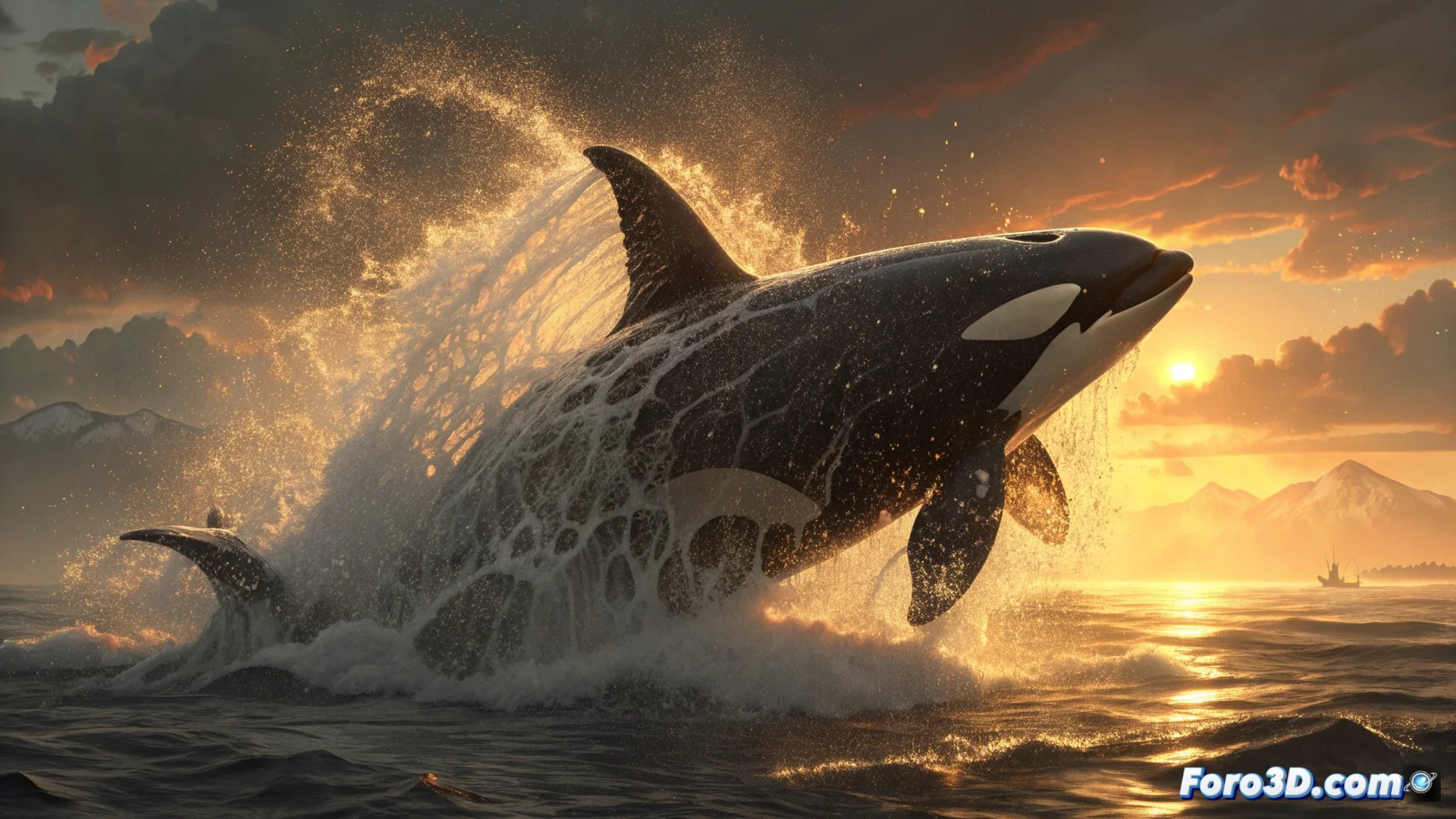
Killer Whale: footage that fuses motion capture and digital animation
The short film Killer Whale stands out for its work in visual effects, where advanced techniques are combined to bring a marine creature to life in a filmed scenario. The team achieves a digital orca emerging from the water with realism that challenges perception, using data from a real actor as the basis for the movement. 🐋
The technical core of the project
To make the animal move credibly, the artists follow a structured workflow. First, a detailed 3D model of the orca is generated. Then, an actor in a special motion capture suit performs the acting within a controlled volume. That data is processed and adapted to the digital model's rig, which is the control system that allows animation.
Key stages in creation:- 3D Modeling: The orca is scanned and modeled with a high level of anatomical detail.
- Motion Capture: An actor performs the sequence, providing the basis for organic movement.
- Adjustment and adaptation: The captured data is cleaned and applied to the rig, with manual adjustments to respect the physics and weight of the animal.
The greatest achievement in VFX is that the audience doesn't even wonder how it was done; they simply believe it.
Integrating the digital with the real
The main challenge is not just animating, but visually integrating the digital element into the filmed plate. The lighting and shading of the model must perfectly match the conditions of the real environment. Additionally, elements like foam, splashes, and the interaction of light with water are simulated, adding complexity and requiring a lot of processing time.
Crucial factors for realism:- Lighting coherence: Matching the lighting and shadows between the digital orca and the original aquatic scene.
- Dynamic simulations: Generating foam, splashes, and particles that interact with the animal's movement.
- Believable physics: Adjusting the animation to convey the sensation of a large body displacing water.
The result: a silent and powerful presence
The project's ultimate goal goes beyond showing an animal. It seeks to convey its physical presence and the inherent force of its movement. In Killer Whale, the digital orca swims on screen with an authority that makes one forget its artificial nature. This short film exemplifies how technology, when applied with precision, can create a complete and convincing visual illusion. 🎬