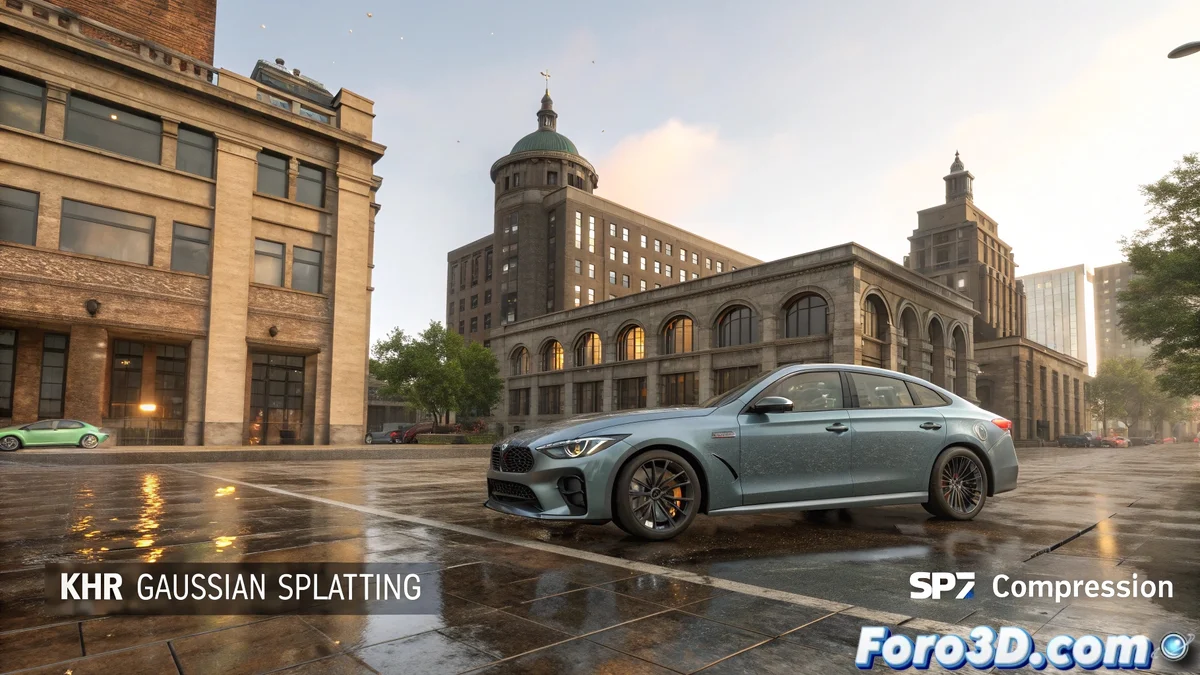
The Revolution of Volumetric Graphics Arrives at the glTF Standard
The Khronos Group, together with the Open Geospatial Consortium (OGC), Niantic Spatial, Cesium (Bentley), and Esri, has announced the inclusion of 3D Gaussian Splats in the glTF standard 🌐. This historic move establishes an interoperable, efficient, and traceable framework for storing and sharing volumetric data with photorealistic quality. Gaussian Splats represent real environments with details that traditional meshes cannot achieve, capturing fine structures, semitransparent materials, reflections, and complex textures through radiance fields.
Game-Changing Extensions
Two critical extensions have been proposed that will transform 3D workflows:
- KHR_gaussian_splatting: Defines how to incorporate splats as point primitives in glTF
- KHR_gaussian_splatting_compression_spz: Enables compression of volumetric splats up to 90%
- Includes attributes such as position, rotation, scale, and transparency
- Support for spherical harmonics for diffuse and specular lighting
- Fallback compatibility to point clouds when necessary
These extensions maintain glTF's philosophy of being open, efficient, and interoperable 🔄.
Technical Advantages and Innovative Use Cases
This integration opens up previously impossible possibilities for modern applications:
- Transport and visualization of complex volumetric scenes on the web
- Geospatial applications with realistic data from real environments
- Augmented reality with seamless integration of volumetric elements
- Video games with advanced atmospheric and lighting effects
- Scientific and medical visualization with precise volumetric data
- Digital preservation of cultural heritage with photographic quality
SPZ compression ensures efficiency without sacrificing visual fidelity, making real-time use viable 🎯.
Impact on the Industry and Workflows
This glTF standard update has profound implications:
- Democratization of advanced graphics techniques
- Unification of formats for volumetric and point cloud data
- Reduction of technical complexity in production pipelines
- Greater accessibility for developers and artists
- Acceleration of extended reality (XR) adoption
- Establishment of best practices for 3D graphics on the web
glTF goes from being the JPEG of 3D to something more like the PNG of fog
Finally, the glTF standard evolves from being the JPEG of 3D to becoming the PNG of volumetric effects. Now you can represent fog, smoke, transparent structures, and complex reflections, all with intelligent fuzzy points that maintain a lightweight footprint... because in the digital world, as in real life, sometimes beauty is in the diffuse details 😅.