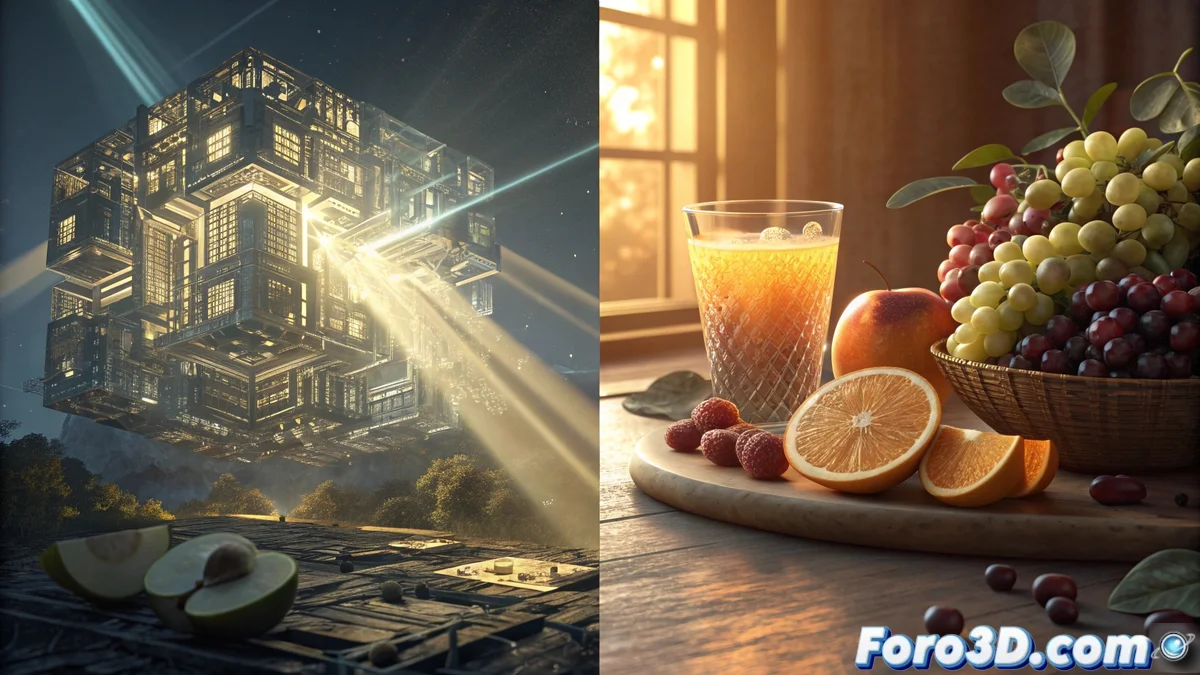
Karma vs Cycles: rendering philosophies in Houdini and Blender
In the world of 3D rendering, two engines stand out for their contrasting approaches: Karma in Houdini and Cycles in Blender. While one adopts a hybrid strategy to distribute workload, the other specializes in pure and precise ray tracing. Understanding their differences helps choose the right tool for each project 🎨.
Core architecture: hybrid vs pure tracing
The main divergence lies in how they process light. Karma, being an XPU engine, is designed to use all system resources. It can distribute work across multiple CPU cores and GPU cards simultaneously. This is key for handling scenes with extreme geometric density, large data volumes, or heavy simulations, typical in high-level productions.
On the other hand, Cycles is based on the ray tracing algorithm. Although it can use the CPU, its optimal performance is achieved by exploiting the massive parallelism of a powerful GPU. This method calculates with great physical fidelity how light interacts with surfaces, offering very precise shadows, reflections, and refractions. Its handling of energy-conserving materials is particularly robust.
Key differences in processing:- Karma (Hybrid): Scales in complex systems, ideal for massive geometry and production environments that require stability with large scenes.
- Cycles (Tracing): Offers pure speed on dedicated hardware, with predictable physical quality and excellent for iterating material designs.
- Resources: Karma balances load between CPU/GPU; Cycles prioritizes GPU computing power to accelerate rays.
Choosing between Karma and Cycles is not just choosing an engine, it's choosing a work philosophy: distributed power versus accelerated physical precision.
Integration into workflow and material creation
The artist's experience is deeply shaped by how the engine integrates into its native software. Karma is part of Houdini's procedural ecosystem. Here, lighting is not a static element; it is manipulated, animated, and connected within node networks, just like any other parameter. To build shaders, artists use VEX or the industry standard MaterialX.
Cycles, on the other hand, is woven into Blender's DNA. Its shading node system is accessible and visual, allowing interactive adjustment of lighting and materials directly in the 3D viewport. This workflow favors quick feedback, where the artist can see changes in real time and avoid surfaces looking artificial or "plastic".
How it affects the artist:- In Houdini/Karma: Light is just another parameter within a complex and powerful procedural graph.
- In Blender/Cycles: Lighting is something adjusted and perfected visually until achieving the desired look.
- Materials: Karma appeals to a technical/programmatic approach; Cycles to a visual and intuitive one.
Conclusion: two paths to realism
Both engines, Karma and Cycles, achieve realistic light simulation, but prioritize different aspects of the rendering process. Karma excels in scalability and handling extreme complexity, being a production tool for studios. Cycles stands out in accessibility, iteration speed, and perfect integration within a unified artistic workflow. The final choice will depend on whether you need to master technical complexity or optimize visual creativity ✨.