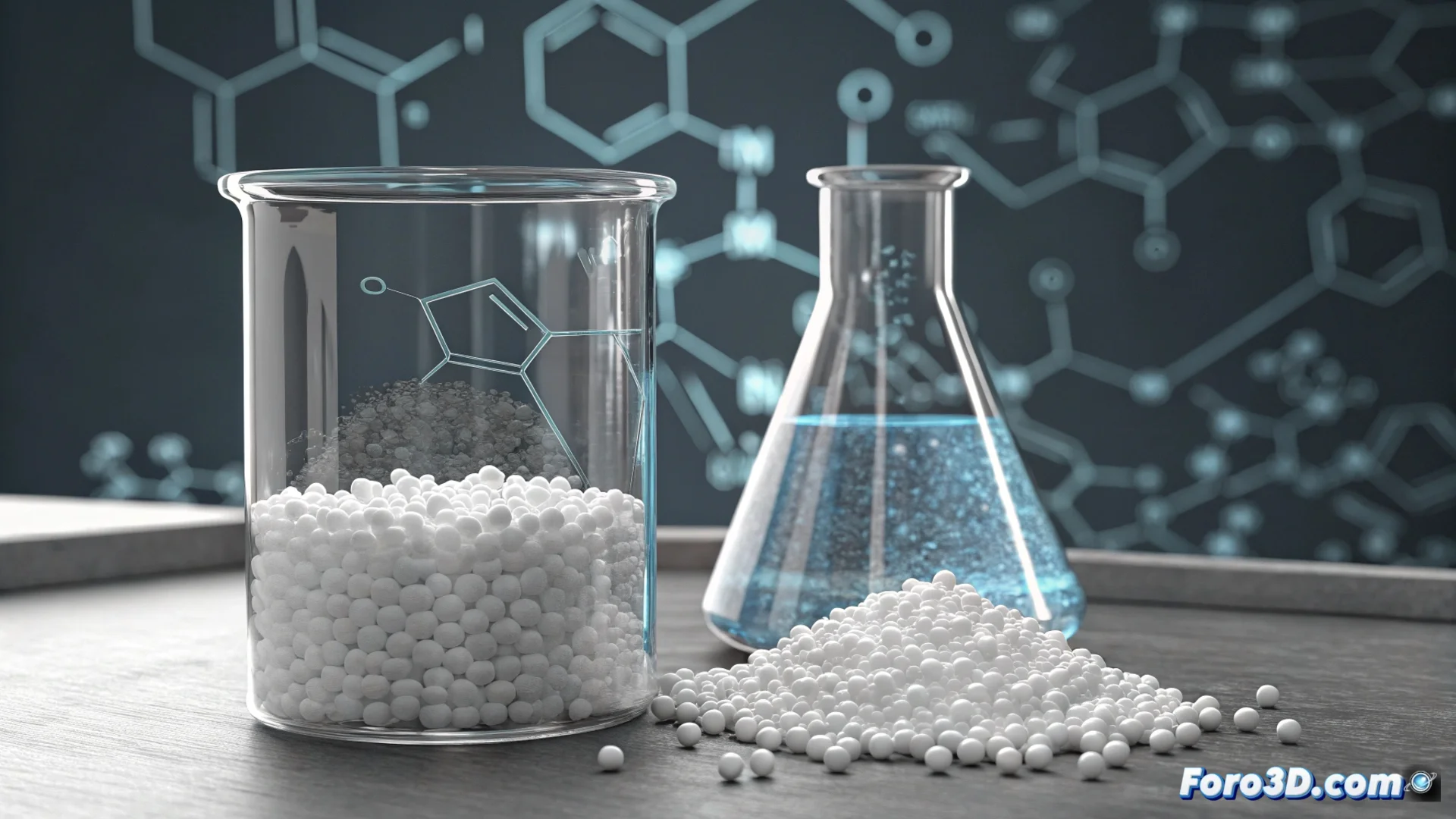
PDK Plastics Enable Unlimited Recycling
Conventional plastics degrade every time they are recycled, limiting their useful life and generating permanent waste. In contrast, ketene dynamic covalent bond polymers (PDK) offer a radical alternative. Their molecular structure is designed to disassemble in a controlled manner under specific conditions, opening the door to true recycling. ♻️
A Chemical Process that Regenerates Raw Materials
Traditional mechanical recycling crushes and melts the plastic, damaging its long polymer chains and reducing its quality. The innovation of PDK plastics lies in a chemical approach. By immersing these materials in a strong acid, their dynamic bonds break in an orderly manner, completely separating the original monomers from any additives or colorants. This allows recovering the basic components in their pure form.
Key Advantages of Chemical Recycling with PDK:- Recover pure monomers, free of contaminants.
- Repolymerize the material without losing mechanical or chemical properties.
- Theoretically, repeat the cycle indefinitely thanks to reversible chemistry.
The PDK approach rebuilds the material from scratch, unlike conventional recycling which only reprocesses it.
Challenges to Move Beyond the Lab
Although the concept is promising, manufacturing PDK at industrial scale still presents considerable obstacles. Current processes for synthesizing these polymers and for depolymerizing them need optimization to be more efficient and less aggressive. The cost of producing these materials far exceeds that of common plastics.
Main Challenges for Implementing this Technology:- Make the chemistry more efficient and reduce production costs.
- Develop specific infrastructures for collecting and processing these plastics.
- Achieve competitiveness in performance and price with established plastics.
The Path to a True Circular Economy
The success of PDK plastics depends on overcoming technical and economic challenges. Their potential to integrate into a circular economy system is enormous, as they could eliminate the concept of plastic waste. However, for now, it remains a laboratory solution that needs to evolve to become a practical and viable alternative in the market. 🔬