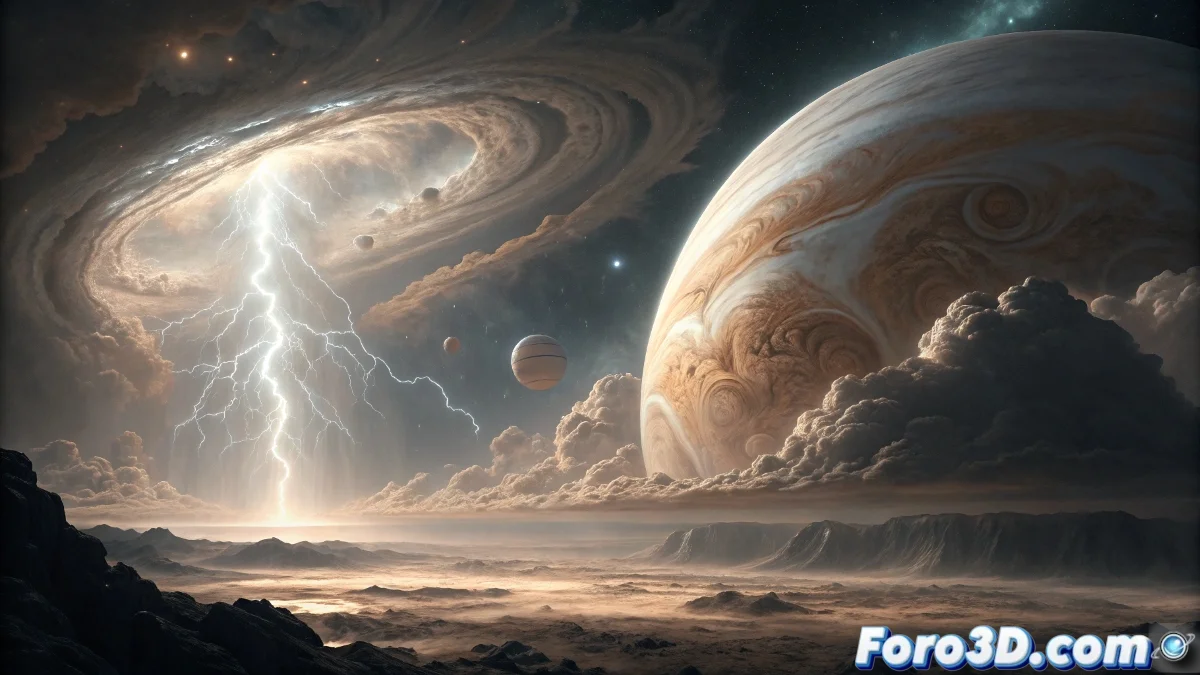
The Diamond Skies of Jupiter and Saturn: When the Universe's Most Valuable Rain Falls on Gas Giants
In the deep atmospheres of Jupiter and Saturn, a phenomenon occurs that seems straight out of science fiction: genuine diamond rains that precipitate toward their cores at astonishing rates. Scientists estimate that approximately 10 million tons of diamonds form and fall annually in these gas giants, creating a unique carbon cycle in the solar system. This extraordinary natural process transforms atmospheric methane into Earth's most precious gems through conditions of pressure and temperature that defy imagination. 💎🌌
Planetary Alchemy: From Methane to Diamond
The process begins in the upper layers of the atmosphere, where powerful lightning storms break down methane (CH₄) into its elemental components. The released carbon forms soot particles that, as they descend through the dense atmospheres, experience incredible pressures that transform them into graphite and then diamond. At depths of approximately 6,000 kilometers, conditions reach pressures 1.5 million times that of Earth and temperatures of 4,000°C — the perfect environment for carbon crystallization.
The Journey of a Carbon Particle
Each diamond undergoes an epic atmospheric cycle that begins as a simple carbon atom and ends as a gem precipitating toward the unknown.
Phase 1: Carbon Release
Lightning bolts a thousand times more powerful than those on Earth break methane molecules, releasing carbon atoms that cluster to form soot particles approximately 1 micrometer in size. These particles initially float in the upper atmospheric layers, where temperatures are relatively "cool" (-150°C).
Phase 2: The Great Transformation
As they descend, the particles experience increasing pressures equivalent to 100,000 Earth atmospheres, transforming the soot into graphite. Continuing their fall, around 5,000 km deep, the graphite undergoes its final metamorphosis into the crystalline structure of diamond under pressures that would instantly crush any earthly material.
Diamond Formation Stages:- Decomposition of methane by atmospheric lightning
- Formation of carbonaceous soot particles
- Transformation of soot to graphite under moderate pressure
- Final crystallization into diamond under extreme pressure
In Jupiter and Saturn, the sky doesn't just rain water — it rains the hardest material known to science, in quantities that would make all Earth's diamond mines combined pale in comparison.
The Final Destiny of the Diamonds
The diamonds continue their descent toward the planet's heart, where temperatures and pressures reach such extreme levels that even these indestructible gems succumb. At depths greater than 30,000 km, the diamonds melt forming an ocean of liquid carbon that surrounds the planetary cores. Some scientists speculate that "diamond icebergs" or even "solid diamond mountains" could form at the interface between different planetary layers.
Differences Between Jupiter and Saturn
Although both planets experience this phenomenon, there are significant variations in how it develops in each world.
Saturn: The Diamond King
Saturn produces significantly more diamonds than Jupiter due to its higher proportion of atmospheric methane and more intense storm patterns. Models suggest that on Saturn, diamonds can reach sizes of up to one centimeter in diameter — genuine gemstones of significant carats falling like cosmic hail.
Jupiter: Smaller but More Abundant Diamonds
Jupiter compensates for its lower production of individual diamonds with a greater total volume due to its colossal size. However, Jupiter's greater gravity means the diamonds melt at shallower depths, having a shorter "life" as solid gems.
Planetary Comparison:- Saturn: Larger diamonds but less total quantity
- Jupiter: Greater total quantity but smaller diamonds
- Both: Final oceans of liquid carbon in their cores
- Possibility of "continents" of solid diamond in deep layers
Scientific Implications and Future Explorations
The study of these phenomena is not just scientific curiosity — it provides crucial information about planetary formation and the evolution of solar systems. Understanding the carbon cycle in gas giants helps model the composition of similar exoplanets detected around other stars.
Space Missions and Detection
The Juno (Jupiter) and Cassini (Saturn) missions have provided indirect data supporting the diamond rain theory. Future missions with more advanced atmospheric probes could directly confirm this phenomenon through deep-penetration spectrometry.
The Human Perspective: Space Mining?
Although the idea of mining diamonds on Saturn seems tempting, the extreme conditions make this possibility practically unfeasible with current technology. The atmospheric pressure at depths where solid diamonds exist is thousands of times greater than what any human-built submarine or probe can withstand.
This eternal diamond rain on Jupiter and Saturn reminds us of the amazing diversity of physical and chemical processes occurring in our solar system, and how the same elements that form life on Earth can create unimaginable wonders on other worlds. The next time you look at Saturn in the night sky, remember that you are contemplating a planet where storms don't just produce lightning — they forge the universe's most perfect gems. 🪐✨