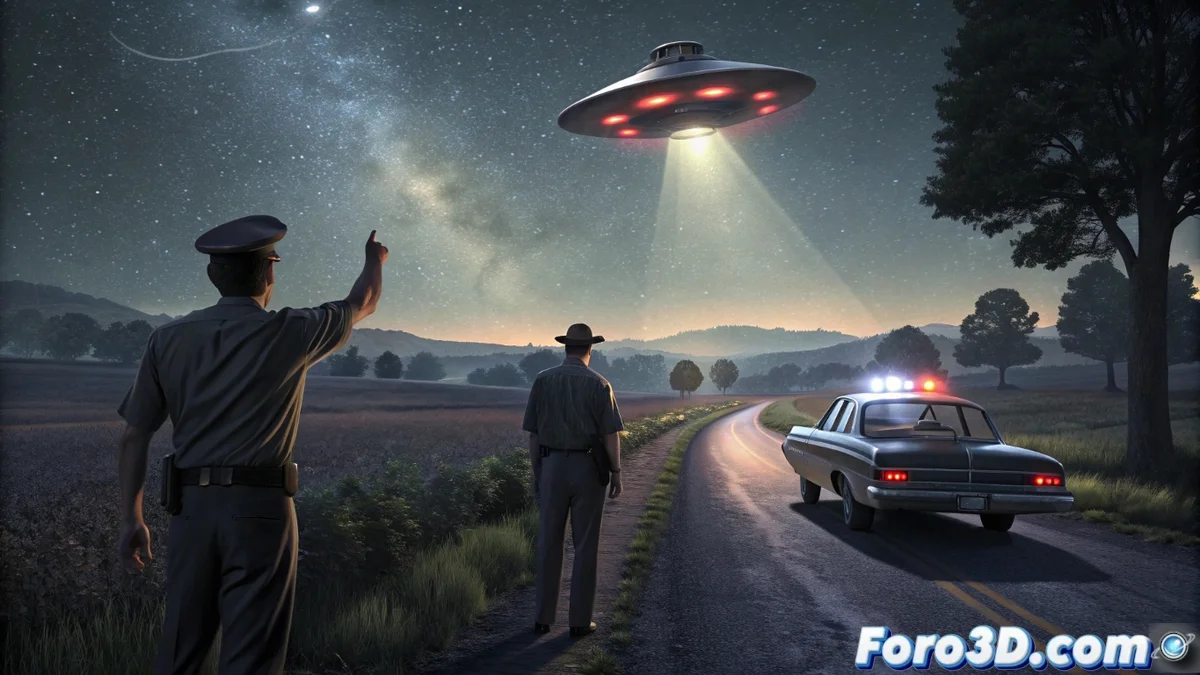
Journalist John G. Fuller and the Exeter UFO Incident
In September 1965, the town of Exeter in New Hampshire was the scene of a series of inexplicable aerial events. 🛸 The journalist John G. Fuller, who had already analyzed the famous Betty and Barney Hill case, decided to investigate these events applying a rigorous journalistic method.
Methodology and Collection of Testimonies
Fuller did not rely on theories, but on meticulously recording the statements of the witnesses. His work, Incident at Exeter, is built from interviewing dozens of people, among whom local police officers stand out. They described objects that flew at low altitude, were completely silent, and emitted high-intensity red lights.
Key characteristics of the reported objects:- Low flight and silent movement, without the characteristic noise of known aircraft.
- Emission of bright red lights that flashed intermittently.
- Ability to move and stop with an agility that surpassed any technology of the time.
Fuller presents these testimonies consecutively, building a collective narrative of what happened.
The Most Significant Encounters
The investigation focuses on the events of the night of September 3. The young Norman Muscarello alerted the authorities about a huge artifact with red lights over a field. Shortly after, officers Eugene Bertrand and David Hunt corroborated the sighting, chasing the mysterious lights in the night sky. Fuller lends credibility to the event due to the number of witnesses and the consistency of their accounts.
Central figures of the incident:- Norman Muscarello: Civilian who gave the first alert after his close encounter.
- Officers Bertrand and Hunt: Agents who visually confirmed the phenomenon and provided technical details about its behavior.
- John G. Fuller: Investigator who documented and organized all available testimonies.
Legacy and Context of Fuller's Work
The book does not attempt to prove or refute an extraterrestrial origin. Its value lies in documenting reported facts, placing the Exeter case within the broad wave of sightings that occurred in the United States in the mid-1960s. Due to its objective tone and focus on ordinary witnesses and authorities, Fuller's work is considered a reference in ufological literature. The case left perplexed agents accustomed to chasing criminals, who found themselves tracking impossible lights in the New Hampshire sky.