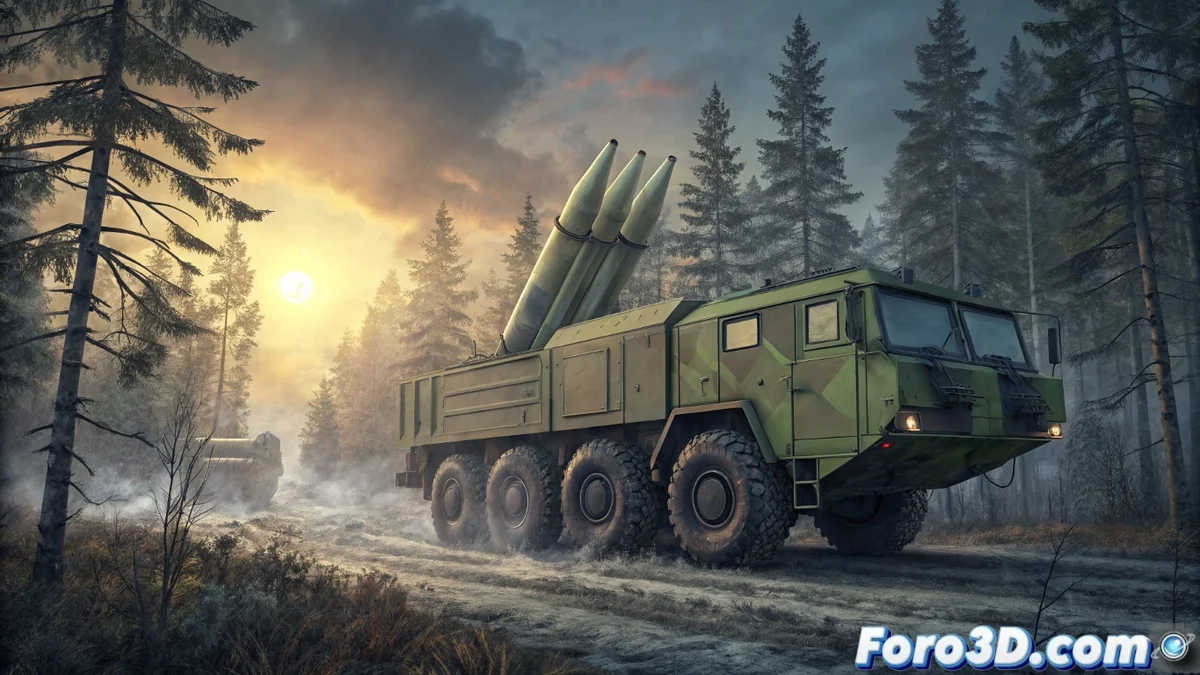
The Iskander Missile System: Mobility and Tactical Precision
Russia deploys the 9K720 Iskander system, designated by NATO as SS-26 Stone. It is a mobile ballistic missile platform designed to operate at short ranges. Its core is a transporter-erector-launcher (TEL) vehicle with 8x8 all-wheel drive, measuring about 13 meters long and providing an autonomous firing base. 🚀
The Mobile Platform and Its Launch Capability
This system is based on a heavy eight-wheeled chassis that can move on roads and rough terrain. Its main function is to carry, prepare, and fire two Iskander-M missiles independently. After launching, the vehicle can quickly withdraw from the area, applying the shoot and scoot tactic to avoid retaliation. Its mobility and short preparation time make it a difficult target to locate and neutralize.
Key features of the launcher vehicle:- 8x8 configuration for high all-terrain mobility.
- Capacity to transport and launch two missiles autonomously.
- Quick operation allowing fire and reposition.
Planning to intercept its unpredictable trajectory is as complex as trying to hit an insect in a dark room.
The Iskander-M Missile and Its Combat Versatility
The Iskander-M missile is the central component. It can be equipped with different types of warheads, providing significant tactical flexibility. Options include conventional fragmentation, thermobaric, or electromagnetic pulse warheads, as well as the capability to carry tactical nuclear payloads. This allows selecting the precise effect on the target, whether critical infrastructure, concentrated troops, or command centers. 💥
Available warhead options:- Conventional warheads (fragmentation, thermobaric).
- Electromagnetic pulse warhead to affect electronic systems.
- Tactical nuclear warhead.
Technical Precision and Operational Range
The system stands out for its reported high precision. It employs a combined guidance system that integrates inertial navigation with terminal correction, either by satellite signals or optical guidance. This reduces the circular error probable (CEP) to a minimum margin, even at its maximum operational range. According to international treaties, its official range is nearly 500 kilometers, although external analyses suggest it could exceed this figure. The missile follows a complex quasi-ballistic trajectory specifically designed to evade and overcome enemy anti-missile defenses, making interception very difficult.