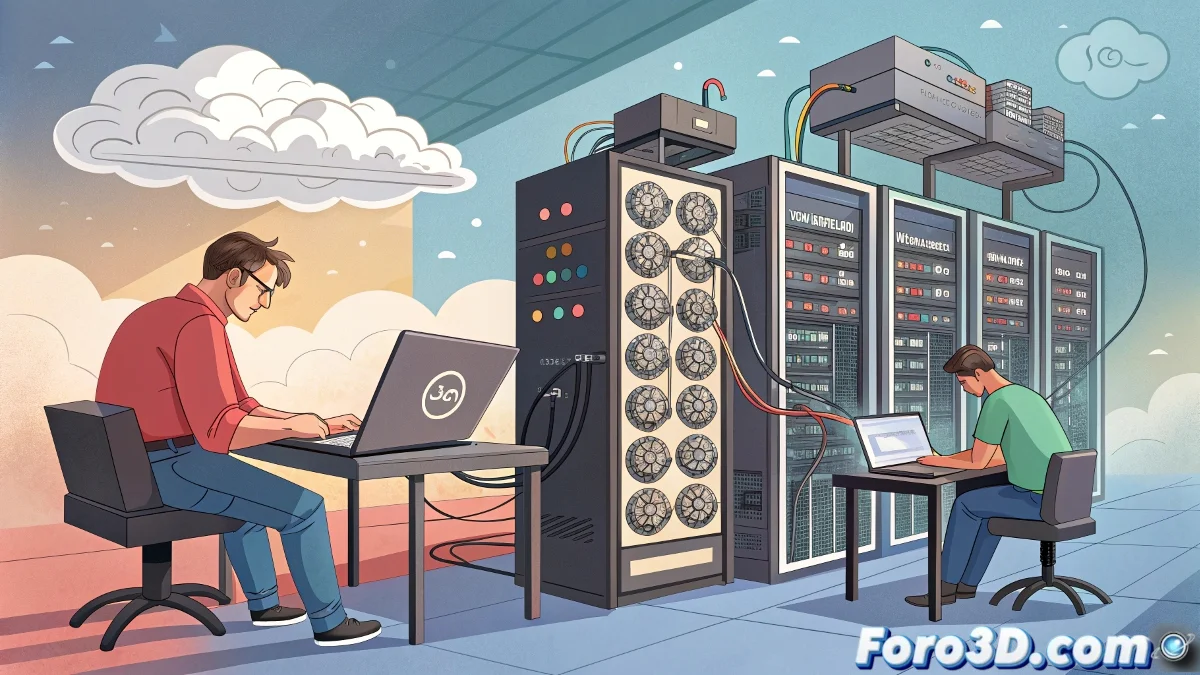
When the cloud competes with your workstation
The decision between investing in local hardware or migrating to cloud render services has become especially relevant in a context of accelerated technical obsolescence and constantly fluctuating component costs. While a decade ago having a local render farm was the standard for professional studios, today cloud services offer capabilities that rival - and in many cases surpass - the most powerful local configurations. This transition represents not only a technical change, but a fundamental transformation in how we conceive production infrastructure in creative industries.
What makes this analysis particularly complex is the dynamic nature of both costs: the accelerated depreciation of hardware and the constant evolution of cloud prices. A high-end workstation can lose up to 40% of its value in the first year, while cloud providers continue to optimize their rates and add capabilities without requiring initial investment from the user. This asymmetry creates a scenario where the traditional ROI calculation must be completely reconsidered.
Critical advantages of cloud rendering
- Elimination of accelerated hardware depreciation
- Ability to scale resources according to project demands
- Access to cutting-edge hardware without initial investment
- Reduction of energy and maintenance costs
The economics of computational elasticity
The cloud model introduces the concept of computational elasticity that transforms fixed costs into variable ones. Where previously a studio needed to invest in hardware capable of handling its most demanding project - leaving capacity idle most of the time - now it can pay only for the resources it uses when it needs them. This shift from capex to opex is particularly valuable for studios with variable workloads, projects of different scales, or those experiencing seasonal production peaks.
In the cloud, you pay for power when you need it; locally, you pay for power in case you need it.
The hidden costs of local hardware often underestimate the true total cost of ownership. Beyond the initial price of graphics cards and processors, electricity (especially relevant with rising rates), cooling, physical space, maintenance, upgrades, and the opportunity cost of time dedicated to system administration must be considered. When all these factors are added up, the appeal of outsourcing these concerns to specialized providers becomes considerably more persuasive.
Scenarios where local hardware still makes sense
- Studios with constant and predictable workflow
- Projects with extreme security and confidentiality requirements
- Locations with limited or unstable internet connectivity
- Need for minimal latency in interactive work
For most contemporary studios, the optimal answer probably lies in a hybrid approach that combines the best of both worlds. Maintaining powerful local workstations for interactive tasks, previewing, and daily work, while using the cloud for final renders, complex simulations, and production peaks. This strategy allows optimizing costs while maintaining the flexibility necessary to adapt to changing project demands. The key is to conduct an honest analysis of specific usage patterns and calculate the break-even point where hardware investment ceases to make financial sense. 💻
And so, between remote servers and local graphics cards, we discover that the smartest decision is not to choose one extreme, but to find the perfect balance between immediate control and infinite scalability - although we probably still need to explain to the accountant that sometimes paying for what you don't see can be more profitable than owning what you touch. ☁️