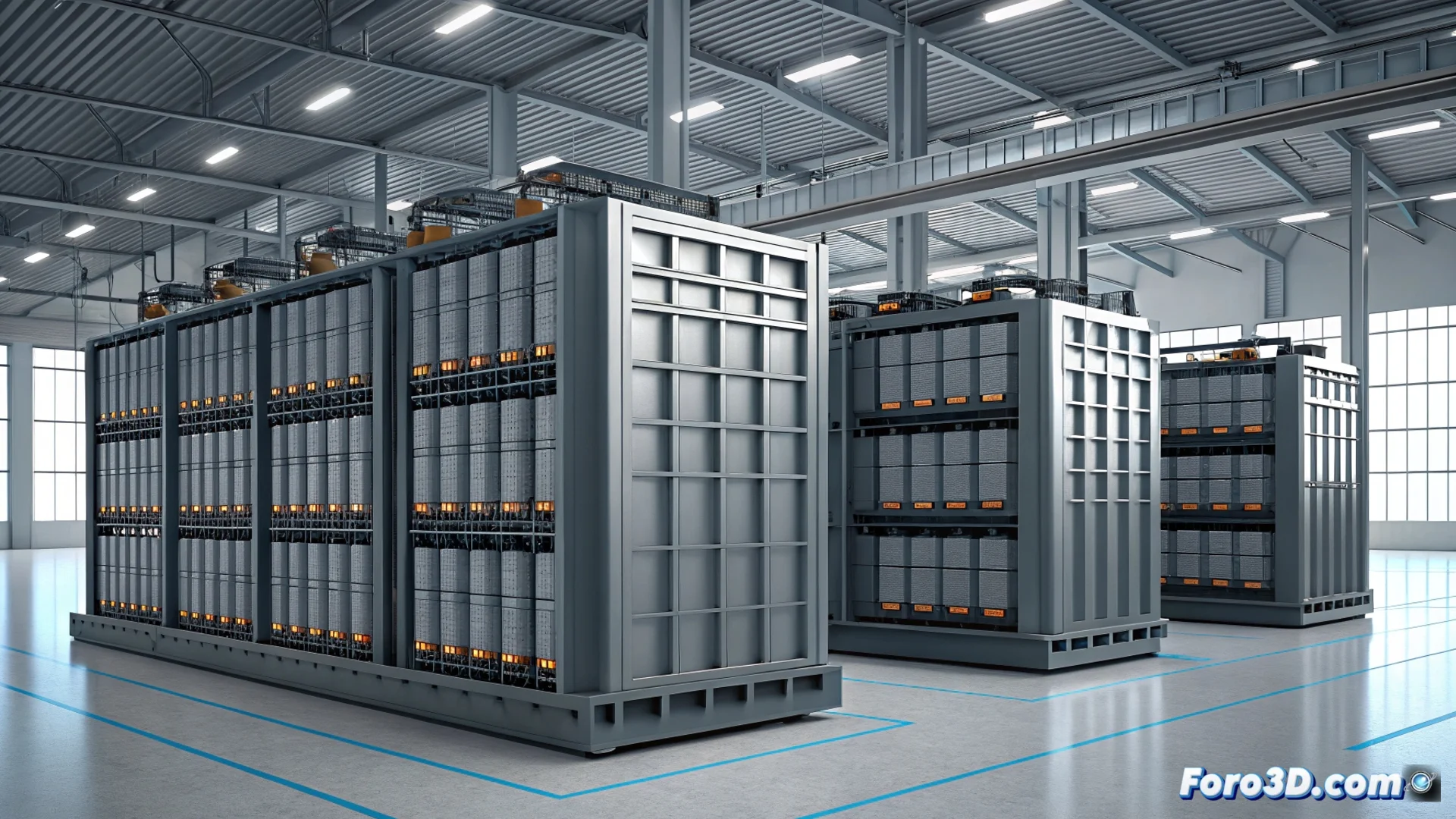
Iron-Air Batteries: An Alternative for Energy Storage
In the search for systems to store energy on a large scale, iron-air batteries emerge as a technical option distinct from those based on lithium ions. Their fundamental principle is to oxidize iron particles with ambient oxygen to release electrons and produce electricity. When recharging, this electrochemical process is reversed, regenerating metallic iron. This cycle leverages common and inexpensive materials, which can significantly reduce costs. ⚡
Components and Electrochemical Operation
The design of these cells is remarkably straightforward. A metallic iron anode acts as the negative electrode. The positive cathode is a porous structure that allows air to enter and oxygen to react. An alkaline aqueous electrolyte completes the assembly. During discharge, the iron oxidizes to ferric hydroxide, releasing electrons that flow through an external circuit. To recharge, electrical current is applied to reverse the reaction and recover pure iron. This mechanism avoids reliance on critical metals like cobalt or nickel.
Key advantages of the system:- Uses abundant and low-cost materials, mainly iron.
- Offers a very high theoretical energy density.
- Its chemistry is inherently safe and non-flammable.
Its main competitor is not lithium, but the simple fact that iron oxidizes by itself in the garage if you leave it forgotten.
Application in the Energy Sector
The characteristics of this technology orient it primarily toward stationary storage. They are ideal for balancing electrical grids with high penetration of intermittent renewable sources, such as solar or wind. Their low cost per capacity allows for the installation of large-scale systems to store energy for extended periods, from days to weeks. However, their specific power is limited and the charge-discharge cycle is slow, making them impractical for use in electric vehicles.
Current development challenges:- Optimize the practical efficiency of the complete cycle.
- Improve response speed and power delivered.
- Solve issues like electrolyte degradation over time.
Future and Technological Development
Several companies and research centers are actively working to overcome current obstacles, such as efficiency loss after multiple cycles. The ultimate goal is to create a robust and durable system that can offer a viable and economical alternative for managing the electrical grid. Although they face performance challenges, their potential to store large amounts of energy economically positions them as a technology to watch closely in the energy transition. 🔋