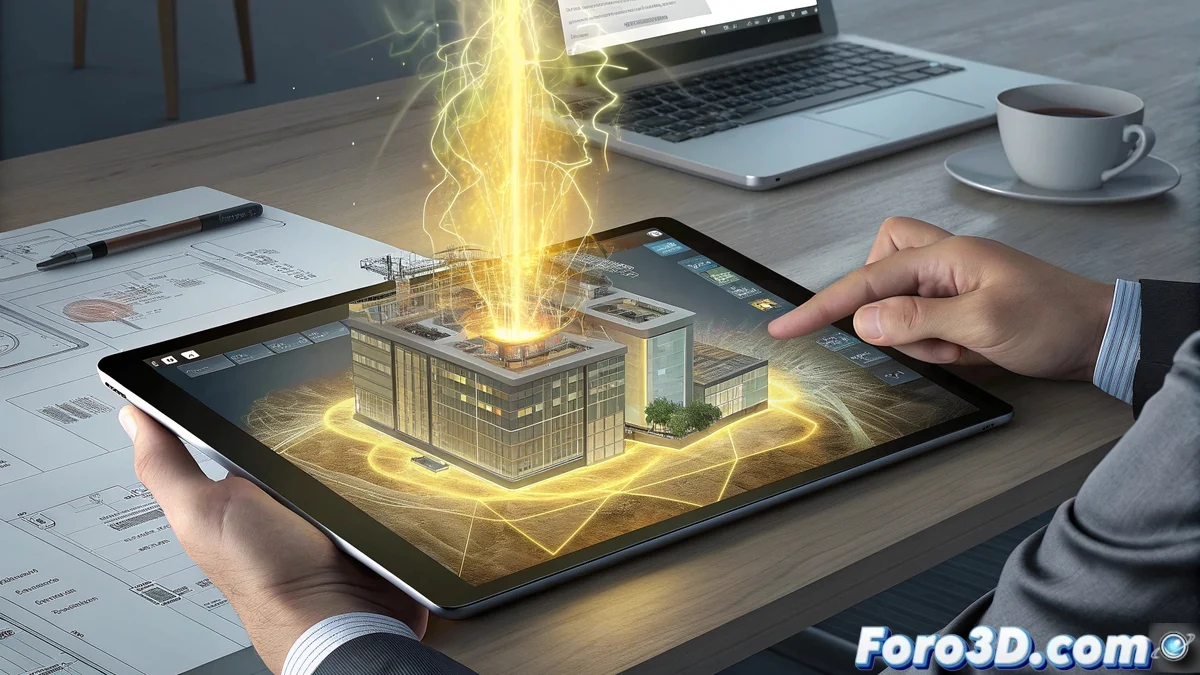
The Mobile Promise of Professional Power
Apple is preparing to launch the iPad Pro with M5 chip, promising a level of performance that challenges conventions between mobile devices and traditional workstations. For the Foro3D community, the crucial question is not whether it can run basic applications, but whether it can truly integrate into professional 3D modeling, animation, and rendering workflows. A realistic evaluation beyond corporate marketing.
Raw Power versus Software Ecosystem
The M5 chip undoubtedly represents a significant leap in processing and graphics capabilities, with faster cores and better energy efficiency. However, the 3D professional user's experience depends as much on the software ecosystem as on the underlying hardware. Applications like Shapr3D and uMake offer impressive capabilities for on-the-go modeling, but lack the functional depth of their desktop equivalents.
Advantages for the Mobile Artist
- Absolute portability for sketches and concepts
- Apple Pencil precision for digital sculpting
- Improved performance for native applications
- Seamless integration with other Apple devices
Limitations for Professional Production
Where the iPad Pro M5 encounters its most significant barriers is in managing complex scenes, heavy rendering, and workflows that require multiple specialized applications. The absence of full software like Maya, 3ds Max, or Cinema 4D, combined with memory and storage restrictions, creates an invisible ceiling for ambitious projects.
Realistic Use Cases
- Concept development and previews
- Digital sculpting and organic modeling
- Client presentations and demonstrations
- Light composition and on-the-go adjustments
A device that expands the possibilities of mobile work but, for now, complements rather than replaces the traditional workstation for 3D professionals.
For studios and independent artists, the iPad Pro M5 could represent the perfect tool for the initial phases of projects and work outside the studio, while computationally intensive tasks continue to be delegated to dedicated workstations. This strategic division of work leverages the best of both worlds 💻.
And that's how we end up with a device more powerful than many desktop computers, mainly used for zooming with two fingers trying to select that elusive vertex... because no matter how much M5 chip it has, some mobile interfaces are still as practical as operating a tank with boxing gloves 😅.