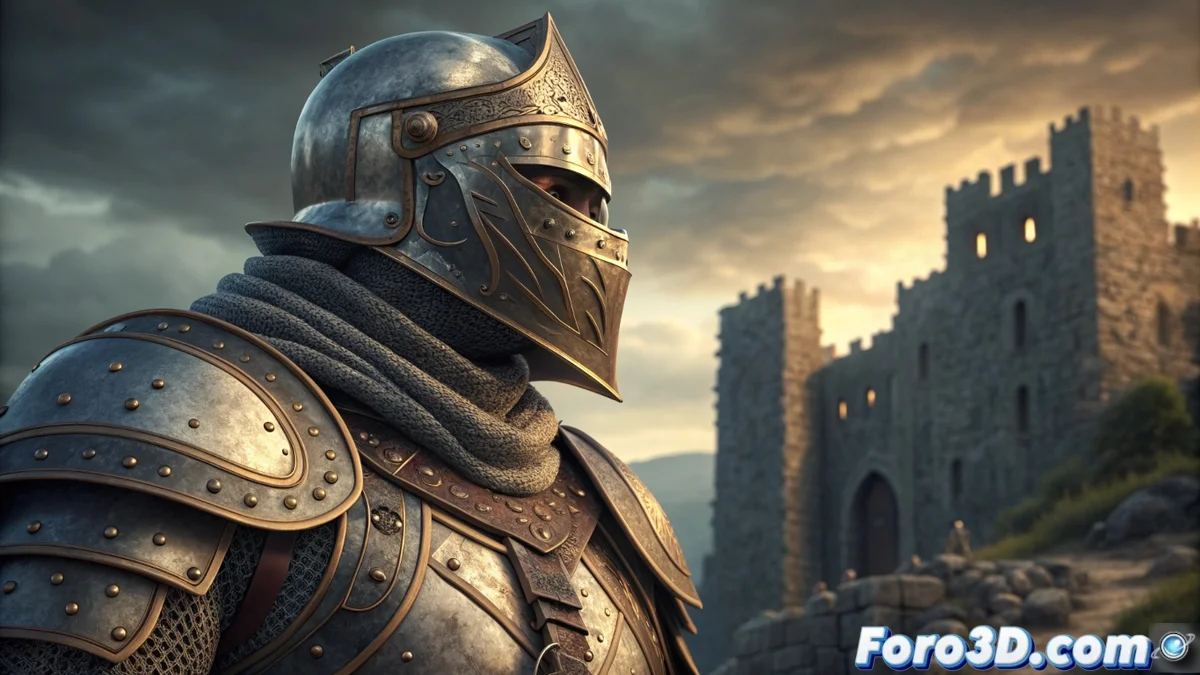
Involuntary Anachronistic Design: When Aesthetics Clash with the Era
In the creation of digital worlds for film, video games, or animation, there exists an imperceptible slip that can fracture the fictional reality. This is involuntary visual anachronism, a phenomenon where aesthetic languages inherent to a specific technology or decade infiltrate a temporally foreign context without artistic justification. This unintentional mix generates a subtle dissonance that the viewer's brain detects, weakening the magic of immersion. The tool, sometimes, speaks louder than the story. 🎭
The Indelible Mark of Technology
This aesthetic clash does not arise from a lack of skill, but from the powerful cultural association generated by certain technical styles. Each era of software and hardware leaves a visual signature that is almost impossible to erase. A 3D model with topology and normal flow typical of the mid-2000s, placed in an environment seeking to emulate 90s 2D art, produces a short circuit in our perception. The same happens with post-production effects like a very specific lens flare or a particular color grading, which became engraved as the distinctive seal of a generation of consoles or software suites. The tool transcends its function and becomes loaded with deep temporal meaning. 🔧
Examples of anachronistic technical marks:- Shaders and lighting: The use of hyperrealistic Physically Based Rendering (PBR) in a project narrating an 80s story, where light was flat and materials had a more painterly look.
- Mesh topology: Characters with polygon density and retopology style characteristic of an era, visible in folds and deformations, within a visual style intended to be timeless.
- User interfaces (UI): HUD elements or menus that unwittingly replicate the skeuomorphic design of certain old operating systems, in a far-future science fiction narrative.
"Involuntary anachronism is the ghostly echo of the technology used, a reminder that every digital brush leaves its texture in time."
The Paradox Between Progress and Imitation
Technical evolution is swift, but assimilating a mature visual language for new tools takes time. It is common to see projects that, when adopting cutting-edge technology, unconsciously drag aesthetic and compositional solutions from the previous stage. It is the paradox of using a latest-generation rendering engine to produce, unintentionally, the plasticky feel and lack of micro-detail from a decade ago. On the contrary, attempting to recreate a nostalgic aesthetic with modern means can fall into excess perfection, losing the rough, grainy, and technically limited essence that defines authentic nostalgia. Anachronism arises when one fails to distinguish between an essential stylistic element of an era and what was merely an accident or limitation of its technology. ⏳
Common manifestations of this paradox:- Futurism with a whiff of the past: Advanced science fiction scenarios that, through their bluish metallic color palettes and typography, inevitably evoke the corporate aesthetic of the early 2000s.
- Anachronistic perfection: Representations of ancient or medieval eras where fabrics, armors, and materials have a level of detail and reflectivity that betrays a contemporary texturing and rendering process, breaking the historical illusion.
- Technological transitions: Digital 2D projects imitating traditional animation, but where the "boiling" or line tremble is too uniform and perfect, losing the organic character of hand-drawn art.
Consequences and Creative Awareness
The final result of this phenomenon can be a perceptual disconnection in the audience, sometimes perceived unconsciously as a lack of "authenticity." It is the visual equivalent of finding a smartphone in a Renaissance painting; the incongruity breaks the spell. To avoid it, it is crucial to develop an historical awareness of tools. Artists and studios must actively reflect on which set of visual decisions (palette, contrast, lighting style, texture treatment) genuinely define the era or style they want to evoke, and which are simply habits or marks of the technology they are using. Aesthetic coherence is as important a pillar as the narrative, and requires intentional design that transcends the mere functionality of the current software. 🧠