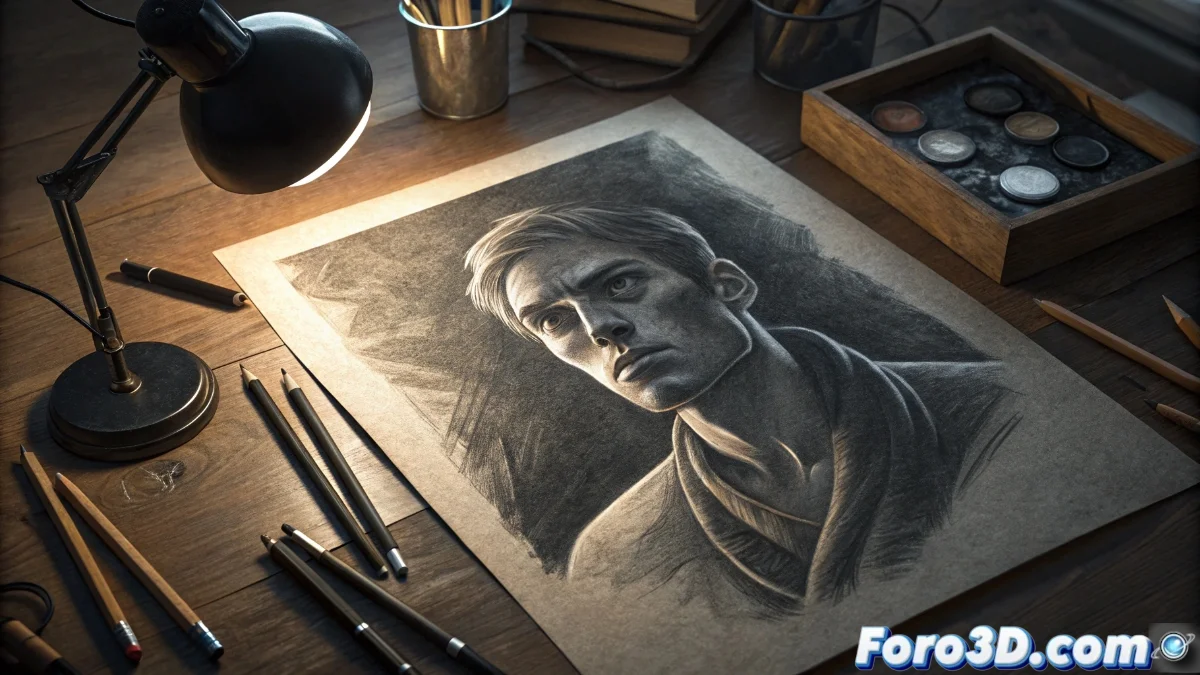
Light and Shadow Inversion in Advanced Drawing
This revolutionary technique completely transforms our way of interpreting visual reality, forcing us to reprogram our established mental schemes. By systematically swapping light areas for dark ones and vice versa, we activate different cognitive processes that enrich our formal analysis capacity 🎨.
Practical Implementation Methodology
To get started with this transformative method, we must carefully select photographic references with well-defined lighting and marked contrasts. The mental process begins by visualizing the inverted image before executing the stroke, whether on physical or digital support. Tonal coherence is fundamental even though the values are swapped, preserving gradual transitions between lights and darks. Experts advise progressing from elementary geometric shapes to more elaborate organic structures 🔄.
Recommended Learning Phases:- Initiation with basic volumes like spheres and cubes to understand the fundamental principles
- Progressive transition to everyday objects with varied surfaces and different textures
- Advancement to anatomical forms and natural elements with complex lighting and multiple planes
True mastery in light inversion arrives when the brain automatically processes forms without relying on pre-established visual conventions
Impact on Artistic Growth
This challenging exercise generates noticeable advances in our observation and analysis skills, freeing us from automated visual patterns. By subverting traditional representations, the creator gains a deeper understanding of light anatomy and its interaction with different materials. Benefits include more accurate volumetric representation, superior contrast handling, and refined mastery of techniques like chiaroscuro. Continuous practice also enhances our mental previsualization capacity for complex scenarios 🚀.
Documented Specific Advantages:- Significant increase in precision for capturing light subtleties and tonal transitions
- Development of a sharper three-dimensional vision and ability to decompose complex forms
- Substantial improvement in texture representation and light behavior on different surfaces
Permanent Perceptual Transformation
The curiously fascinating thing about this practice is that, once internalized, it begins to alter our everyday perception. Many experienced artists report episodes where they visualize light inversions in ordinary situations, noting shadows where there is light in non-artistic contexts. This phenomenon demonstrates how intensive visual training can permanently reconfigure our perceptual processes, creating a deeper connection with the very essence of form and light ✨.