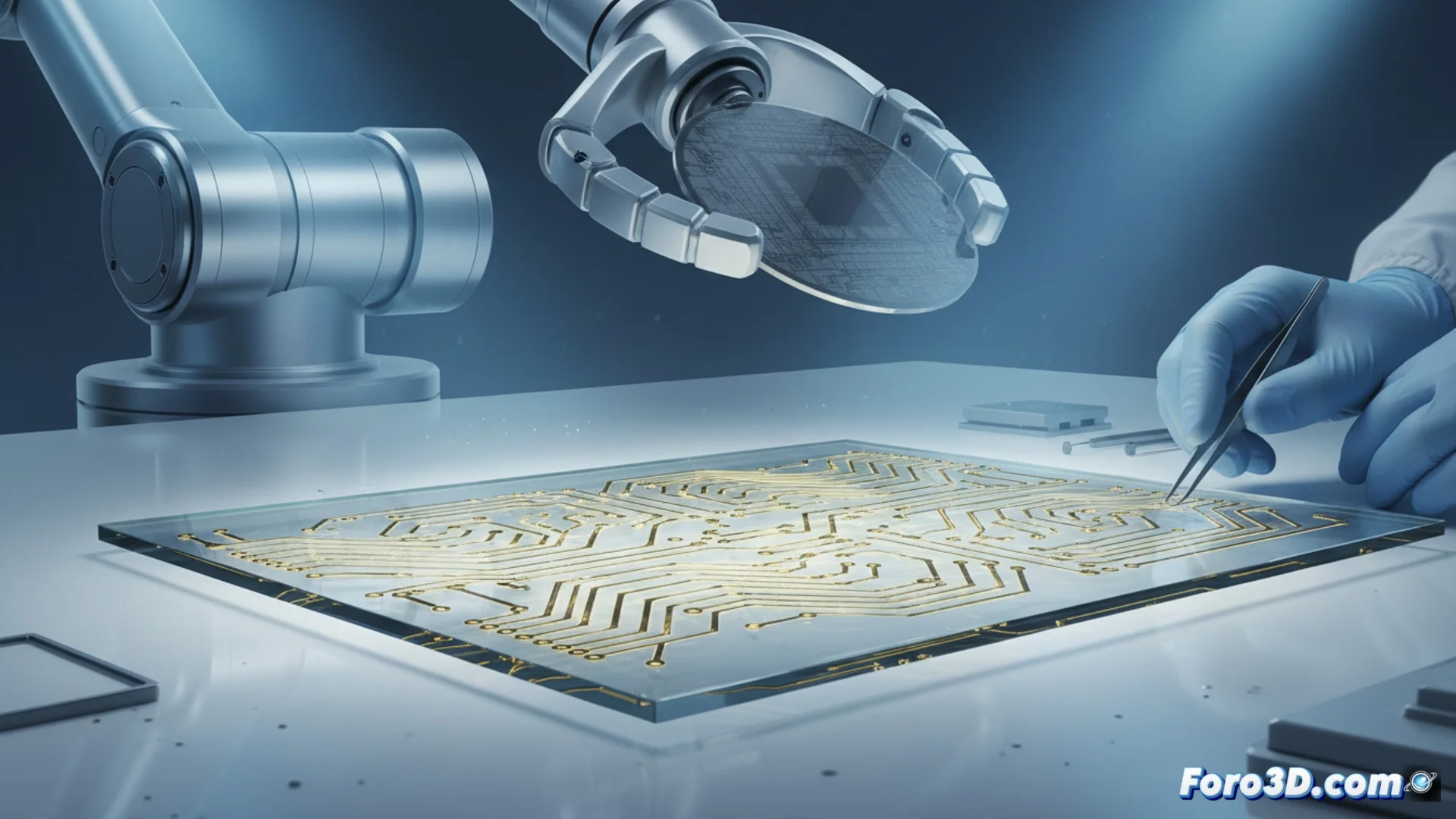
Intel Presents Its Glass Substrate Technology at Nepcon Japan 2026
The company Intel has unveiled its new glass substrates proposal at the Nepcon Japan 2026 event. This development arises to meet the growing demand for manufacturing integrated circuits with higher density and power, especially aimed at AI accelerators and the field of supercomputing. The technology enables packaging more elements in a single unit, helping processors manage complex tasks more efficiently. 🚀
Key Technical Advantages of Glass Substrates
This innovative solution uses glass as the base material, replacing traditional organic or ceramic substrates. Glass exhibits superior physical properties, such as improved dimensional stability and exceptional flatness. This allows manufacturers to design thinner interconnection tracks and place transistors in closer proximity.
Main benefits of this technology:- A wider bandwidth is achieved for data transfer.
- Latency is reduced in communication between different chip cores.
- Performance can be increased without excessively expanding the physical size or energy consumption.
Glass substrate technology marks a turning point for packaging ultra-high-performance chips, enabling previously impossible densities.
Focus on Artificial Intelligence and Supercomputing
Intel directs this novelty primarily toward the segment of AI accelerators and supercomputers. Circuits using these substrates will be able to house a greater number of processing cores and fast memory in a compact space.
Critical applications enabled:- Training large-scale and complex artificial intelligence models.
- Simulating scientific phenomena that require enormous computing power.
- Scaling computational performance while keeping energy consumption under control.
Future Outlook and Considerations
This technical advancement lays the foundation for the next generation of high-performance processors. The ability to integrate more components efficiently is essential to keep pace with the demand for power in AI and HPC. The pending challenge will be ensuring that the manufacturing cost of these futuristic chips does not excessively impact their final price for the user. 💡