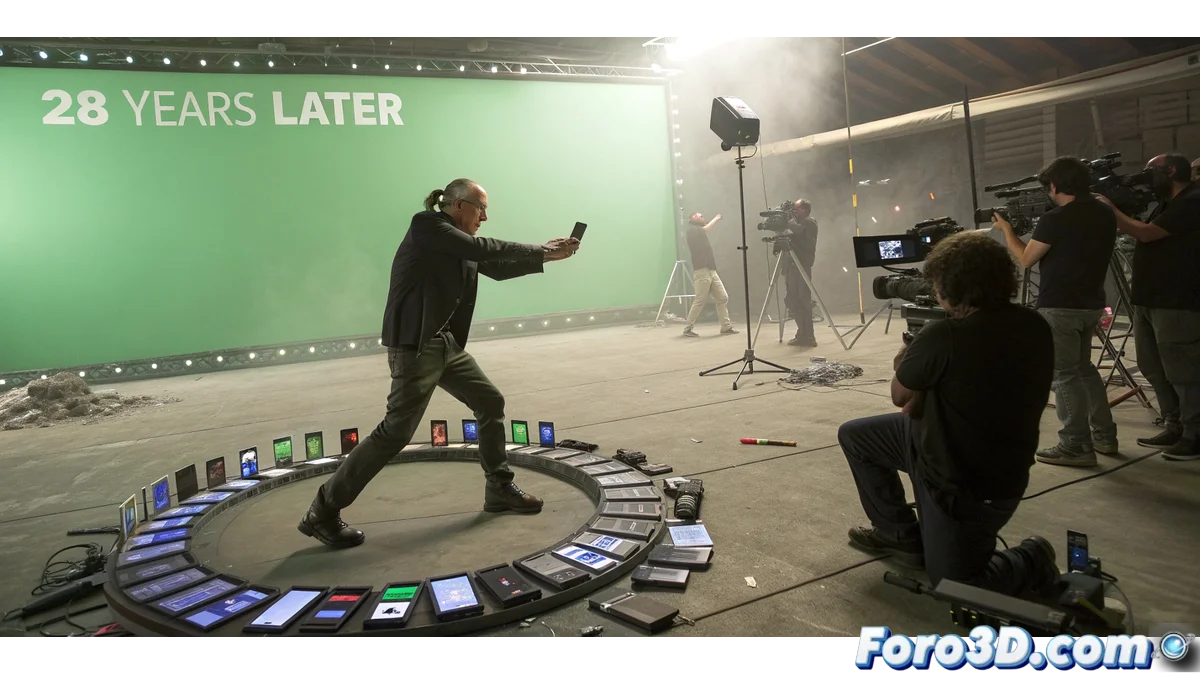
Revolutionizing Horror with Pocket Technology 📱
The new installment in the saga, 28 Years Later, combines tradition and technology in a surprising way under the direction of veteran Danny Boyle. In a nod to the homemade style of the original 28 Days Later—filmed with a miniDV digital camcorder—Boyle now uses a rig of up to 20 iPhones to capture key scenes with innovative visual storytelling. This modern approach keeps the saga's digital legacy alive while adapting it to the present, demonstrating that technical innovation can arise from accessible tools.
Pocket Bullet Time with Circular iPhone Rig
Boyle describes his setup as pocket bullet time. Arranging up to 20 iPhones in a semicircle, the team captures 180-degree sequences that allow selecting different angles during editing and generating dynamic scenes of shocking violence. This approach not only reduces costs compared to traditional camera systems, but also offers unprecedented creative flexibility—each iPhone functions as an independent camera, providing multiple perspectives of the same action in real time. 🎬
Ultra Panoramic Format for Expanded Tension
The film bets on an ultra panoramic format of 2.76:1, similar to that of classic 70mm films but with a modern twist. This extremely wide frame:
- Expands the visual field horizontally, forcing the viewer to constantly scan the screen
- Reinforces the sensation that the threat can emerge from any corner of the frame
- Creates compositions that are asymmetrical and charged with narrative tension
- Pays homage to past eras while filming with contemporary technology
The choice is not just aesthetic; it is structurally linked to the narrative of paranoia and omnidirectional danger.
When the format forces the eye to search for danger, horror becomes an active experience, not passive.
Mobility and Technical Challenges
The choice of iPhone was not merely aesthetic—it allowed mobility and agility in remote locations like wild Northumbria. However, it presented significant technical challenges:
- Automatic stabilization that complicated tracking in post-production
- Precise synchronization between multiple devices
- Massive data management from 20 simultaneous streams
- Color consistency between different iPhone sensors
The team resolved these issues with flexible solutions in the pipeline, including custom software and manual adjustments.
Digital Legacy and Technological Irony
It is deeply ironic that what began as a low-budget homemade effect—the miniDV camcorder from the first 28 Days Later—has become a modern digital luxury thanks to the device we all carry in our pocket. The evolution reflects not only technological advances, but also a creative philosophy: using accessible tools to achieve powerful cinematic results. Where there was once one camera, now there are twenty; where there was once digital grain, now there is 4K resolution; but the spirit of innovation within constraints remains identical.
In the end, the true zombie is not the infected on screen, but the idea that expensive equipment is needed to make innovative cinema. Boyle proves it: sometimes, the best camera is the one you already have... multiplied by twenty. 😅