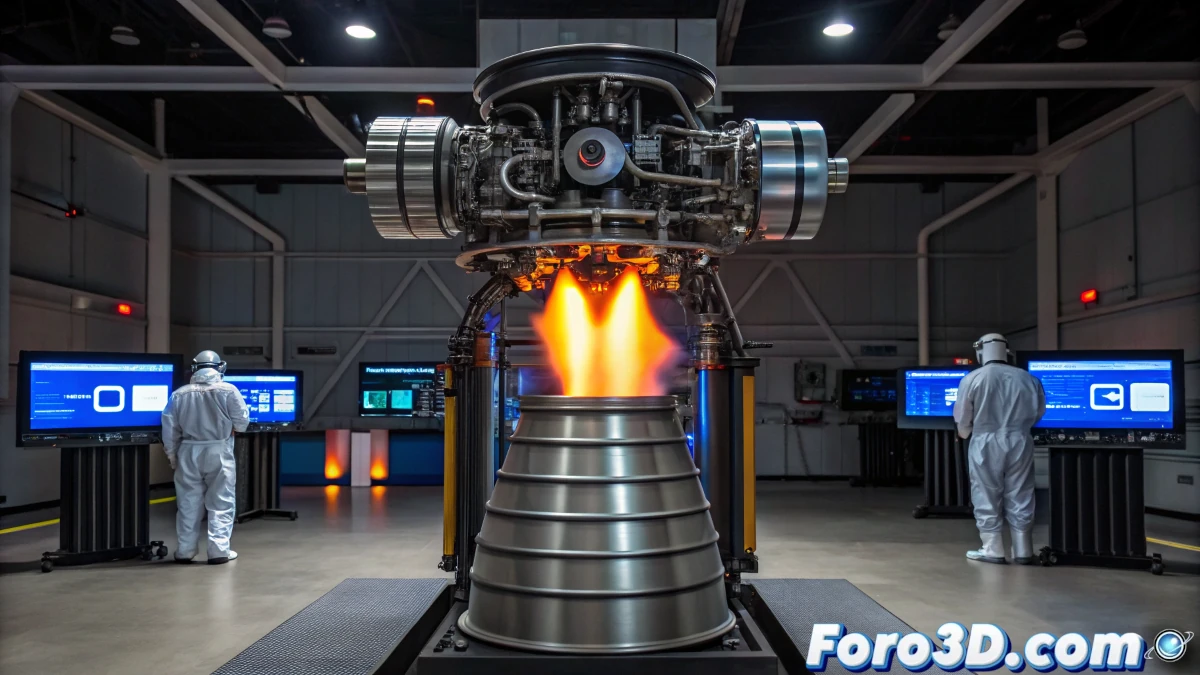
The advancement of 3D printing in space exploration
The aerospace industry continues to evolve with new technologies that enable improved efficiency and reduced costs in rocket manufacturing. Among these advances, 3D printing has taken on a key role, facilitating the production of lighter and more resistant components.
An engine with adjustable thrust
A team of engineers has developed a rocket engine with the ability to modify its thrust level in real time. This feature is fundamental for adjusting the speed and trajectory of a spacecraft in different phases of a space mission, ensuring greater precision in its maneuvers.
“The use of 3D printing in the manufacturing of space engines opens the door to a new era of efficiency and adaptability.”
3D printing as a solution in space propulsion
The inclusion of a 3D printed combustion chamber has been a determining factor in this development. This piece incorporates an optimized cooling system that improves the engine's stability and extends its operating time during tests.
- Weight reduction: lower total mass without compromising strength.
- Greater control: thrust adjustments over a wide power range.
- Efficient production: fast manufacturing with less material waste.
Successful tests and optimized performance
During multiple trials, the engine has demonstrated stable performance at different thrust levels, overcoming technical challenges associated with variable combustion. This represents a significant advancement for its integration into future space missions.
The future of propulsion with 3D printing
This development is an example of the impact of additive manufacturing on space exploration. With the ability to create more flexible and efficient engines, this technology positions itself as a viable alternative to improve rocket performance in scientific and commercial missions.