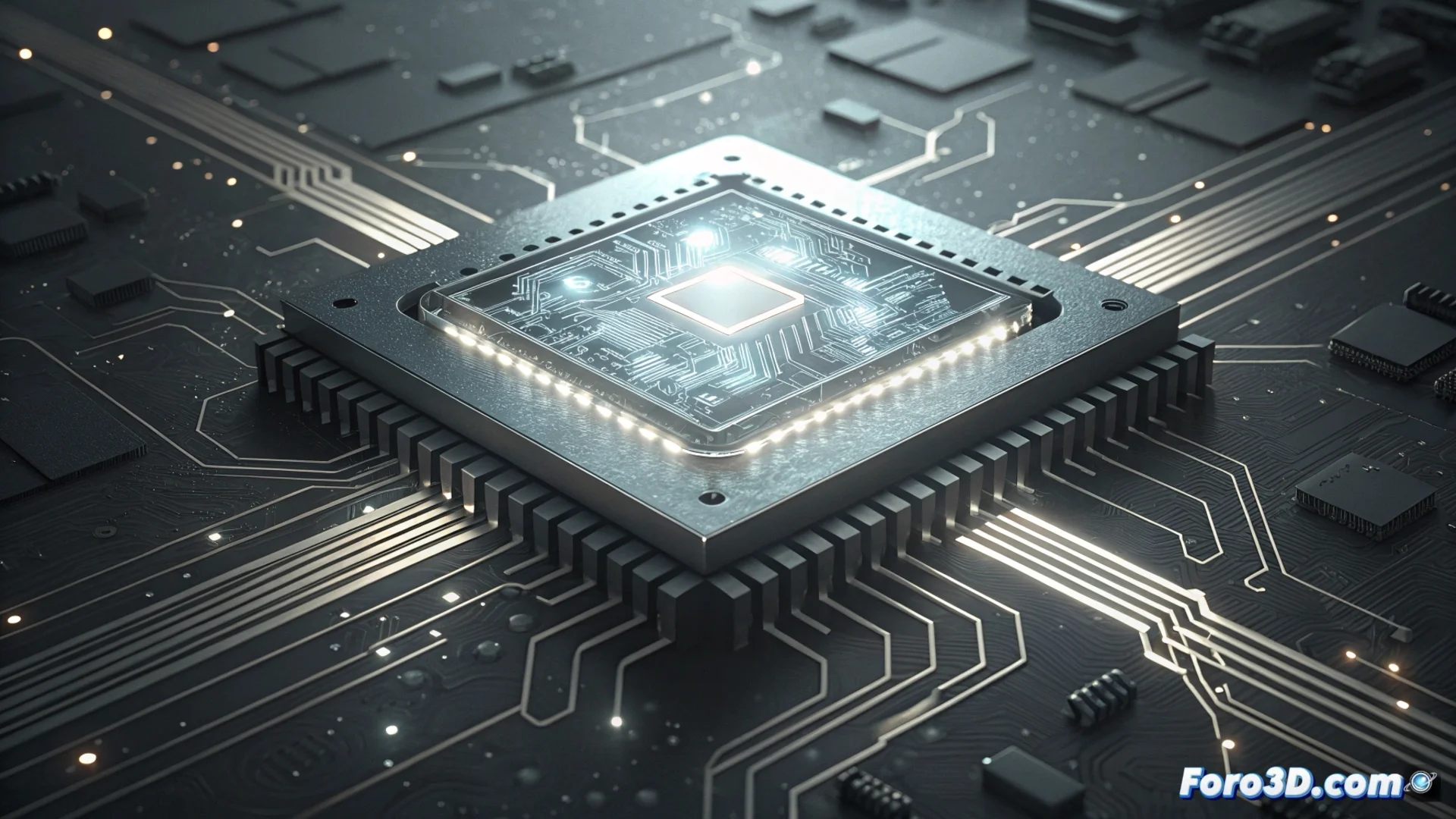
In-Memory Analog Computing Reduces AI Energy Consumption
The in-memory analog computing (AiMC) architecture redefines how systems execute artificial intelligence tasks. Instead of constantly moving data between memory and the central processing unit, these specialized circuits compute directly within the memory. This shift addresses the main efficiency problem in modern chips: the enormous energy expenditure on transporting information. 🚀
The Fundamental Principle of AiMC
The technical foundation of this technology uses non-volatile memory cells, such as ReRAM or PCM, to perform mathematical operations analogically. The weights of a neural network are programmed as conductance levels in a matrix. By applying input voltages, Ohm's and Kirchhoff's physical laws naturally perform massive multiplication and accumulation. This parallel process avoids digitizing and moving each data point, saving a huge amount of energy and time.
Key advantages of in-memory processing:- Extreme efficiency: Systems can operate with a fraction of the power used by traditional von Neumann architectures.
- Massive parallelism: The fundamental vector operation for AI inference occurs simultaneously across the entire memory matrix.
- Reduced latency: By eliminating data transport, the time to obtain a result is drastically accelerated.
It is paradoxical that to build more complex AI, a key solution is to return to the basic analog principles of electronic circuits.
Challenges for Large-Scale AiMC Implementation
Bringing this technology to commercial products is not without obstacles. Analog precision is inherently lower than digital. Factors such as variability in manufacturing cells or drift in their values over time can affect calculation accuracy. Researchers are developing compensation techniques and new circuit designs to mitigate these effects. Additionally, the software ecosystem must adapt to compile and deploy models on these specialized accelerators.
Current development areas:- Compensating for variability: Algorithms and circuits are created to correct inaccuracies in memory cells.
- Adapting software: Tools must be developed to allow programmers to use this hardware without knowing its low-level details.
- Integrating into systems: The goal is to combine AiMC cores with traditional digital processors on a single chip.
Future and Practical Applications
Despite the challenges, progress in in-memory analog computing is steady. Several companies are already showcasing functional prototypes. This technology is crucial for implementing AI models at the edge, that is, directly on resource-limited devices like sensors, mobile phones, or wearables, where energy efficiency is the decisive factor. Its evolution promises to revolutionize how and where we can execute artificial intelligence. 🔋