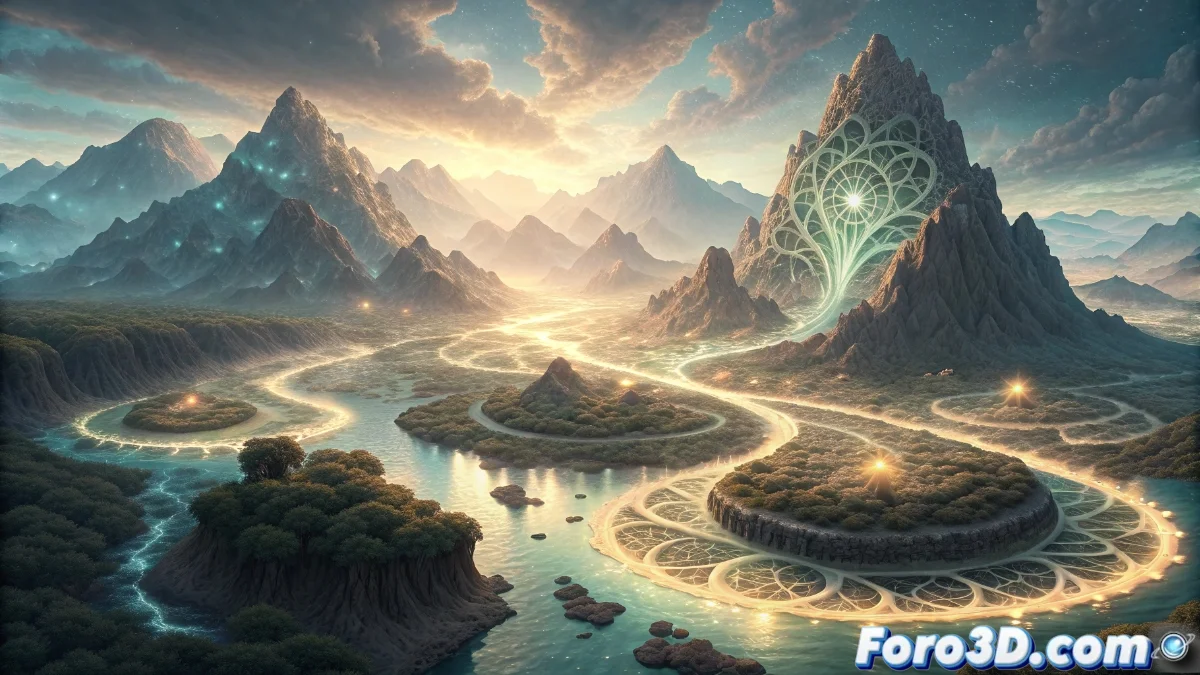
Impossible Worlds through Mathematical Fractals in Digital Graphics
Fractal geometry opens doors to dimensions where the natural fuses with the impossible, creating visual universes that completely challenge our conventional spatial understanding. These mathematical structures exhibit self-similarity at different scales, producing landscapes where organic patterns coexist with topological impossibilities that captivate both mathematicians and digital artists 🌌.
Advanced Fractal Generation Techniques
The construction of these alternative universes is based on procedural rendering methods implemented through specialized graphics engines. Fractal displacement shaders apply nonlinear mathematical transformations to base geometries, while particle systems follow trajectories defined by chaos equations. The combination of Perlin noise with signed distance fields (SDF) enables perfect transitions between structures at different levels of magnification.
Essential Components in Fractal Generation:- Iterative algorithms like the Mandelbrot set for infinitely detailed base structures
- Iterated Function Systems (IFS) that replicate patterns at multiple scales simultaneously
- Multiresolution approximation that ensures sharpness in fractal details regardless of viewing distance
Mathematicians see order where artists see chaos, and artists see chaos where mathematicians see order - the true fractal impossibility lies in reconciling these perspectives
Implementation in Immersive Environments
These mathematical principles find direct application in the development of immersive experiences and video games that require expansive worlds with unlimited visual variability. Engines like Unreal Engine and Unity incorporate native fractal generation tools that allow designers to create surreal landscapes with infinite diversity. The domain warping technique produces spatial distortions that transform conventional terrains into dreamcore architectures.
Practical Applications of Fractals:- Procedural landscape generation for video games with infinite visual variation
- Creation of impossible architectures where staircases ascend to nowhere and forests fold recursively
- Virtual reality experiences with environments that challenge conventional physical laws
The Fractal Paradox: Order within Chaos
The dual nature of these impossible worlds creates a fascinating conceptual tension between mathematical precision and artistic expression. While pure mathematicians might argue that these structures are too orderly to be genuinely chaotic, digital artists insist that they are too chaotic to be considered orderly. This perceptual dichotomy perhaps represents the true fractal impossibility: achieving convergence of both perspectives into a unified understanding of these alternative realities 🎭.