Imagine an experiment that combines physics, technology, and innovative materials. A team of physicists from the University of Amsterdam has created small 3D-printed particles that move on their own over a fluid. This phenomenon is due to a physical effect known as the Marangoni effect, in which a drop of liquid with lower surface tension spreads across the surface of another fluid instead of mixing with it. A everyday example of this is when alcohol spreads over water and dissolves little by little.
The Marangoni Effect and Autonomous Movement
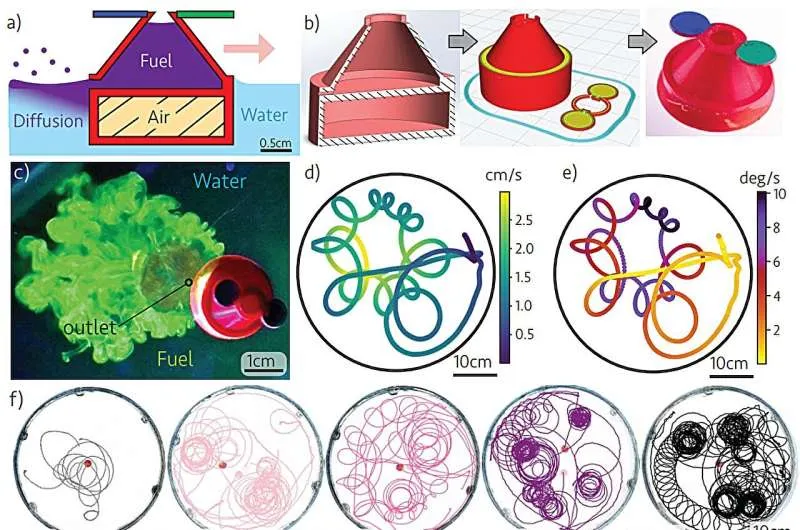
The particles created by these researchers have a shape similar to a hockey puck and are hollow. They are designed to float on water and each one has a small fuel tank, which in this case is alcohol. As the alcohol is gradually released through a small hole, it creates a continuous expansion that propels the particle forward, like a miniature vehicle.
How Do the Particles Move?
The most surprising thing about these particles is that their speed is directly related to the concentration of alcohol. The more concentrated the alcohol, the faster they move. In the experiments conducted, these particles reached speeds of up to 6 centimeters per second and were able to move for several minutes before running out of fuel.
- The particles move faster with higher alcohol concentration.
- The movement can last several minutes before the fuel runs out.
- The particles can interact and cluster together, like cereal in milk.
Potential for Practical Applications
The researchers believe that these particles could have significant applications in various fields. For example, they could be used to clean contaminants from liquid surfaces or to distribute chemicals more efficiently. This breakthrough shows how 3D printing is not only for creating models, but also for developing functional solutions that respond to the laws of physics in surprising ways.
"This breakthrough shows us how technology, combined with physics, can create surprising and efficient solutions to solve practical problems." – Researchers from the University of Amsterdam
The Impact of Technology on Science and Industry
This experiment is a clear example of how technology can open new doors in science and industry. With the combination of innovative materials, the Marangoni effect, and 3D printing, researchers are creating unique solutions that could transform how we approach problems in areas such as environmental cleaning and chemical distribution.