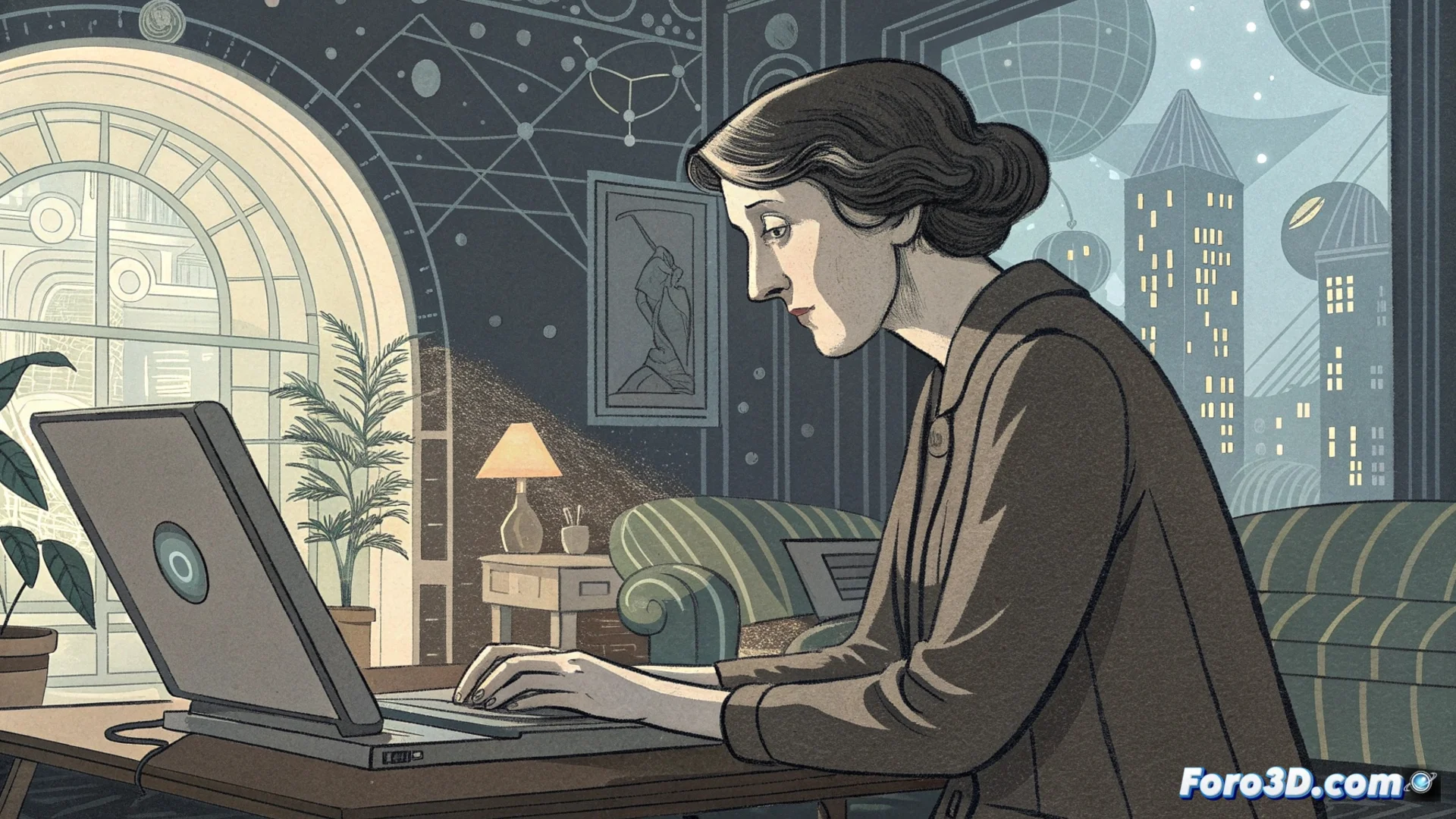
If Virginia Woolf Designed Her Own Room in the Metaverse Today
Imagine Virginia Woolf's sharp mind confronting today's digital landscape. Her iconic essay on the need for a physical space to create would undoubtedly transform into a quest for autonomous virtual domains. These would not be mere rooms, but digital ecosystems designed to grant true sovereignty over thought. 🧠
The Prelude: Crossing a Digital Silence Filter
Accessing this sanctuary would not be immediate. It would require overcoming a first barrier of digital silence. This mechanism does not aim to isolate, but to purify the mind from the constant noise generated by social networks and algorithmic surveillance systems. Upon crossing it, the person would free themselves from the frenetic pace imposed by platforms that trade attention. This would be the foundation for achieving deep and genuine concentration.
Key features of this digital vestibule:- It functions as a cognitive airlock that disconnects from external stimuli.
- Its goal is to eliminate informational noise and accountability pressure.
- It prepares the mental ground for uninterrupted creative work.
The goal is to restore the intimate freedom to think and create without an invisible audience judging.
Shielding the Creative Process in the Virtual Core
The heart of this digital room would lie in its ability to protect creation. Algorithms that profile, predict, and seek to monetize every interaction would be excluded from its architecture. The space's design would prevent any evaluative gaze, whether social or commercial, from conditioning the act of creating. Here, the digital capitalist patriarchy would have no windows to spy through.
Elements of this digital shielding:- Absence of engagement metrics, likes, or behavior analytics.
- Architecture that does not record or store internal processes to sell data.
- An environment where creation arises from an internal need, not external validation.
The Final Technical and Philosophical Challenge
Perhaps the greatest difficulty would not lie in programming the space, but in ensuring that the exit does not lead directly to a social network to showcase what was produced. The authentic room of one's own in the metaverse would need a transition system, a digital airlock that allows decompressing the intention and consciously choosing whether and how to share the work. The true challenge is to build a door that does not automatically return us to the cage of performative visibility. 🔒