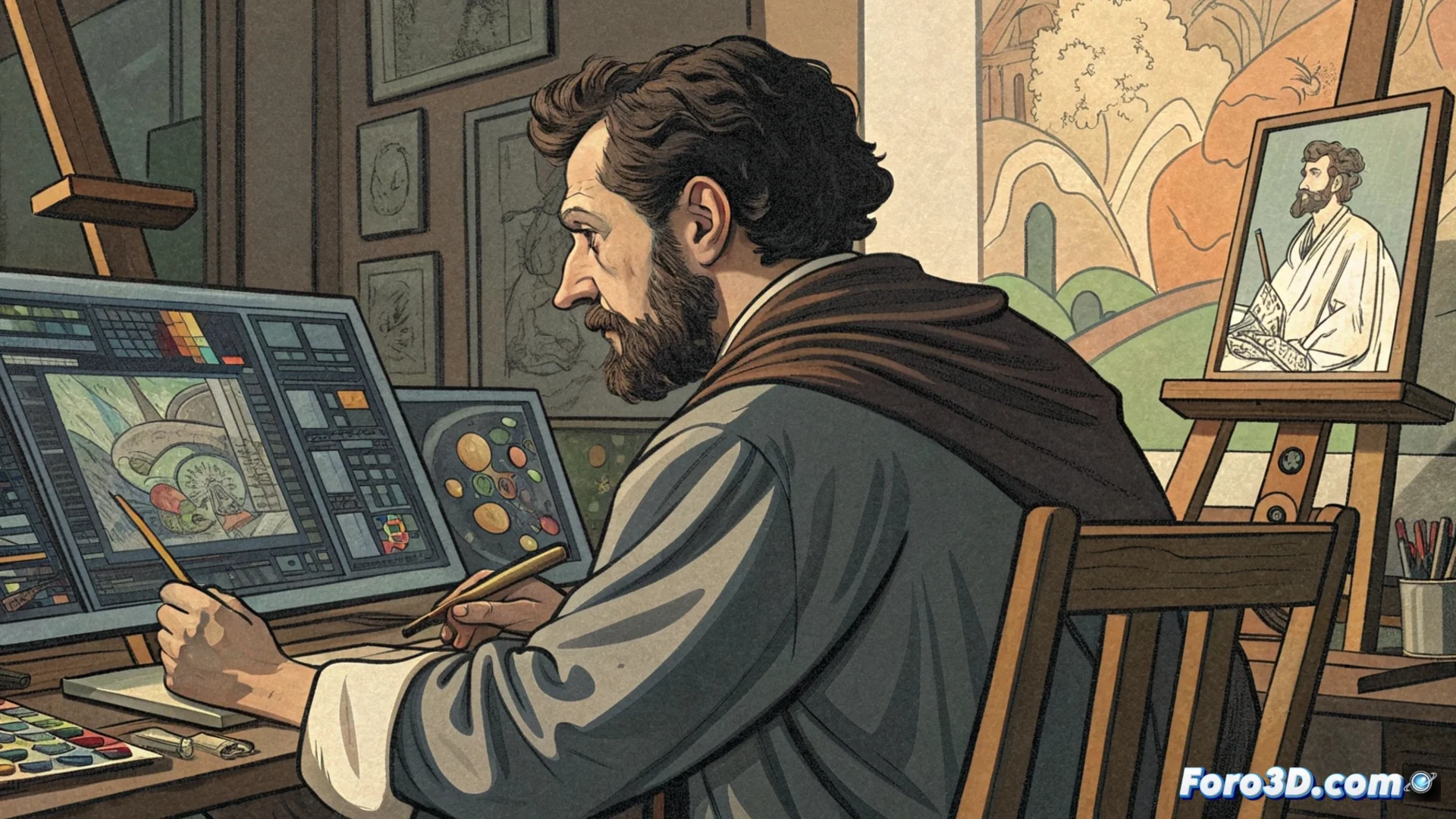
If Pablo Picasso Created Today, He Would Found the Data Cubism Movement
If the genius of cubism operated in our time, his restlessness would not be limited to the canvas. He would explore how to capture and express the overwhelming complexity of the digital world. His quest would lead him to visualize information radically, giving rise to Data Cubism, a direct evolution of his idea of capturing multiple viewpoints in a single plane. 🎨
The goal: forced multidimensional perception
This movement does not seek to create aesthetic graphs. Its goal is to force the viewer to perceive a topic from all its angles at the same time. A piece on climate change, for example, would integrate economic data, social patterns, ecological impacts, and the emotional state of communities. The viewer cannot ignore any layer, achieving a holistic understanding that traditional reports fragment.
Key characteristics of Data Cubism:- Simultaneous perspectives: Show all facets of a problem in a unified composition.
- Data as raw material: Raw information becomes the basic pigment and form.
- Holistic understanding: The design forces the brain to integrate multiple dimensions of information.
The Guernicas of the 21st century are not painted, they are programmed.
The technique: a fusion of classical art and modern code
To build these works, current tools would be used. The technical base could be a particle system in 3D, where each visual variable is assigned to a dataset: color represents an emotion, geometry defines a structure, and texture shows deterioration. The creative process involves programming rules and letting the system compute, generating compositions where data and expression are inseparable.
Tools and processes involved:- 3D render engines: To generate complex visual compositions.
- Fragment shaders: To process and visualize data at the pixel level with programmable logic.
- Data processing algorithms: To translate numerical information sets into visual parameters.
The artist's studio in the digital era
The workspace no longer smells of turpentine and oil. The environment is dominated by the hum of a server rendering a humanitarian crisis in 8K and the aroma of cold coffee. Here, the artist is also a programmer, and the masterpiece is born from the intersection of a powerful concept, a robust dataset, and an elegant algorithm. This is the legacy Picasso could leave today: a movement that challenges how we see, understand, and feel the information that defines our time. 💻