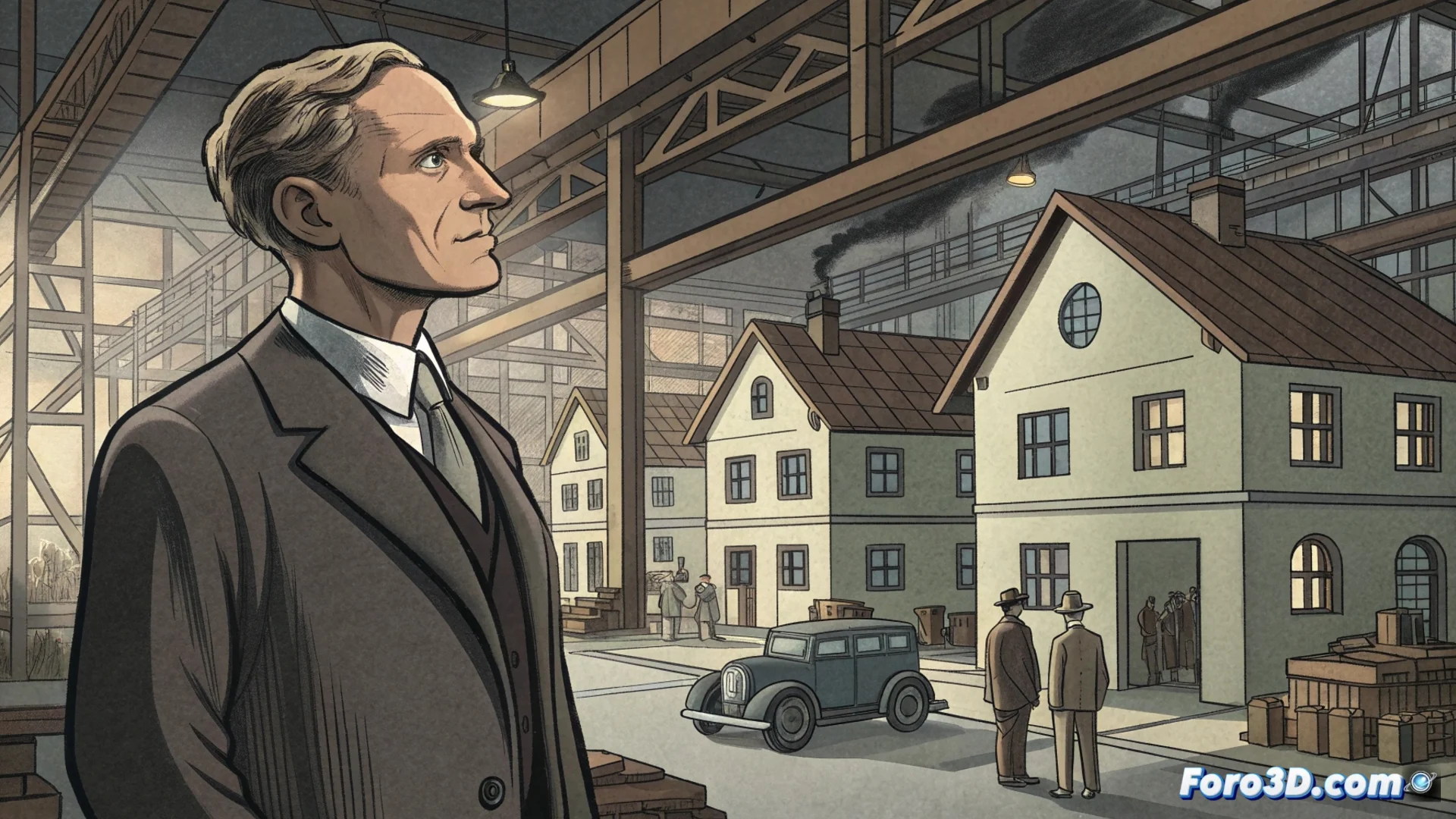
If Henry Ford Applies His Method to Current Housing
Imagine that the pioneer of mass production, Henry Ford, tackles the current housing challenge. His radical approach would be identical: manufacture in series to reduce costs. He wouldn't build houses one by one; he would produce them on an assembly line, transforming housing from a craft project into a standardized industrial product. The ultimate goal is the same as with the Model T: make an essential good accessible to the vast majority through efficiency and scale. 🏭
The Factory as the Origin of the Home
The process begins in large industrial warehouses. Specialized assembly lines manufacture complete habitable modules or entire house sections. Prefabricated, lightweight, and durable materials are used that fit precisely. Each workstation adds a specific component: electrical wiring, plumbing, insulation panels, or interior finishes. This system allows for constant quality control, accelerates the production pace, and eliminates stoppages due to adverse weather conditions. The house leaves the factory as a finished good, ready for transport.
Key advantages of factory manufacturing:- Superior quality control: Every step is inspected in a controlled environment.
- Constant production speed: No interruptions due to rain, cold, or material shortages.
- Material optimization: Waste is reduced by calculating and cutting with industrial precision.
The goal is not to build houses, but to produce them. Efficiency and scale are the keys to solving the problem.
From the Factory to the Site in Record Time
The complete modules travel in adapted trucks to the site, where the foundation is already prepared. Instead of a process that takes months, a large-capacity crane places the main sections. A small team of technicians handles connecting the systems and securing the structures in a matter of hours. This method minimizes the labor required on-site and significantly reduces disturbances to the surrounding neighborhood.
Benefits of quick final assembly:- Immediate habitability: The house is ready to use in a very short time.
- Lower logistical impact: Truck and worker traffic is reduced over long periods.
- Prioritize functionality and maintenance
Related Links