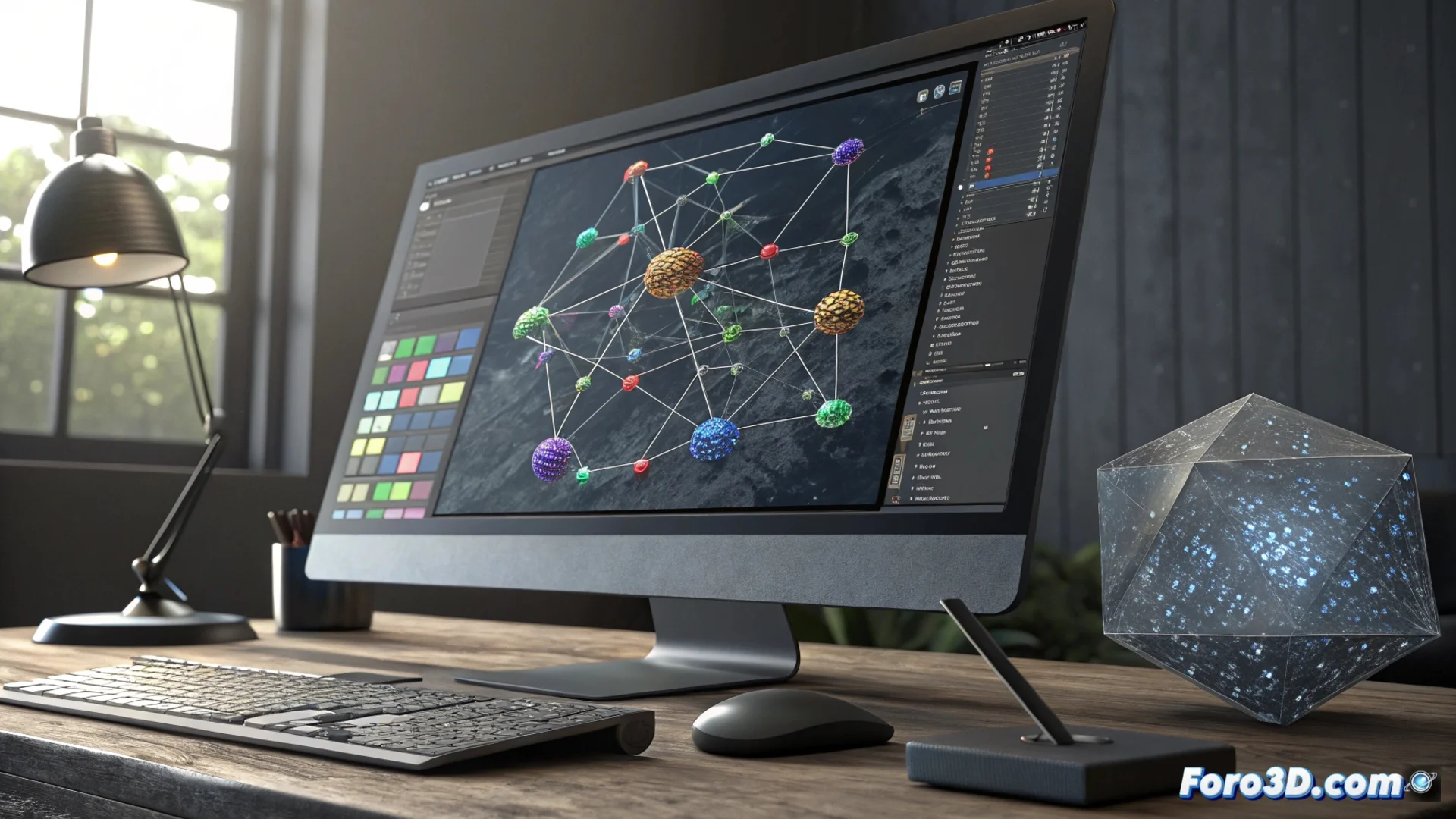
ICE in Softimage XSI: The Visual Node-Based Programming Environment
At the core of Softimage XSI lies ICE (Interactive Creative Environment), a system that revolutionized how digital artists think and build. This visual node-based programming environment allows designing complex behaviors for 3D objects, particles, and deformations, all without a single line of traditional programming code. Its deep integration with the software enables a non-destructive and fully procedural workflow. 🧩
A Precursor to Modern Procedural Design
ICE's philosophy directly influenced the development of similar tools in other 3D packages. Its node-based approach allows exploring ideas and testing configurations interactively, as changes are processed and visible instantly in the viewport. Users can build everything from simple animation controls to complete dynamic simulation systems, extending the software's native capabilities to solve specific production problems. This flexibility made it a powerful platform for developing internal tools.
Key Components of the ICE Workflow:- Nodes: Each performs a specific task, such as generating random values, calculating vectors, or evaluating logical conditions.
- Compounds: Pre-assembled node networks that users can create and reuse, defining complex data flows.
- Data Flow: Connections between nodes determine how objects behave, particles are generated, or meshes are deformed in the scene.
ICE requires thinking like a programmer, but without the syntax; sometimes, finding the exact node among hundreds can feel like a treasure hunt.
Handling Data and Events in the 3D Scene
ICE operates directly on Softimage's architecture, allowing it to access and manipulate any data within the scene. This includes geometry, particle information, deformers, and custom mesh attributes. Being a procedural system, any adjustment made at any point in the node network causes the entire system to automatically recalculate the final result. This approach greatly streamlines the process of iterating and refining visual effects, simulations, or animation tools.
Areas Where ICE Demonstrates Its Power:- Particle Effects: Create rain, fire, swarms, or dust systems with custom logic.
- Procedural Deformations: Apply twists, waves, or complex morphs based on scene data.
- Rigging and Animation Tools: Develop custom controls and automatic behaviors for characters.
The Legacy and Challenge of a Node-Based System
Although its power for extending the software is undeniable, mastering ICE involves a learning curve. The user must learn to structure problems logically and navigate a vast library of nodes. However, once this barrier is overcome, it offers unprecedented control over the creative process, allowing the creation of unique solutions that go beyond standard tools. Its design laid the foundation for understanding the power of visual abstraction in digital production. ⚙️