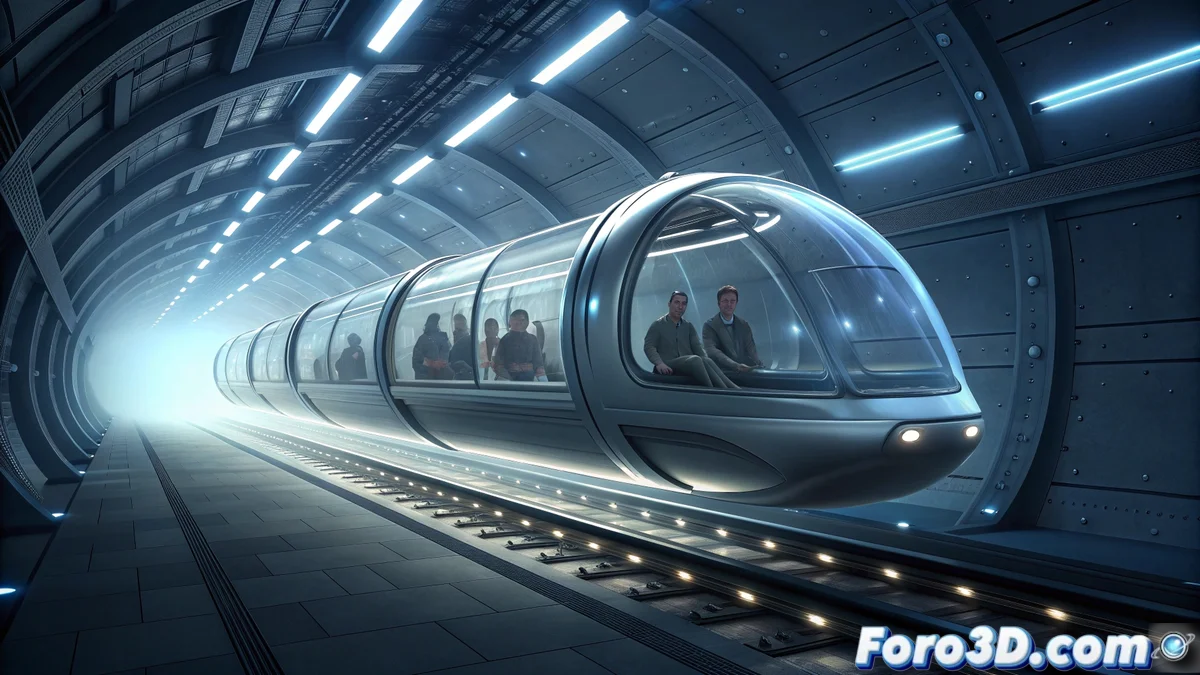
Hyperloop: the land transport that challenges the speed of sound
The idea of an ultrahigh-speed land transport system has moved from science fiction to engineering labs. The Hyperloop concept proposes a radical model: capsules that transport people and goods through low-pressure tubes, where friction and air resistance almost disappear. This approach promises to revolutionize how we perceive distances. 🚄
The principles that drive the capsule
The core of this technology lies in eliminating the two major brakes on speed: contact with a surface and aerodynamic resistance. To achieve this, the capsules float on an air cushion and use passive magnetic levitation, which almost completely eliminates mechanical friction. Simultaneously, the partial vacuum environment inside the tube drastically reduces air drag, allowing the capsules to move with unprecedented energy efficiency.
Key elements of the system:- Aerodynamic capsules: Designed to travel inside a sealed tube, transporting passengers or cargo.
- Low-pressure tubing: A tubular infrastructure that maintains a partial vacuum environment along the entire route.
- Linear propulsion system: Electric motors that accelerate and brake the capsules in a controlled manner along the tube.
Connecting distant cities in minutes, not hours, is the ultimate goal pursued by this disruptive technology.
Redrawing the travel map
The most tangible promise of Hyperloop is compressing travel time. Operating at speeds that can exceed 1000 km/h, interurban routes of several hundred kilometers would be completed in a few minutes. This would transform mobility, making it viable to live in one city and work in another far away. The modular design aims for frequent and on-demand service, similar to an ultra-high-speed subway. 🗺️
Advances and technical validation:- Several companies and university teams have built scale prototypes that validate levitation and propulsion in controlled environments.
- Speed tests have been conducted on short test tracks, demonstrating the stability of the capsules.
- The current focus is on scaling the technology and solving engineering challenges at the level of real infrastructure.
The giant obstacles it faces
Implementing this vision involves colossal challenges. Building and maintaining hundreds of kilometers of vacuum tubing is an engineering and logistical feat. Ensuring absolute safety is critical; any failure in a sealed system traveling at subsonic speeds poses extreme risks. Additionally, the construction cost of this infrastructure is astronomical, requiring political consensus and major investments. Engineers must also solve tube thermal expansion and create control systems with unshakeable reliability. The idea of reading a book at the speed of sound is seductive, but reality demands overcoming these enormous technical and economic hurdles. ⚠️