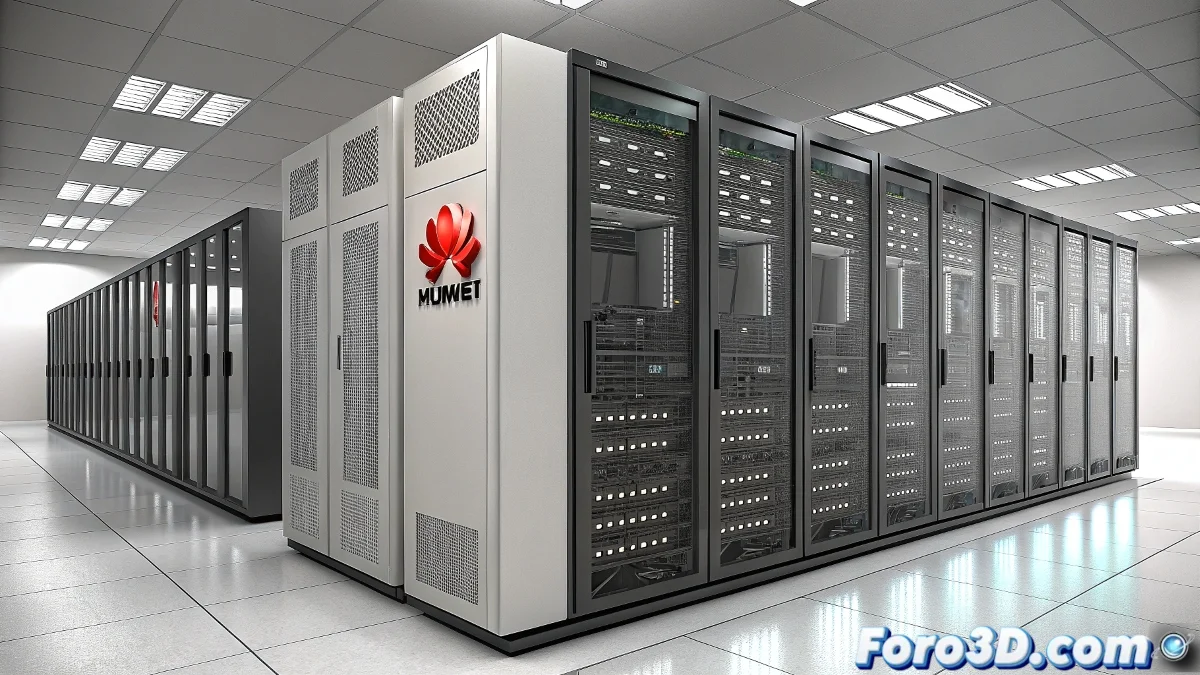
Atlas 950 SuperCluster: Huawei Redefines High-Performance Computing
Huawei has presented its Atlas 950 SuperCluster, a high-performance computing system capable of reaching 1 ZettaFLOPS in FP4 operations 🚀. The cluster incorporates hundreds of thousands of 950DT APUs, specifically designed to accelerate artificial intelligence workloads, scientific simulation, and big data analysis. This infrastructure not only represents a quantum leap in computing power but also sets new standards for energy efficiency in massive-scale data centers. Because in the AI era, processing power is the new digital oil 💡.
Architecture and Technical Capabilities of the Giant
The Atlas 950 combines thousands of nodes with specialized 950DT processors, optimized for FP4 operations that enable massive calculations with reduced energy consumption ⚡. Each 950DT APU is designed to handle mixed-precision operations, crucial for AI model training and complex simulations. The system is interconnected via a high-speed network that minimizes latency and maximizes throughput, ensuring that the hundreds of thousands of units work in harmony as a single computational superorganism. An engineering feat that few companies could match.
The cluster incorporates hundreds of thousands of 950DT APUs, designed to accelerate artificial intelligence workloads, scientific simulation, and big data analysis.
Applications in Research and Industry
Huawei highlights that the SuperCluster will accelerate training of extremely complex artificial intelligence models, reduce scientific simulation times from years to days, and offer quasi-real-time big data analysis 🧪. Academic institutions, government research centers, and technology corporations will be able to leverage this power for projects ranging from climate modeling and drug discovery to global supply chain optimization. The Atlas 950 is not just a tool; it is an accelerator of human progress.
Unprecedented Scalability and Performance
With hundreds of thousands of interconnected 950DT APUs, the Atlas 950 offers linear scalability and built-in fault tolerance, ensuring continuous operations even in the event of individual hardware failures 🔧. The ability to reach 1 ZettaFLOPS in FP4 positions it among the world's most powerful clusters, rivaling traditional exascale systems but with greater efficiency for AI workloads. This scalability allows users to start with smaller configurations and expand according to their needs, without sacrificing performance or stability.
Impact on Competition and the Market
The launch of the Atlas 950 SuperCluster consolidates Huawei as a key player in the race for global computational supremacy 🏆. Against systems like Nvidia's GPU-based supercomputers or Google's TPU chips, Huawei bets on an architecture specialized in FP4 operations, optimized for the next generation of AI models. This move could influence how future data centers are designed, prioritizing energy efficiency and specialization over raw generalist performance. The HPC market will never be the same.
The Irony of Absolute Power
With so much computing capacity, even your morning coffee might feel intimidated by the Atlas 950... though it still can't make you one like your home coffee maker does ☕.