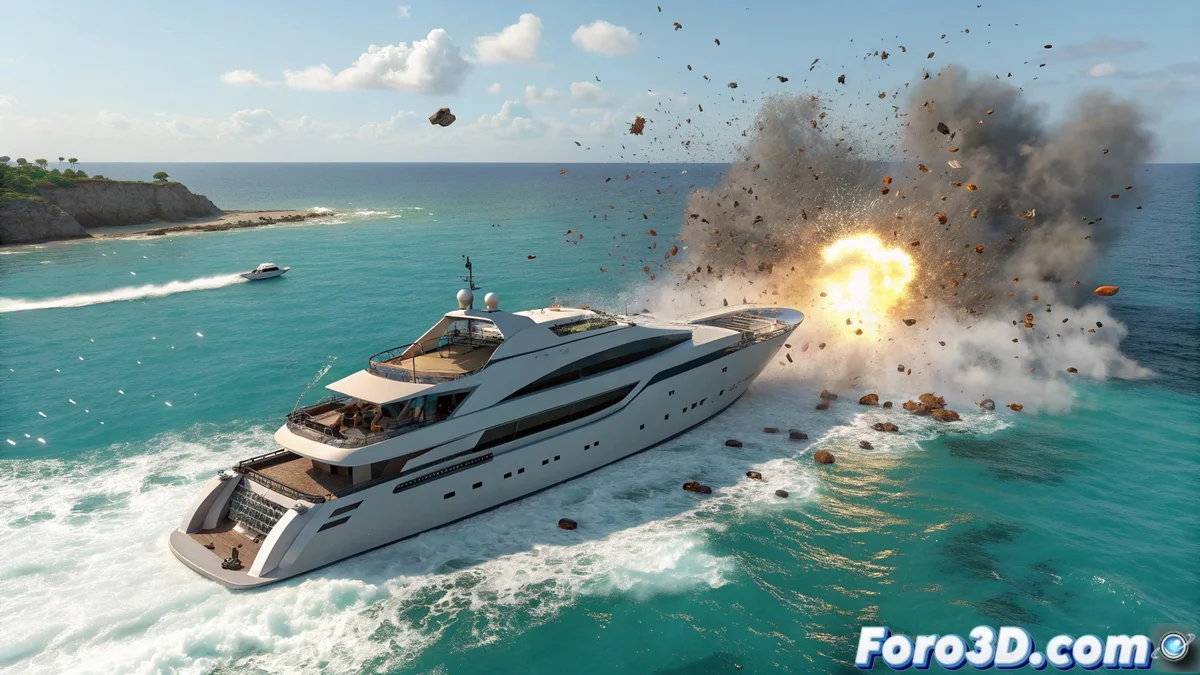
The Art of Destroying Things Digitally 🚢💥
Imagine a peaceful recreational vessel sailing through the turquoise waters of the Caribbean. Suddenly, without warning, a cataclysmic explosion turns it into a thousand flying splinters. This isn't the plot of an action movie, but the result of a simulation created with 3D software, where highly realistic visual effects can be created without getting even a little wet. It's paradise for VFX artists: all the spectacle and no pollution fines.
Setting Up the Vessel and the Environment
The first step is to model the ship in an application like Blender, paying attention to every detail, from the hull to the deck accessories. Then, an idyllic environment is built: a Caribbean sea with realistic water shaders and a clear sky with intense, warm lighting. The key is that the model's geometry is prepared for its imminent and glorious disintegration.
Fracturing the Model and Preparing the Simulation
To achieve believable destruction, specialized modifiers are used. In Blender, the Cell Fracture tool is ideal for breaking the model into hundreds of pieces. In Houdini, more advanced fracture nodes are used. The goal is for each fragment to be ready to be propelled by the forces of an explosion, with a physics dynamics simulator ensuring that the movement, weight, and collisions are natural. 🤯
Procedural fracturing is the foundation of any believable destruction simulation, transforming a solid model into a puzzle of pieces awaiting chaos.
Adding the Particle Explosion
This is where the magic happens. A particle emitter is created to act as the detonator for the explosion. This system generates expansive forces that violently and randomly push the ship's fragments. To increase realism, secondary effects are added such as:
- Simulations of smoke and fire (Pyro FX in Houdini).
- Incandescent sparks and flashes.
- Particle trails to give a sense of speed.
In Blender, this can be achieved by combining particle systems with fluid simulations for the gaseous elements.
Details That Add Realism to the Scene
The explosion itself is only one part. The interaction with the environment is what really sells the effect. The ship's pieces must fall into the water, generating splashes, concentric waves, and foam. 🏖️ The final render with engines like Cycles or Karma handles the lighting, capturing the reflections of the fire on the water and the shadows of the flying fragments, adding an extra layer of drama to the sequence.
While you, in the comfort of your studio, try to destroy a digital yacht into a thousand pieces with particles, in the real Caribbean someone is quietly sipping a mojito on the deck of a real one. The simulation will never be that refreshing. 😉