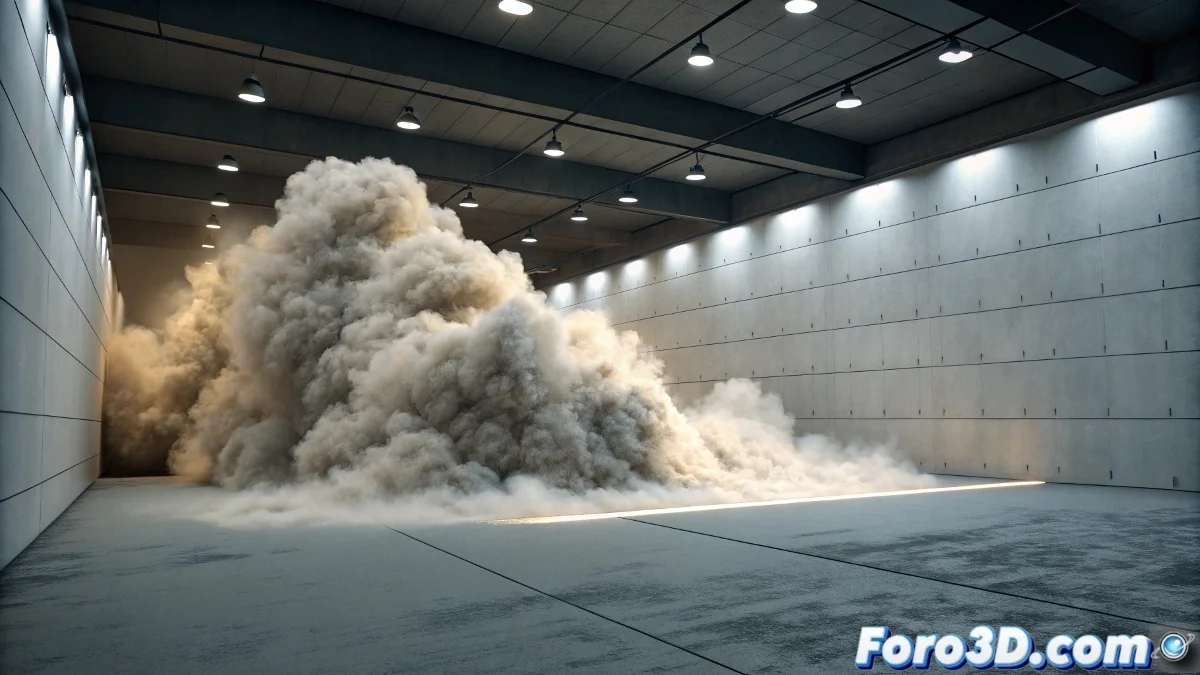
The Chaos of Clumped Particles
One of the most frequent problems in XSI occurs when particles decide to completely ignore their individual existence and pile up as if they were at a subway exit during rush hour. This particle agglomeration completely ruins the simulation and the credibility of the effect.
The phenomenon of particles passing through each other generally indicates problems in collision settings or dynamics calculations. What should be a natural and dispersed behavior turns into a quite unaesthetic virtual traffic jam.
Particles in XSI sometimes behave like teenagers at a concert: they all want to be in the same place at the same time
Essential Settings to Avoid Clumping
Solving this problem requires adjusting several key parameters that control how particles interact with each other and their environment. The solution usually lies in the proper combination of these settings.
- Particle collision radius: increase this value to prevent penetration
- Repulsion forces: apply noise and turbulence to separate them naturally
- Simulation substeps: increase calculations per frame for greater precision
- Maximum velocity: limit speed to prevent passing through due to fast movement
Advanced Solutions for Persistent Cases
When basic settings are not enough, it's time to apply more specific techniques. XSI's particle system offers powerful tools but requires deep understanding to master them completely.
The scale of the simulation dramatically affects behavior. Values that work for large particles can be useless for systems with thousands of small particles 😅
- Add wind forces: create directional movement to avoid stagnation
- Use goals or targets: direct particles to specific positions
- Modify density: reduce the total number if excessive
- Set up collision groups: separate particles with different behaviors
Systematic Approach for Diagnosis
Before giving up, it's advisable to follow an orderly method to identify the root of the problem. Starting with a simple scene and gradually adding complexity usually reveals which setting is failing.
Testing with different emitter types and forces can indicate if the problem is specific to certain conditions or general to the system. Sometimes the solution is in completely changing the approach.
- Start with basic emitter and few particles
- Check scene scale and units
- Test different physics integrators
- Review cache and memory calculations
After applying these solutions, your particles should flow harmoniously... or at least give you a different kind of problem to entertain yourself with 🎯