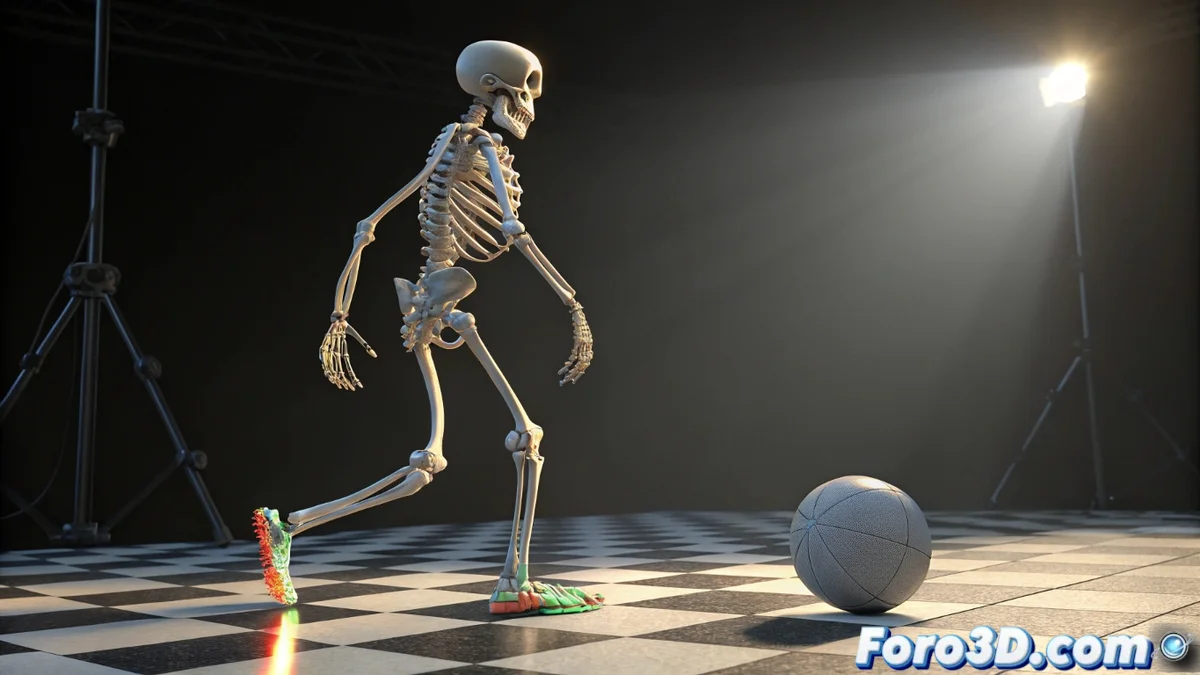
How to Prevent Feet from Sliding in Character Animation
One of the most common problems when animating a walk or run cycle is foot sliding. This error makes the character lose credibility by appearing to skate on the ground, completely breaking the illusion of weight and physics. Fixing it is essential to achieve convincing locomotion. 🎬
Understanding the Foot Skating Problem
Sliding occurs when the foot's position in world space does not remain static during moments of full contact with the terrain. Instead of being anchored, the foot bone moves involuntarily on the horizontal (X) and depth (Z) axes, creating that unnatural skating effect that distracts the viewer.
Main consequences of sliding:- The character loses weight and connection with the environment, appearing to float.
- The animation conveys little force and lack of intention in the movement.
- It breaks immersion and the professional quality of the final work.
The magic in animation often lies in making something stay perfectly still when it should.
Locking Feet in Keyframes
The direct technical solution is to lock the foot's translation in the frames where the heel impacts and where the toes push off to lift. You must ensure that the translation values in X and Z are exactly zero during these phases. Animators often use constraints (IK), animation layers, or manual editing in the curve editor to achieve this precise anchoring.
Methods to anchor feet:- Use IK constraints or pin controls to fix the foot automatically.
- Isolate the foot animation in a specific layer to adjust only the ground contact.
- Manipulate keyframes directly in world space to cancel any translation.
Polishing and Flattening Animation Curves
Reviewing the graph editor is the definitive step to eliminate residual sliding. You must look at the translation curves (X and Z) of the foot controller. In contact frames, these curves must show completely flat plateaus. Any slope or tilt in that plateau is the cause of the unwanted movement. Adjust the keyframe handles to flatten the curve and ensure total immobility. 📉
Mastering this technical aspect transforms a clumsy animation into solid and realistic locomotion. Anchoring the feet and polishing the curves are not minor details, but the foundation for a character to interact convincingly with its world. Investing time in this polishing makes the difference between a forced-looking movement and one that flows naturally. ✅