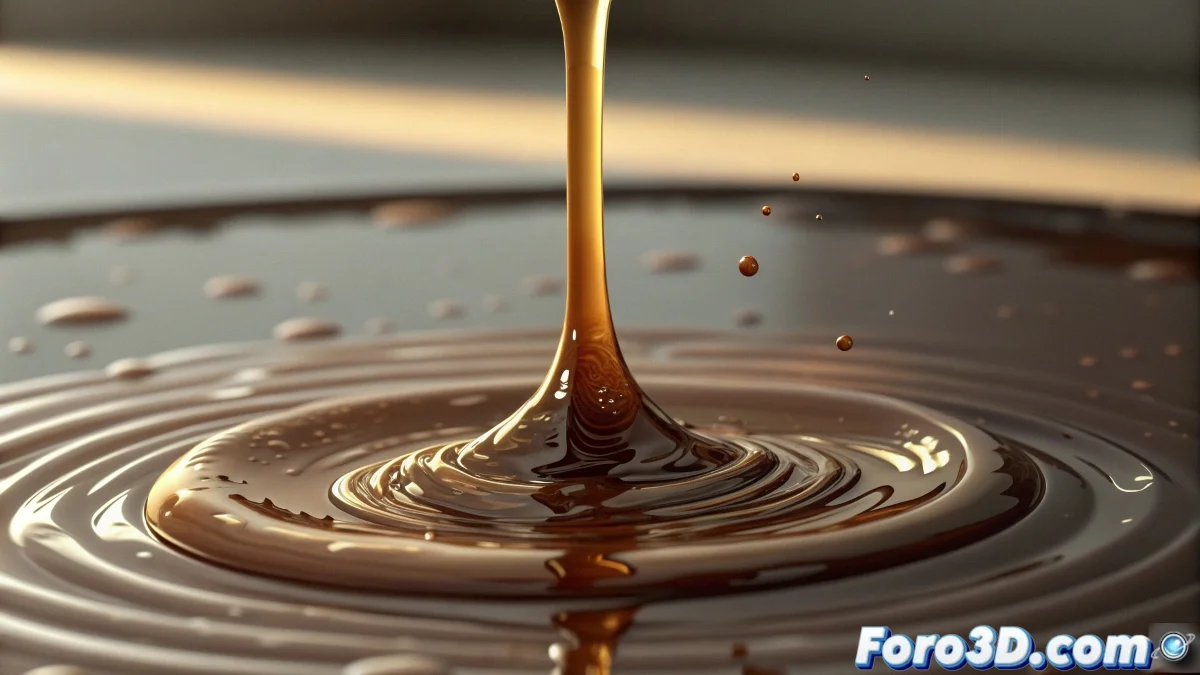
The Art of Making Particles Drip
Creating a convincing drip effect in RealFlow is like learning to control the patience of water itself. The particles want to fall in continuous streams, but you need to convince them to separate into individual drops with a life of their own. The secret lies in the perfect balance between cohesion and gravity.
To simulate realistic drips, you need to work with emitters that produce particles in a controlled manner and with physical properties that favor droplet formation. It's not just about making particles fall, but about recreating that magical moment where the accumulated liquid yields to its own weight.
In RealFlow, making things drip is the art of convincing particles to separate at just the right moment
Emitter Setup for Dripping
The type of emitter and its parameters determine whether you'll get a continuous stream or the desired drip effect. Emitters of the object or square type are ideal for this purpose.
- Small emitter: use reduced dimensions to control the flow
- Low emission speed: values between 10-50 for spaced-out drops
- Adjusted particle radius: size consistent with the scene scale
- Emission by frames: control timing for periodic drops
Physical Properties for Perfect Drops
Viscosity and surface tension are your best allies for transforming generic particles into recognizable drops. These parameters control how particles join together and separate from each other.
A high viscosity makes particles stick together forming coherent drops, while surface tension creates that characteristic rounded effect of real drops 😊
- Medium-high viscosity: values between 2-5 for cohesion
- Active surface tension: between 5-15 for spherical shape
- Standard gravity: 9.8 for realistic fall
- Noise forces: minimal for natural variation
Advanced Techniques for Specific Drips
Depending on the effect you're looking for, you can apply additional techniques to refine the behavior of the drops. From slow, heavy drips to fast, light ones.
The key is to experiment with different parameter combinations and observe how they interact with each other. Sometimes small adjustments create big differences in the final result.
- Use drag daemons for air resistance
- Apply wind for drips with curved trajectories
- Vary density for heavier or lighter drops
- Control particle lifespan to avoid accumulation
After mastering these adjustments, you'll be able to create everything from the most subtle drip to complete waterfalls... though you'll probably spend more time watching virtual drops than paying attention to real ones 💧