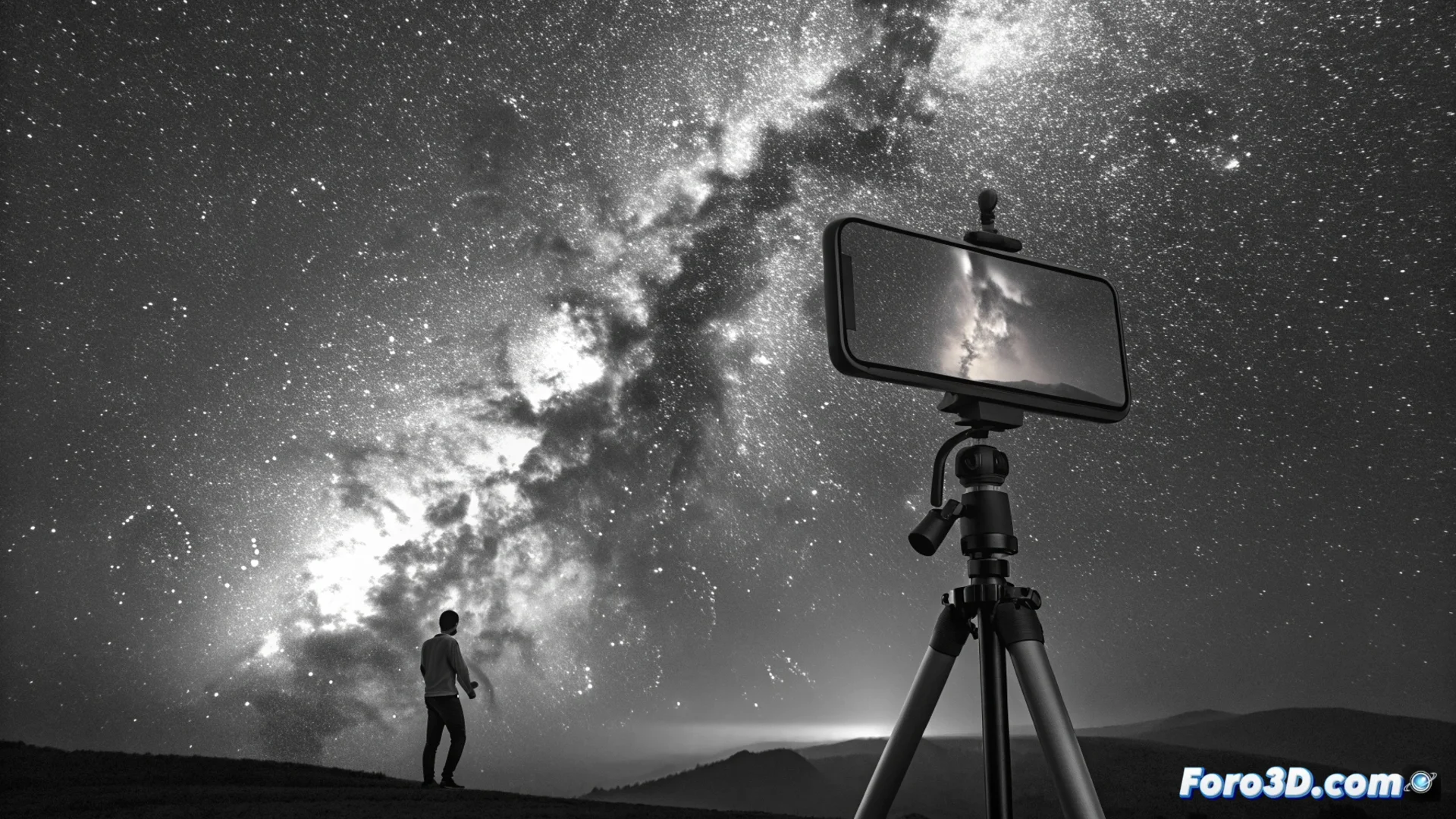
How to Capture the Milky Way with Your Mobile Phone
Achieving a clear image of the Milky Way or a star field depends on two key factors: a completely stable support and escaping the light pollution of the city. Fortunately, many current smartphones integrate a Astrophotography mode that automates the complex process of taking long exposures, greatly simplifying the task. 📱✨
The Power of Automatic Stacking
By activating this specialized function, the phone programs an ultra-long exposure that can last several minutes. Instead of a single photo, the system captures a sequence of multiple frames. Internally, the software aligns them to correct the apparent movement of the stars and then fuses them. This method of combining images averages the light information and effectively suppresses digital noise, producing a final result with more detail and less grain than a single shot, without the user having to configure manual parameters.
Key advantages of automatic mode:- Executes multi-minute exposures automatically.
- Aligns photos to compensate for Earth's rotation and avoid trails.
- Digitally fuses captures to suppress noise and highlight details.
The biggest challenge is often not technical, but finding a sufficiently dark sky and having patience during the sequence.
Advanced Control with Dedicated Apps
For those seeking total control over the process, there are specialized applications. These apps allow manually adjusting values such as ISO, exposure time, and intervals between shots. This control is ideal for planning longer sequences or using with cameras that lack automatic modes. The post-stacking is then performed on a computer with software like Sequator or DeepSkyStacker.
Workflow with advanced apps:- Manually adjust ISO, shutter speed, and intervals.
- Capture a series of images in RAW format for greater flexibility.
- Transfer the photos to the PC and use specialized software to align and average the pixels, revealing faint galactic structures.
Final Considerations for Success
Regardless of the method chosen, success lies in the location and preparation. A sturdy tripod is essential to avoid any vibration during the long exposure. Patience is also a crucial component, as you must allow the phone to complete its capture sequence in total darkness. In the end, the reward is a personal window into the immensity of our galaxy, captured with the device you carry in your pocket. 🌌