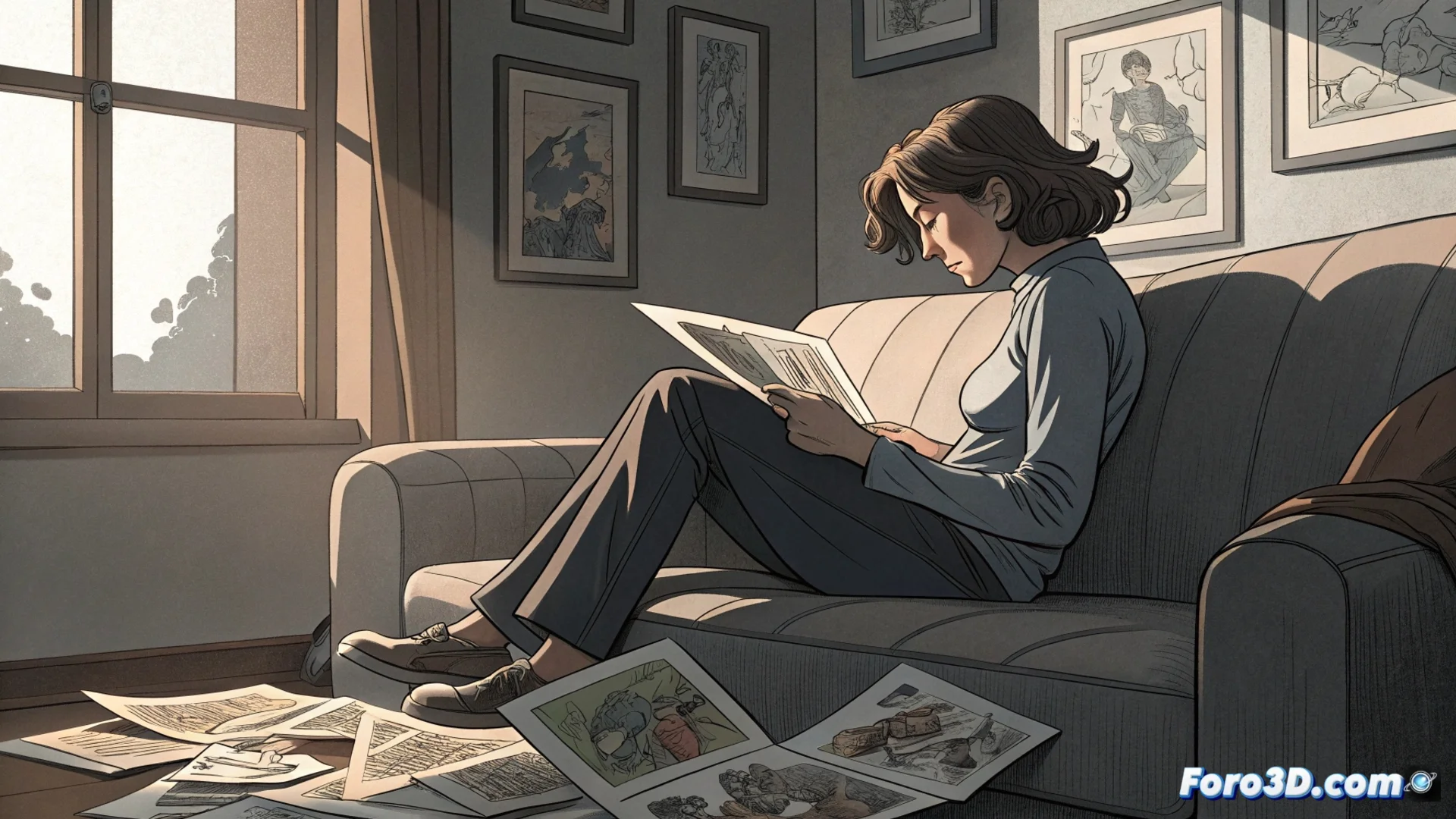
How to be happy: the comic by Eleanor Davis that explores happiness
The work How to Be Happy compiles a series of comics and illustrations created by Eleanor Davis. The author addresses universal themes such as perceiving anxiety, doubting, experiencing joy, and how people connect with each other. She does so with a frankness that does not attempt to sugarcoat human experiences. Each chapter operates as a visual and narrative inquiry into the moments that shape everyday life. 📖
A graphic style that dialogues with each story
Davis exhibits exceptional mastery of the medium by constantly varying her graphic technique. Her visual language transforms to match the emotional weight of each story. She can use a sharp line and elemental shapes to convey fragility, or opt for intricate compositions and textures to express internal bewilderment. This adaptability makes the form consolidate the message of each section, generating an immersive reading.
Key characteristics of her artistic approach:- Modulates the line and complexity according to the emotional tone she needs to convey.
- Uses powerful visual metaphors to make the abstract tangible in internal states.
- The composition of each page actively reinforces the narrative, not just decorates it.
The real trick to being happy, one of the vignettes seems to suggest, is to accept that sometimes the instruction manual is written in a language you don't understand, and to keep flipping through it anyway.
Navigating the complexity of what we feel
The book does not propose simplistic solutions or universal recipes. Instead, it presents snapshots of existence that capture inherent paradoxes and contradictions. A character may seek connection while isolating themselves, or desire tranquility while sabotaging their own well-being. Davis draws these internal processes with a clarity that allows observing how individuals navigate their conflicts, without always guaranteeing a conventional happy ending.
Aspects it addresses about the emotional experience:- Examines the duality in human behaviors, such as seeking connection and isolating simultaneously.
- Illustrates self-sabotage and contradiction as natural parts of seeking peace.
- Presents open or ambiguous endings, reflecting the reality of many personal conflicts.
A work that invites reflection, not instruction
The central value of How to Be Happy lies in its ability to show rather than explain. Through her versatile art and concise narratives, Davis builds a space where the reader can recognize their own struggles and joys. The work functions as a mirror of the human condition, celebrating the continuous search more than arriving at a destination. In the end, the comic suggests that the process of understanding the manual of life, even without mastering the language, already constitutes a valid path in itself. ✨