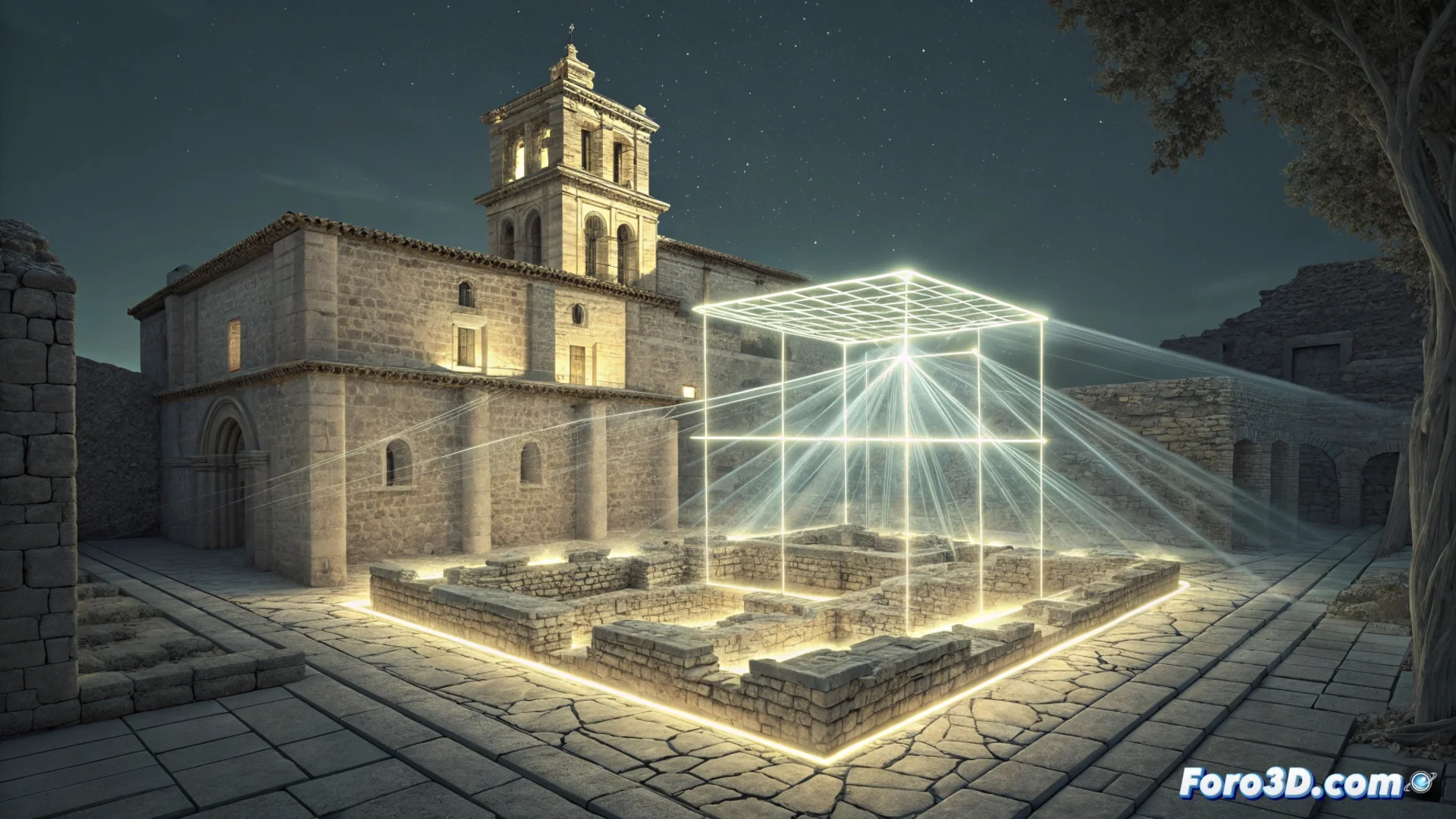
How svogi works for real-time lighting
The technique known as SVOGI (Sparse Voxel Octree Global Illumination) represents an advance in simulating how light interacts in a 3D environment dynamically. 🚀 Its main objective is to process global illumination while the scene is being rendered, without the need to precalculate all the lighting information.
The foundation: voxelizing the scene into a hierarchical structure
The core of SVOGI lies in transforming the complex geometry of a scene into a manageable volumetric mesh. To achieve this, a sparse voxel octree is built. An octree is a data structure where each node or cell can be divided into eight child cells, organizing 3D space efficiently. The key is that it is sparse, meaning that nodes are only generated in areas where there is actually geometry, saving a large amount of memory and processing power.
Key features of the octree in SVOGI:- Stores data per voxel: Each cell or voxel stores essential information from the surface it represents, such as its normal vector and albedo color.
- Rebuilds dynamically: The engine can update this tree every frame or at regular intervals, allowing it to reflect moving objects or changes in lighting.
- Discretizes space: Converts the continuous scene into a hierarchy of cubes, facilitating subsequent light calculations.
The magic of SVOGI is not in the geometry itself, but in how it organizes space so that light can be traced intelligently and quickly.
Calculating light: from voxelization to illumination
Once the scene is represented as a voxel field, the system can execute algorithms to simulate the physical behavior of light. The most common method is cone tracing. This algorithm launches virtual cones through the octree to evaluate two main phenomena: ambient occlusion and indirect irradiance.
Processes executed by cone tracing:- Evaluate occlusion: Determines how much ambient light reaches a point, creating soft shadows and more realistic contacts.
- Calculate indirect irradiance: Simulates how light bouncing from a colored surface affects the color of adjacent surfaces, generating color bleeding.
- Depend on resolution: The precision of these effects is directly linked to the octree resolution and the depth to which the cones are traced.
Balance between fidelity and performance
Although SVOGI promises accurate global illumination in real time, its implementation has a significant computational cost. The voxelization process and cone tracing consume a lot of GPU resources. For this reason, some developers opt for more traditional and less demanding techniques, such as precalculated lightmaps, especially in projects where the priority is to maintain a high frame rate without overloading the graphics hardware. ⚖️ The choice always depends on finding the right balance between visual quality and performance in the final application.