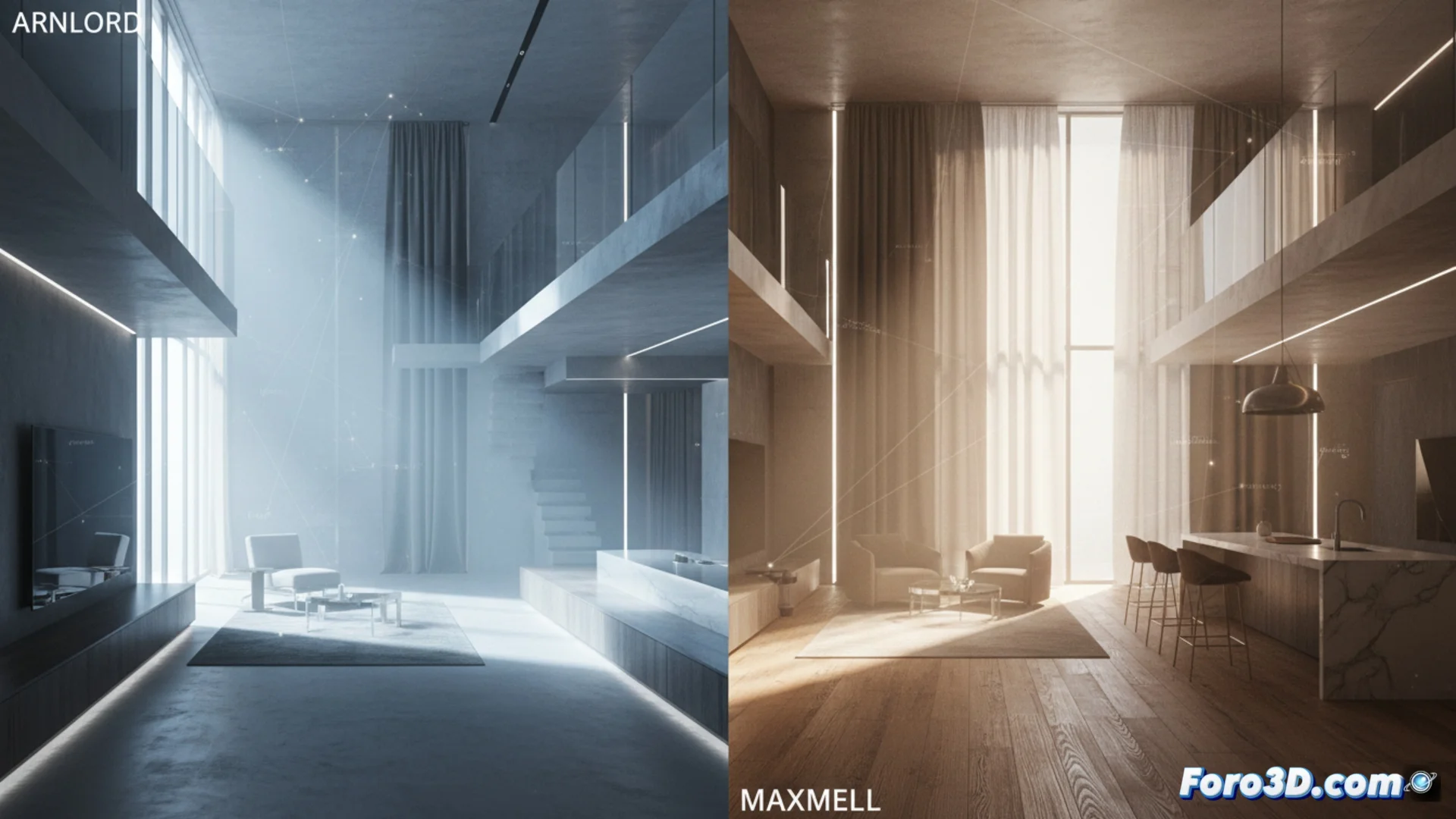
How Arnold and Maxwell Process Complex Scenes Differently
When working with complex 3D scenes, the choice of render engine is crucial. Arnold and Maxwell represent two distinct philosophical approaches to solving this challenge. One integrates into environments like Maya or 3ds Max and focuses on efficiency, while the other is dedicated to simulating light with extreme precision. Understanding their differences helps choose the right tool for each project. 🎨
Contrasting Rendering Philosophies
The technical foundation of each engine dictates its behavior. Arnold uses an optimized ray tracing system to produce clean images quickly, handling very dense geometries and volumetric effects well. Maxwell, on the other hand, operates as an unbiased engine; it calculates all possible light paths to achieve a physically real simulation, which can make the render take longer to complete, especially in complex environments.
Key Differences at the Core:- Arnold: Prioritizes an agile workflow and fast preview times, using adaptive sampling.
- Maxwell: Seeks absolute physical fidelity, which requires calculating more data and extending processing time.
- Result: Arnold may show some controlled noise, while Maxwell aims for a final result completely free of artifacts.
Physical perfection comes at a time cost, and it's not always what the client prioritizes when viewing the final work.
Approach to Materials and Lighting
The way materials are created and lighting is managed is another point of divergence. Arnold provides flexible shaders that allow artists to set up surfaces intuitively and artistically, optimizing the calculation. Maxwell implements a physically layered materials model, where each property (like roughness or index of refraction) interacts with light realistically, which can give a superior sense of authenticity but requires more precise parameter adjustments.
Practical Comparison:- Arnold's System: Favors speed and artistic control, ideal for quick iterations in production.
- Maxwell's System: Generates highly realistic renders, but requires more care in setup to manage render times.
- Post-processing: A Maxwell render often doesn't need retouching to remove noise, unlike some Arnold outputs.
Deciding Based on Project Needs
In a real production environment, the choice boils down to valuing what is more important: agility or physical precision. Arnold is usually the option for projects with tight deadlines where quick previewing and adjustments are needed. Maxwell shines when extreme realism is the main goal and there is time for the render to converge. In the end, reflecting on whether the client will perceive the difference in a thumbnail can be as important as the technology used. ⚖️