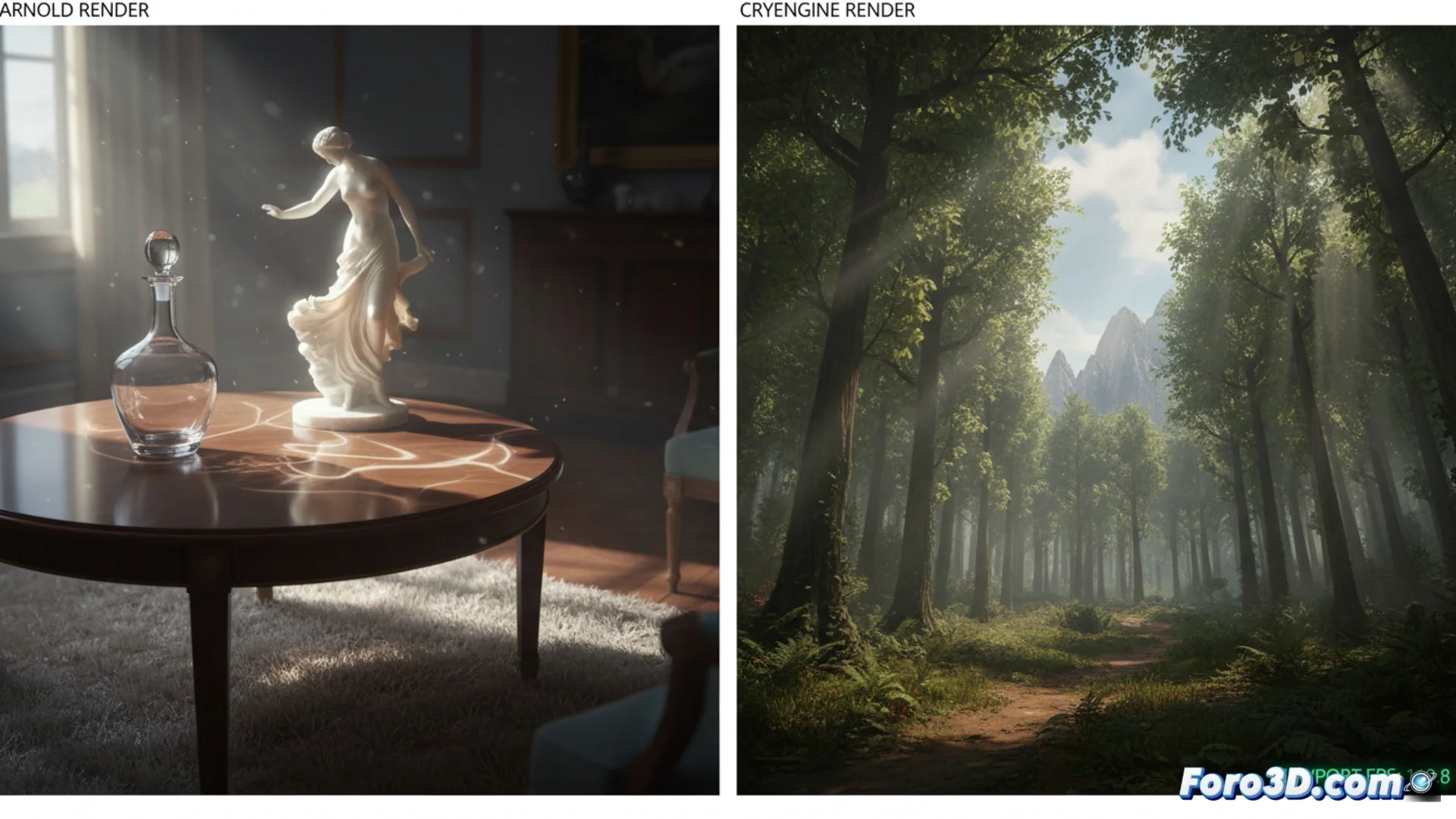
How Arnold and CryEngine Handle Scene Complexity
Two technologies stand out for approaching rendering in radically different ways. Arnold Render operates as a pure ray tracing engine, integrated into software like Maya, prioritizing the simulation of light with physical precision. On the other hand, CryEngine V is built to produce real-time graphics, specializing in extensive open worlds. Understanding their differences is key to choosing the right tool. 🎯
Conflicting Fundamental Paradigms
The central philosophy of each engine dictates its behavior. Arnold seeks to achieve a high-fidelity final image, accepting longer computation times to achieve predictable photorealism. CryEngine, on the other hand, sacrifices some of that precision to maintain a high frame rate, forcing artists to use techniques that simulate effects efficiently. In a scene with many reflections, Arnold calculates them exactly, while CryEngine usually uses precomputed maps or screen effects. 🔄
Managing resources differently:- Arnold: Loads all geometry and scene data into RAM memory to process them during rendering, which can demand large amounts of memory.
- CryEngine V: Manages assets dynamically, loading and unloading models based on the camera position, a vital technique for huge environments.
- Lighting approach: Arnold uses progressive sampling that reduces noise over time. CryEngine relies on its real-time global illumination system (SVOGI) and requires baking lightmaps for static elements.
Choosing between one and the other is not about which engine is more powerful, but about deciding if the project needs interactivity or absolute physical fidelity in the resulting image.
Strategies for Dense Scenes
When a scene contains millions of polygons and complex materials, each engine applies its own solution. Arnold scales efficiently on render farms and its node-based system allows building very elaborate shaders. CryEngine, designed for video games, relies more on aggressive optimization, using levels of detail (LOD) and culling techniques to maintain performance. 🏗️
Characteristic workflows:- Artistic predictability: With Arnold, adjustments are more straightforward and results are linear, without needing to "trick" the engine.
- Real-time preparation: Setting up all optimized systems in CryEngine (like light baking) can take more time than rendering a clean frame in Arnold.
- Target environment: Arnold shines in cinematics and VFX where quality is paramount. CryEngine dominates in interactive applications and open worlds that must render at 60 fps.
Selecting the Right Tool
The final decision between using Arnold Render or CryEngine V depends on the project requirements. If the goal is to achieve impeccable physical photorealism regardless of computation time, Arnold is the option. If a vast and detailed environment needs to render interactively, CryEngine and its dynamic resource management are ideal. Understanding these fundamental differences allows optimizing the production pipeline and allocating technical resources intelligently. ⚖️