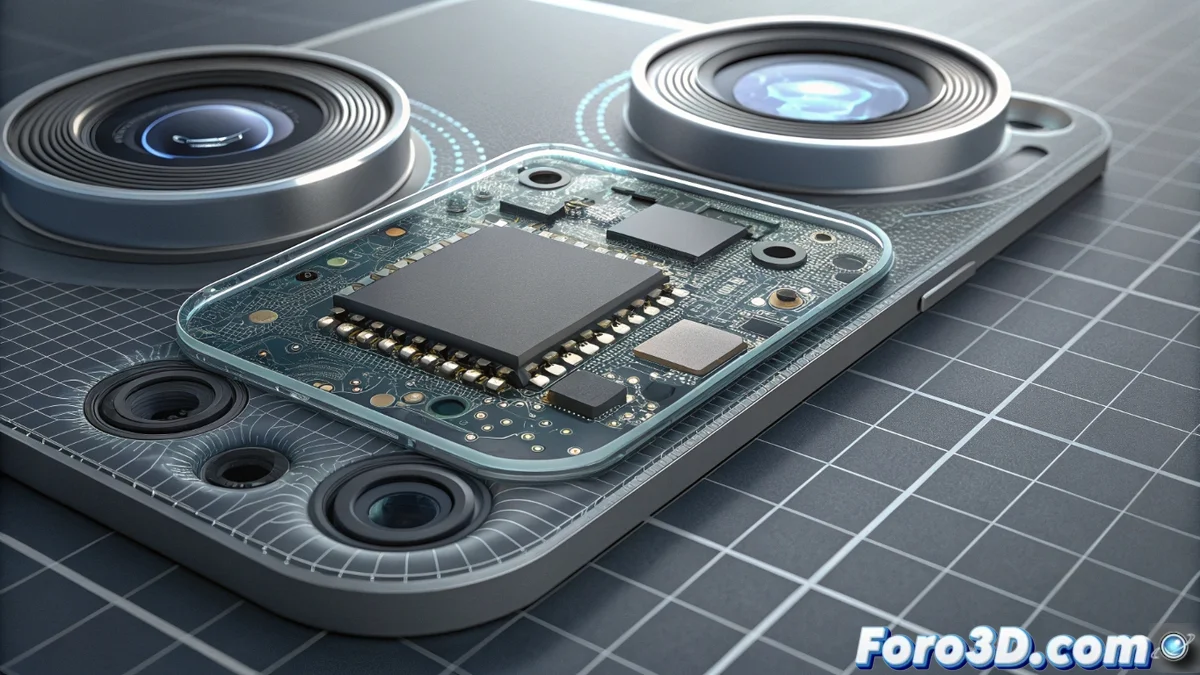
How a ToF Sensor Works and Why It's Key in Your Mobile
A time-of-flight (ToF) sensor is a hardware component that calculates distances directly. It does this by sending an infrared light pulse and precisely measuring the time it takes to reflect off an object and return to the origin. This method generates a depth map of the scene almost instantly, a capability that has become enormously popular in devices like smartphones. 📏
The Mechanism Behind Depth Measurement
The foundation of this technology is a simple yet powerful physical principle: the speed of light is constant. By knowing the exact time it takes for the light pulse to go and return, the sensor can calculate the distance to the object with great accuracy. Repeating this process millions of times per second builds a detailed 3D representation of the environment, allowing devices to perceive the space around them.
Key Advantages of ToF Technology:- Offers direct distance measurement, without relying on contrast or ambient light.
- Processes data with great speed, ideal for real-time applications.
- Works effectively in low-light conditions, where other systems fail.
The ToF sensor doesn't just see the world in 2D; it scans it in depth, adding a new dimension to the camera's perception.
Revolutionizing Autofocus in Photography
The most widespread application of the ToF sensor is to improve autofocus in mobile cameras. With precise distance data to subjects, the system can adjust lenses instantly, eliminating the annoying delay when focusing. This is particularly useful for capturing sharp photos indoors or at night.
How It Benefits the End User:- Achieves faster and more reliable focus, especially in portraits and low-light scenes.
- Reduces blurry or out-of-focus photos because the system doesn't need to "search" for the focus point.
- Enables effects like background blur (bokeh) with higher quality and realism.
The Pillar for Immersive Augmented Reality
Beyond photography, ToF is essential for developing convincing augmented reality experiences. The 3D depth map it generates allows applications to understand the geometry and volumes of the physical environment. This makes it possible to place virtual objects stably and realistically, making them interact coherently with real-world surfaces. 🕶️
From trying furniture in your living room to games that use your room as a stage, the technology provides the necessary spatial understanding layer. Thus, your device not only knows there's a wall, but also how far away it is and its shape, fusing the digital and physical in a previously impossible way.